Scientists Return from Expedition to Drill Beneath Frozen Russian Lake
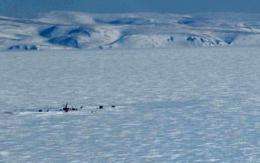
(PhysOrg.com) -- A team of scientists from the United States, Germany, Russia and Austria has just returned from a six-month drilling expedition to a frozen lake in Siberia: Lake El'gygytgyn, "Lake E" for short.
Lake E was created 3.6 million years ago when a meteor more than a half-mile wide hit Earth and formed an 11-mile wide crater.
There, the researchers collected the longest sediment core samples retrieved in the Arctic region. Information contained in the cores, say the scientists, is of unprecedented significance for understanding climate change in the Arctic.
Cores collected from three holes drilled under the frozen Lake E are more than 30 times longer than cores from the Greenland Ice Sheet, according to geoscientist Julie Brigham-Grette of the University of Massachusetts at Amherst, the lead U.S. scientist on the project.
The research team will compare this Arctic record with oceanic and land-based records from lower latitudes to better understand global climate change.
Nearly 3.5 tons of temperature-controlled sediment cores are being flown by special cargo plane from Siberia to St. Petersburg in early June, then on to a lab in Germany to begin analysis by paleoclimatologists.
Archived core halves will arrive later at the University of Minnesota's LacCore facility, where they will be preserved in cold storage.
Brigham-Grette says the team recovered a total of 1,165 feet of sediments; the sediment record collected extends back roughly two million years.
"Studying high-latitude systems is of great importance to an understanding of Earth's climate at all latitudes," says Paul Filmer, program director in the National Science Foundation (NSF)'s Division of Earth Sciences, which co-funded the expedition to Lake E with NSF's Office of Polar Programs. "Of primary interest is determining why and how the Arctic evolved from a warm forested ecosystem to a cold permafrost ecosystem between two and three million years ago."
The continuous record collected in this unique lake "offers us a way to look at the glacial/interglacial climate change of the past," Brigham-Grette says.
"Earth's warm and cold cycles over the past one million years varied every 100,000 years at times. Before that, however, climate change, especially in high latitudes, varied over 41,000- and 23,000-year cycles. The record from Lake E will show the ramp up to that type of change in the Earth's climate."
Below the lake's sediments, cores drilled into bedrock will offer geologists a rare opportunity to study meteor impact melt rocks from one of the best preserved large meteor impact craters on Earth, and the only one formed in silicon-rich volcanic rock.
The team recovered roughly 40 meters (131 feet) of the earliest history of the lake in the warm middle Pliocene. This geologic time interval is fascinating, says Brigham-Grette, as a possible analog for future climate.
Initial results from the drilling are still limited.
The sediment cores could not opened in the field because of the remoteness of the drilling site, and rough transportation overland.
During pilot coring in November, the scientists recovered 141 meters (462 feet) of sediments showing alluvial fan and lake deposits in permafrost at the western edge of the lake outside the talik (unfrozen ground in an area of permafrost).
After drilling, the borehole was permanently instrumented for future ground temperature monitoring as part of the Global Terrestrial Network for Permafrost.
The Lake El'gygytgyn Drilling Project is an international effort funded by the International Continental Drilling Program (ICDP), the U.S. National Science Foundation Earth Sciences Division and Office of Polar Programs, the German Federal Ministry for Education and Research (BMBF), Alfred Wegener Institute (AWI), GeoForschungsZentrum-Potsdam (GFZ), the Russian Academy of Sciences Far East Branch (RAS/FEB), Russian Foundation for Basic Research (RFBR), and the Austrian Ministry for Science and Research.
The leading Russian institutions include the Northeastern Interdisciplinary Scientific Research Institute (NEISRI), the Far East Geological Institute (FEGI), and Roshydromet's Arctic and Antarctic Research Institute (AARI).
The deep drilling system for Arctic operations was developed by DOSECC Inc.; core curation was handled by Lac-Core at the University of Minnesota.
Provided by National Sleep Foundation (news : web)


