Space station crew finally at full staff of six (w/Video)
May 29, 2009 Space station crew finally at full staff of six

Enlarge

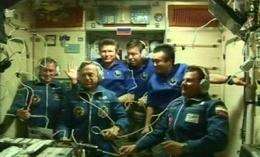
Expedition 20 - the first six-strong International Space Station crew - assembled in the Zvezda module for the welcoming ceremony immediately after hatch opening following the arrival of ESA astronaut Frank De Winne, Russian cosmonaut Roman Romanenko and Canadian Space Agency astronaut Robert Thirsk with the Soyuz TMA-15 spacecraft on 29 May 2009. Credits: ESA

The crew of the International Space Station has increased to six for the first time today with the arrival of three new residents including ESA astronaut Frank De Winne with the Soyuz TMA-15 spacecraft.

The Soyuz TMA-15 docked with the International at 14:34 CEST (12:34 UT). After leak checks, the hatches between the two spacecraft were opened at 16:14 CEST (14:14 UT).

The new crewmembers, ESA astronaut Frank De Winne, Russian cosmonaut Roman Romanenko and Canadian Space Agency astronaut Robert Thirsk, were welcomed on the ISS by the three Expedition crewmembers already in residence: Russian cosmonaut Gennady Padalka, NASA astronaut Michael Barratt and Japanese astronaut Koichi Wakata. Together they will form the first ever six-person ISS crew - Expedition 20.

FLV player

The Soyuz TMA-15 spacecraft docked with the International Space Station at 14:34 CEST (12:34 CEST) today. The Soyuz crew, including ESA astronaut Frank De Winne, is scheduled to enter the ISS after hatch opening at 15:45 CEST (13:45 UT). Watch the replay of the docking.

With the Expedition 20 crew now together on the ISS, it is also the first time that all five ISS partners are represented by astronauts on the Station at the same time.

"This is a very exciting moment for the ISS Partners and a major milestone for human spaceflight and exploration. With Frank, Roman and Bob now together with the other three ISS crewmembers, we reach a full six-crew capability on the Station. We have had a very intense two weeks in Europe: the roll out of the Node 3, the selection of six new members of the European Astronaut Corps and now this milestone," said Simonetta Di Pippo, ESA Director of Human Spaceflight. "This opens up new and exciting opportunities on the utilisation of the Station for scientific and research activities but also in preparation for future exploration missions to more distant destinations."

De Winne, Romanenko and Thirsk will spend the next six months on the Station. For the first four months of their stay, De Winne will be a Flight Engineer as a member of the Expedition 20 crew, reporting to Expedition 20 Commander Gennady Padalka. With a rotation of three of the six crewmembers due in October, De Winne will take over as Commander of the Expedition 21 crew until his return to Earth in November. He is the first European to take on this role.

During his mission, called OasISS, De Winne will use the scientific facilities of the ISS, especially the European Columbus laboratory, to undertake a European programme of scientific experiments and technology demonstrations. These come predominantly from scientific institutions across Europe and include experiments in human physiology, biology, radiation dosimetry, exobiology, fluid physics and materials sciences.

ESA views education as a valuable aspect of its human spaceflight missions, helping to inspire the youth of today. As such, the OasISS mission will be the prime focus of ESA’s education activities during the mission, including a live lesson given by De Winne from the ISS.

The Expedition 20 crew will hold their first news conference on Monday 1 June at 16:25 CEST (14:25 UT).

Provided by European Space Agency (news : web)


print this article email this article download pdf blog this article bookmark this article     Stumble it Digg this share on Facebook retweet share on Reddit add to delicious
Rate this story - 5 /5 (2 votes)


May 29, 2009 all stories

Comments: 0

5 /5 (2 votes)
  • Stumble this up

  • Digg this

  • share this

  • hide
  • Related Stories

  • Russia signs deal to ferry astronauts in 2012
    created May 29, 2009 | popularity not rated yet | comments 0
  • Roscosmos Calls For Launch Swaps And Bigger ISS Crew
    created Mar 15, 2006 | popularity not rated yet | comments 0
  • Soyuz Spacecraft To Cost NASA $65 Million
    created Aug 19, 2005 | popularity not rated yet | comments 0
  • Expedition 14 to Arrive at Space Station Early Wednesday
    created Sep 19, 2006 | popularity not rated yet | comments 0
  • Endeavour Set to Leave International Space Station Today
    created Mar 24, 2008 | popularity not rated yet | comments 0


  • hide
  • Relevant PhysicsForums posts

  • The shape of our solar system's orbits.
    created Nov 07, 2009
  • Above or Below the Line of Nodes
    created Nov 07, 2009
  • Supernova vs. Nova?
    created Nov 07, 2009
  • Supernova's Gamma Rays and Comets
    created Nov 06, 2009
  • More from Physics Forums - General Astronomy

Other News

Deep creep means milder, more frequent earthquakes along Southern California's San Jacinto fault

Deep creep means milder, more frequent earthquakes along Southern California's San Jacinto fault

Space & Earth / Earth Sciences

created 13 hours ago | popularity 4.7 / 5 (3) | comments 0

With an average of four mini-earthquakes per day, Southern California's San Jacinto fault constantly adjusts to make it a less likely candidate for a major earthquake than its quiet neighbor to the east, the ...


Success in 'space elevator' competition (AP)

Success in 'space elevator' competition (Update 3)

Space & Earth / Space Exploration

created Nov 05, 2009 | popularity 4.3 / 5 (33) | comments 50

(AP) -- A robot powered by a ground-based laser beam climbed a long cable dangling from a helicopter on Wednesday to qualify for prize money in a $2 million competition to test the potential reality of the ...


In a Galaxy Far, Far Away...

In a Galaxy Far, Far Away...

Space & Earth / Astronomy

created Nov 06, 2009 | popularity 4.8 / 5 (5) | comments 17

(PhysOrg.com) -- Astronomers have published the discovery of the farthest known object in the cosmos: a star that exploded when the universe was only 630 million years old -- only 4.6% of its current age. ...


'Dropouts' pinpoint earliest galaxies

'Dropouts' pinpoint earliest galaxies

Space & Earth / Astronomy

created Nov 06, 2009 | popularity 4.2 / 5 (10) | comments 13

Astronomers, conducting the broadest survey to date of galaxies from about 800 million years after the Big Bang, have found 22 early galaxies and confirmed the age of one by its characteristic hydrogen signature ...


Space hotel taking bookings for 2012 opening

Space hotel taking bookings for 2012 opening

Space & Earth / Space Exploration

created Nov 05, 2009 | popularity 4.4 / 5 (21) | comments 11

(PhysOrg.com) -- The first orbiting space hotel is on track to open for its first customers in 2012, but hurry, as bookings are filling fast.