Researchers make breakthrough in the quantum control of light
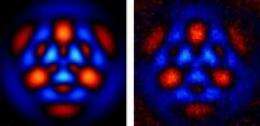
Researchers at UC Santa Barbara have recently demonstrated a breakthrough in the quantum control of photons, the energy quanta of light. This is a significant result in quantum computation, and could eventually have implications in banking, drug design, and other applications.
In a paper to be published in today's issue of the journal Nature, UCSB physics researchers Max Hofheinz, John Martinis, and Andrew Cleland document how they used a superconducting electronic circuit known as a Josephson phase qubit to prepare highly unusual quantum states using microwave-frequency photons. The breakthrough is the result of four years of work in the laboratories of Cleland and Martinis.
The project is funded by the federal agency called the Intelligence Advanced Research Projects Activity, or IARPA. The government is particularly interested in quantum computing because of the way banking and other important communications are currently encrypted. Using large numbers, with hundreds of digits, encryption codes are changed daily and would take years of traditional computing to break. Quantum computing could potentially break those codes quickly, destroying current encryption schemes.
In the experiments, the photons were stored in a microwave cavity, a "light trap" in which the light bounces back and forth as if between two mirrors. In earlier work, these researchers showed they could create and store photons, one at a time, with up to 15 photons stored at one time in the light trap. The research shows that they can create states in which the light trap simultaneously has different numbers of photons stored in it. For example, it can simultaneously have zero, three, and six photons at the same time. Measuring the quantum state by counting how many photons are stored forces the trap to "decide" how many there are; but prior to counting, the light trap exists in a quantum superposition, with all three outcomes possible.
Explaining the paradoxical simultaneity of quantum states, Cleland said that it's like having your cake and eating it -- at the same time.
"These superposition states are a fundamental concept in quantum mechanics, but this is the first time they have been controllably created with light," Cleland said. Martinis added, "This experiment can be thought of as a quantum digital-to-analog converter." As digital-to-analog converters are key components in classical communication devices (for example, producing the sound waveforms in cell phones), this experiment might enable more advanced communication protocols for the transmission of quantum information.
First author Hofheinz designed and performed the measurements. He is a postdoctoral researcher from Germany who has been working at UCSB for the last two years on this project. The devices used to perform the experiment were made by Haohua Wang, a postdoctoral researcher from China, who is second author on the Nature publication.
The scientists said their research is leading to the construction of a quantum computer, which will have applications in information encryption and in solving or simulating problems that are not amenable to solution using standard computers.
Source: University of California - Santa Barbara (news : web)


