A quicker, cheaper SARS virus detector -- one easily customizable for other targets
May 29, 2009
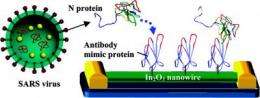
Antibody mimic protein is tailored to attach to nanowire base at one end, leaving biologically active area open for detection. Image: University of Southern California
Members of a USC-led research team say they've made a big improvement in a new breed of electronic detectors for viruses and other biological materials — one that may be a valuable addition to the battle against epidemics.
It consists of a piece of synthetic antibody attached to a nanowire that's attached to an electrical base, immersed in liquid.
If the protein the antibody binds to is present in the liquid, it will bind to these antibodies, immediately creating a sharply measurable jump in current through the nanowire.
The basic principle of nanotube and nanowire biosensors for protein detection was first demonstrated in 2001, but the new design by a team headed by Zhongwu Chou and Mark Thompson of the University of Southern California uses two new elements.
First, it takes advantage of bioengineered synthetic antibodies, much, much smaller versions of the natural substances that are designed to bind with a specific protein and only that protein.
Second, it uses indium oxide (In2O3) nanowires instead of silicon and other materials previously tried. Metal oxides, according to a new study published in ACSNano, do not, unlike silicon, develop "an insulating native oxide layer that can reduce sensitivity."
The result, according to the paper, is a device that can detect its target molecules with a sensitivity as great as the best alternative modes, do so more rapidly and without use of chemical reagents.
It is also potentially considerably cheaper than alternatives.
"We believe," the authors write, "that nanowire bisensor devices functionalized with engineered proteins … can have important applications ranging from disease diagnosis to homeland security."
Additionally, the system can be useful in basis research, in helping to establish certain important parameters for two-part biological systems like the antibody/target protein pair.
The protein the prototype system detects is the SARS (severe acute respiratory syndrome) virus n-protein, which infected more than 8,000 people in 2002-2003, killing nearly 10 percent of them.
Commercial systems using enzyme-linked immunosorbent assay (ELISA) now exist to test for SARS, but the new system has advantages in time, cost and portability.
The first step was the creation, by Richard Roberts and Mark Thompson, chemists, and their team of the synthetic antibody, including both the active area, design to interact with the protein and, at the other end, a chemical "hook" that would bind it to nanowire at this point and only this point. "This … strategy allows every bound [detector molecule] to retain full activity, a clear advantage over antibodies, which [in earlier biosensor designs] are often bound to nanowire surface via amine containing residues randomly distributed over the antibody surface."
The Zhou lab, which has specialized in nanowire and nanotube technology for years, performed the complex set of procedures to synthesize the wires, attaching
In tests, the group performed if anything better than predictions, showing a standard and low level of activity when no SARS protein was present, leaping quickly to a higher level when the protein was introduced, in response patterns that varied consistently according to concentration of the SARS protein. Devices complete except for the detector molecule showed no response at all.
The response was complete in less than ten minutes, compared to hours needed for results from ELISA tests - which are basically present/not present tests with relatively little quantitative elements.
Next steps are to enable detection in more complex environment, such as Serum and whole blood, by integrating the nanobiosensor with micro systems such as microfluidics chips and micro filters.
-
Nano World: Nanowires help spot cancer
Sep 30, 2005 |
not rated yet |
0
-
New test speeds up SARS detection
Aug 01, 2007 |
not rated yet |
0
-
Detecting Cancer with Silica Nanoparticles
Sep 18, 2006 |
not rated yet |
0
-
Researchers combine nanotubes and antibodies to detect cancer
Nov 17, 2005 |
not rated yet |
0
-
Chemical probes beat antibodies at own game
Apr 26, 2007 |
not rated yet |
0
-
Engineers build first sub-10-nm carbon nanotube transistor
Feb 01, 2012 |
4.9 / 5 (33) |
30
-
Something old, something new: Evolution and the structural divergence of duplicate genes
Jan 31, 2012 |
4.6 / 5 (7) |
1
-
The hidden nanoworld of ice crystals: Revealing the dynamic behavior of quasi-liquid layers
Jan 30, 2012 |
5 / 5 (4) |
1
-
Stock market network reveals investor clustering
Jan 27, 2012 |
3.9 / 5 (23) |
8
-
Of microchemistry and molecules: Electronic microfluidic device synthesizes biocompatible probes
Jan 26, 2012 |
5 / 5 (2) |
0
-
Thermodynamics q
3 hours ago
-
what is electricity???
7 hours ago
-
Can Plasma Be Solid
8 hours ago
-
What is delta Δ ?
8 hours ago
-
Need some help understanding Hertz–Knudsen formula
9 hours ago
-
Anatomy of Fat man: implosion-critical bomb
11 hours ago
- More from Physics Forums - General Physics
More news stories
Lab study raises questions over nano-particle impact
Tests involving chickens have raised questions about the impact on health from engineered nano-particles, the ultra-fine grains commonly used in drugs and processed foods, scientists said on Sunday.
Nanotechnology / Bio & Medicine
13 hours ago |
5 / 5 (7) |
2
New kind of solar cell could capture significantly more energy than current cells
New solar cells could increase the maximum efficiency of solar panels by over 25%, according to scientists from the University of Cambridge.
Feb 08, 2012 |
4.5 / 5 (13) |
14
|
Nanoshell whispering galleries improve thin solar panels
Visitors to Statuary Hall in the U.S. Capitol Building may have experienced a curious acoustic feature that allows a person to whisper softly at one side of the cavernous, half-domed room and for another on ...
Nanotechnology / Nanomaterials
Feb 07, 2012 |
4.4 / 5 (7) |
6
|
'Dark plasmons' transmit energy
Microscopic channels of gold nanoparticles have the ability to transmit electromagnetic energy that starts as light and propagates via "dark plasmons," according to researchers at Rice University.
Feb 09, 2012 |
4.8 / 5 (10) |
1
|
Revealing how a battery material works
Since its discovery 15 years ago, lithium iron phosphate (LiFePO4) has become one of the most promising materials for rechargeable batteries because of its stability, durability, safety and ability to deliver ...
Nanotechnology / Nanomaterials
Feb 08, 2012 |
5 / 5 (6) |
0
|
Scientists discover molecular secrets of 2,000-year-old Chinese herbal remedy
For roughly two thousand years, Chinese herbalists have treated Malaria using a root extract, commonly known as Chang Shan, from a type of hydrangea that grows in Tibet and Nepal. More recent studies suggest that halofuginone, ...
New method to examine batteries -- MRI from the inside
There is an ever-increasing need for advanced batteries for portable electronics, such as phones, cameras, and music players, but also to power electric vehicles and to facilitate the distribution and storage of energy derived ...
Google might launch Drive for cloud storage soon
(PhysOrg.com) -- Google's next big move, according to the Wall Street Journal, is a cloud storage service called Drive. Hardly first to the plate, Google is simply catching up to introducing its cloud reposi ...
A mitosis mystery solved: How chromosomes align perfectly in a dividing cell
Although the process of mitotic cell division has been studied intensely for more than 50 years, Whitehead Institute researchers have only now solved the mystery of how cells correctly align their chromosomes during symmetric ...
Starve a virus, feed a cure? Findings show how some cells protect themselves against HIV
A protein that protects some of our immune cells from the most common and virulent form of HIV works by starving the virus of the molecular building blocks that it needs to replicate, according to research published online ...
Researchers find extensive RNA editing in human transcriptome
In a new study published online in Nature Biotechnology, researchers from BGI, the world's largest genomics organization, reported the evidence of extensive RNA editing in a human cell line by analysis of RNA-seq data, demons ...
May 29, 2009
Rank: not rated yet