Theorists Reveal Path to True Muonium
May 29, 2009 Theorists reveal path to true muonium

Enlarge

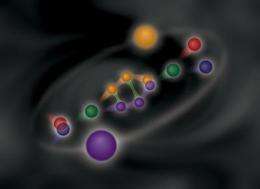
In this artist's depiction of how experimentalists could create true muonium, an electron (blue) and a positron (red) collide, producing a virtual photon (green) and then a muonium atom, made of a muon (small yellow) and an anti-muon (small purple). The muonium atom then decays back into a virtual photon and then a positron and an electron. Overlaying this process is a figure indicating the structure of the muonium atom: one muon (large yellow) and one anti-muon (large purple). Credit: Graphic: Terry Anderson/SLAC

(PhysOrg.com) -- True muonium, a long-theorized but never-seen atom, might be observed in future experiments, thanks to recent theoretical work by researchers at the Department of Energy's SLAC National Accelerator Laboratory and Arizona State University. True muonium was first theorized more than 50 years ago, but until now no one had uncovered an unambiguous method by which it could be created and observed.

"We don't usually work in this area, but one day we were idly talking about how experimentalists could create exotic states of matter," said SLAC theorist Stanley Brodsky, who worked with Arizona State's Richard Lebed on the result. "As our conversation progressed, we realized 'Gee…we just figured out how to make true muonium.'"

True muonium is made of a muon and an anti-muon, and is distinguished from what's also been called "muonium"—an atom made of an electron and an anti-muon. Both muons and anti-muons are created frequently in nature when energetic particles from space strike the earth's atmosphere. Yet both have a fleeting existence, and their combination, true muonium, decays naturally into other particles in a few trillionths of a second. This makes observation of the exotic atom quite difficult.

In a paper published on Tuesday in , Brodsky and Lebed describe two methods by which electron-positron accelerators could detect the signature of true muonium's formation and decay.

In the first method, an accelerator's electron and positron beams are arranged to merge, crossing at a glancing angle. Such a collision would produce a single photon, which would then transform into a single true muonium atom that would be thrown clear of the other particle debris. Because the newly created true muonium atoms would be traveling so fast that the laws of govern, they would decay much slower than they would otherwise, making detection easier.

In the second method, the electron and positron beams collide head-on. This would produce a true muonium atom and a photon, tangled up in a cloud of particle debris. Yet simply by recoiling against each other, the true muonium and the photon would push one another out of the debris cloud, creating a unique signature not previously searched for.

"It's very likely that people have already created true muonium in this second way," Brodsky said. "They just haven't detected it."

In their paper, Lebed and Brodsky also describe a possible, but more difficult, means by which experimentalists could create true tauonium, a bound state of a tau lepton and its antiparticle. The tau was first created at SLAC's SPEAR storage ring, a feat for which SLAC physicist Martin Perl received the 1995 Nobel Prize in physics.

Brodsky attributes the pair's successful work to a confluence of events: various unrelated lectures, conversations and ideas over the years, pieces of which came together suddenly during his conversation with Lebed.

"Once you pull all of the ideas together, you say 'Of course! Why not?' Brodsky said. "That's the process of science—you try to relate everything new to what you already know, creating logical connections."

Now that those logical connections are firmly in place, Brodsky said he hopes that one of the world's colliders will perform the experiments he and Lebed describe, asking, "Who doesn't want to see a new form of matter that no one's ever seen before?"

More information: "Production of the Smallest QED Atom: True Muonium," Physical Review Letters

Source: SLAC National Laboratory (news : web)


Rate this story - 4.5 /5 (11 votes)

Rank Filter

Move the slider to adjust rank threshold, so that you can hide some of the comments.


Display comments: newest first

  • Smellyhat - May 29, 2009
    • Rank: 5 / 5 (2)
    Experimentalists?
  • Bob_B - May 29, 2009
    • Rank: 5 / 5 (2)
    Smellyhat: That's just a theory!
  • freddy - May 29, 2009
    • Rank: 5 / 5 (4)
    "...true muonium, decays naturally into other particles in a few trillionths of a second. This makes observation of the exotic atom quite difficult."

    Not even an exclamation mark???
  • sender - May 29, 2009
    • Rank: 2.3 / 5 (3)
    Using a magneto optical trap and photosensitive devices as listed below non-catalytic analysis might be achieved with less energy input.

    http://pubs.acs.o...a025954z
  • omatumr - May 29, 2009
    • Rank: 1.7 / 5 (6)
    PROMISES, PROMISES, AND MORE PROMISES !

    Is it time for a DOE grant renewal of theoretical work at SLAC National Accelerator Laboratory and Arizona State University?

    I well remember a theoretical paper [H. Heiselberg, Neutron Star Masses, Radii and Equation of State, in Proceedings of the Conference on Compact Stars in the QCD Phase Diagram, eConf C010815, edited by R. Ouyed and F. Sannion, Copenhagen, Denmark, Nordic Institute for Theoretical Physics (2002) pp. 3-16, http://arxiv.org/...?0201465

    It was published a couple of years after we showed that neutrons are highly energized in neutron stars from repulsive interactions between neutrons!

    Oliver K. Manuel
    http://www.omatumr.com
  • thales - May 29, 2009
    • Rank: 4 / 5 (2)
    It would be great if they described the theoretical properties of muonium. I'd really like to have some exotic matter on hand for my warp bubble and wormhole projects.
  • earls - May 29, 2009
    • Rank: 3 / 5 (5)
    "Physical chemists consider muonium to be an isotope of hydrogen"

    http://en.wikiped.../Muonium

    Hrm.
  • E_L_Earnhardt - May 30, 2009
    • Rank: 3 / 5 (2)
    Isn't it marvelous the number of combinations we can make from a limited alphabet?
  • holoman - Jun 01, 2009
    • Rank: 1 / 5 (1)
    I know someone who patented the process and equipment
    already in development for this antimatter production
    a year ago.

May 29, 2009 all stories

Comments: 9

4.5 /5 (11 votes)

  • hide
  • Related Stories

  • A Particle of a Different Flavor?
    created Nov 29, 2007 | popularity not rated yet | comments 0
  • Physicists Discover New Particle: the Bottom-most 'Bottomonium'
    created Jul 10, 2008 | popularity not rated yet | comments 0
  • Search for Rare Particle Decay Comes Up Short
    created Aug 01, 2006 | popularity not rated yet | comments 0
  • New form of matter-antimatter transformation observed for first time
    created Mar 13, 2007 | popularity not rated yet | comments 0
  • Particles from Space Test New Muon Detection System
    created Dec 14, 2006 | popularity not rated yet | comments 0


  • hide
  • Relevant PhysicsForums posts

  • Pressure created by clamping base and cover
    created 45 minutes ago
  • How to find static friction
    created 6 hours ago
  • Calculating decible increases
    created 14 hours ago
  • Coefficients of friction
    created 14 hours ago
  • More from Physics Forums - General Physics

Other News

Extra large carbon

Extra large carbon

Physics / General Physics

created 14 hours ago | popularity 4.7 / 5 (12) | comments 7 | with audio podcast

An exotic form of carbon has been found to have an extra large nucleus, dwarfing even the nuclei of much heavier elements like copper and zinc, in experiments performed in a particle accelerator in Japan. ...


Scientist explore future of high-energy physics

Scientist explore future of high-energy physics

Physics / General Physics

created 20 hours ago | popularity 4.9 / 5 (12) | comments 8 | with audio podcast

In a 1954 speech to the American Physical Society, the University of Chicago's Enrico Fermi fancifully envisioned a particle accelerator that encircled the globe. Such would be the ultimate theoretical outcome, ...


Leaf veins inspire a new model for distribution networks (w/ Video)

Physics / General Physics

created 17 hours ago | popularity 5 / 5 (3) | comments 0 | with audio podcast

(PhysOrg.com) -- Following the straight and narrow may be good moral advice, but it’s not a great design principle for a distribution network. In new research, a team of biophysicists describe a complex netting of interconnected ...


New magnetic tuning method enhances data storage

New magnetic tuning method enhances data storage

Physics / General Physics

created 20 hours ago | popularity 4.2 / 5 (5) | comments 0 | with audio podcast

Researchers in Chicago and London have developed a method for controlling the properties of magnets that could be used to improve the storage capacity of next-generation computer hard drives.


High-performance microring resonator developed by INRS researchers

Physics / Optics & Photonics

created 12 hours ago | popularity 1.5 / 5 (2) | comments 0

A new, more efficient low-cost microring resonator for high speed telecommunications systems has been developed and tested by Professor Roberto Morandotti's INRS team in collaboration with Canadian, American, and Australian ...