A drone for security and safety (w/Video)
May 29, 2009 A drone for security and safety

Enlarge

(PhysOrg.com) -- European researchers have developed a small robotic drone capable of helping save lives in emergency situations or preventing terrorist attacks in urban areas.

Drones, known as unmanned aerial vehicles (UAVs), have proven to be of great value in military operations, but so far, their advantages have not been fully exploited for civilian uses.

In civil life, drones are mainly used in the agriculture sector - for assessing how well crops are growing in a particular part of a field - or for meteorological measurements.

The main barrier to the wider use of drones is their large size and lack of manoeuvrability around obstacles. Most military drones are fixed-wing UAVs designed to operate at high altitudes and do not need a lot of manoeuvrability. In built up, highly populated areas such drones would pose a danger to people if they hit a tree or a building, or crashed due to the loss of its navigational signal.

Smaller, lighter and autonomous

Seeing a market opportunity, European researchers and companies that make up the EU-funded µDrone (Micro Drone Autonomous Navigation and Environment Sensing) project are developing a smaller, more manoeuvrable drone that is capable of sensing and avoiding objects in its flight path. The new drone would be capable of carrying out missions autonomously in places with obstacles, such as in an urban area or inside a building.

You need Flash installed to watch this ideo

Such drones could be used to patrol sensitive areas to detect intruders, find the survivors of a disaster or detect chemical spills, among other operations, says project coordinator Christophe Leroux.

“The monitoring of public and private sites is becoming increasingly important in the field of security and surveillance,” says Leroux. “Mobile multi-sensor surveillance systems, able to be deployed quickly to analyse a situation, will boost the efficiency of the security teams. By combining sensors and robots, we can develop applications to search and warn, and to detect hazardous materials.”

The project team is close to developing a prototype of a small-size UAV capable of vertical take off and landing and for autonomous inspection and survey operations in urban areas with moving obstacles.

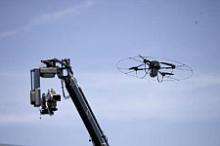
The mini-UAV was developed by AirRobot, a Germany-based company which is part of the project consortium. The drone is about 50cm in diameter, weighs less than one kilogram and can carry about 200grams. It looks like a miniature helicopter with four propellers, allowing it to take off and land vertically. A protective band surrounds the machine, preventing harm to people and the machine if an accident occurs.

The team also developed the software and hardware so the drone can locate its position in the air, navigate autonomously, and respond to unexpected events, such as an obstacle. Mission planning, collision avoidance and trajectory determination have been built into the drone’s software and hardware. The software’s visual memory map allows it to return home along its previous flight path.

The drone can be controlled from the ground or it can fly on a mission autonomously following a predefined path. Manual control can be switched on and off depending on the mission. The software and interface allows an operator without any technical knowledge to control it easily in urban areas or inside a building, Leroux says.

Monitoring for safety and security

He believes the new drone will be useful for policing, for example to determine the extent of a riot and for deploying forces, or for support at a crime scene. A remotely operated micro-UAV could be used to explore a crime scene inside a building without endangering the lives of police officers.

It can also be used for security. If an intrusion is detected, a UAV should be able to move faster than any ground-based robot or a human guard. Public places, airports, oil production facilities, pipelines and nuclear sites could be monitored using the micro-UAV.

The consortium is now focusing on evaluating and testing the new drone with potential users, including fire services. A small-sized UAV could be used for reconnaissance of the fire scene, helping fire fighters better assess how the fire is developing and if lives need to be saved. The drone will be tested with a fire service in Greece in November 2009 to determine how it performs.

“There is a need in the market for such a drone,” Leroux says. “Many end-users have already expressed an interest.”

More information: http://www.ist-microdrones.org/

Provided by ICT Results


Rate this story - 4 /5 (3 votes)

Rank Filter

Move the slider to adjust rank threshold, so that you can hide some of the comments.


Display comments: newest first

  • Flakk - May 29, 2009
    • Rank: not rated yet
    Yea thats how it starts.


    Then later you end up with swarms of the critters floating around your city augmenting the cameras that don't catch activity in every nook and cranny.
  • denijane - May 30, 2009
    • Rank: not rated yet
    Cool, one more thing to watch us with. In the end, we'll all live in a Big Brother.
  • Fazer - May 30, 2009
    • Rank: not rated yet
    Perhaps Big Brother is inevitable. So, it is up to us to make sure it is a benign Big Brother. As long as we don't let the use of surveillance get out of control, I think we will adjust to the new privacy level. Look on the bright side, at least honest, law abiding people will have video to back them up in the event that someone violates their rights.

    As for just the privacy issue, I don't think anyone really cares if you pick your nose when no one else is around. The more cameras, the more footage to watch. It would take at least 1/4 of humanity to watch everyone, and if we use pattern recognition software, it will be looking for very specific things, things that most of us would never need to worry about.
  • mfritz0 - May 31, 2009
    • Rank: not rated yet
    I guess if big brother was afraid you might unzip your human suit and let that Zeta-Reticuli inside it wander about in your recently dug tunnel system. It might be worth letting them be used.
  • Mercury_01 - May 31, 2009
    • Rank: not rated yet
    If one of those things was watching me, I think Id pull out my 12 guage

May 29, 2009 all stories

Comments: 5

4 /5 (3 votes)

  • hide
  • Related Stories

  • Two Robot Chefs Make Omelets
    created Dec 04, 2008 | popularity not rated yet | comments 0
  • A Perfect Female Companion: Project Aiko
    created Dec 12, 2008 | popularity not rated yet | comments 0
  • Security Alert: Beware of SMS Messages That Can Take Control of Your Phone
    created Apr 20, 2009 | popularity not rated yet | comments 0
  • Video: Swine flu health tips
    created Apr 30, 2009 | popularity not rated yet | comments 0
  • Robotic ants building homes on Mars?
    created Oct 21, 2008 | popularity not rated yet | comments 0


  • hide
  • Relevant PhysicsForums posts

  • how to welding thin SS foil (0.002")?
    created Feb 08, 2010
  • Civil Engineering is hazardous to your career prospects
    created Feb 06, 2010
  • hot water circulator, kitchen faucet, ? mixing
    created Feb 06, 2010
  • Static or dynamic pressures in duct
    created Feb 06, 2010
  • Nuclear Engineering in Australia??
    created Feb 06, 2010
  • Building Gravitational Wave Experiment
    created Feb 05, 2010
  • More from Physics Forums - General Engineering

Other News

The power of 'random'

The power of 'random': 'Seemingly loopy' technique could dramatically improve communications networks

Technology / Computer Sciences

created 17 hours ago | popularity 4.8 / 5 (8) | comments 5 | with audio podcast

A radical new approach to the design of communications networks, called "network coding," promises to make Internet file sharing faster, streaming video more reliable, and cell-phone reception better -- among ...


'Revolutionary' water treatment units on their way to Afghanistan

Technology / Engineering

created 11 hours ago | popularity 4.3 / 5 (6) | comments 4 | with audio podcast

The United States Army has taken delivery of the first two units of a "revolutionary" waste-water treatment system that will clean putrid water within 24 hours and leave no toxic by-products, according to scientists at Sam ...


Imec and Holst Centre achieve breakthrough in battery-less radios

Imec achieves breakthrough in battery-less radios

Technology / Semiconductors

created 12 hours ago | popularity 4.9 / 5 (11) | comments 1 | with audio podcast

At today's International Solid State Circuit Conference, Imec and Holst Centre report a 2.4GHz/915MHz wake-up receiver which consumes only 51µW power. This record low power achievement opens the door to battery-less ...


Android

Google developing a translator for smartphones

Technology / Software

created 18 hours ago | popularity 4.8 / 5 (8) | comments 3 | with audio podcast report

(PhysOrg.com) -- Google is developing a translator for its Android smartphones that aims to almost instantly translate from one spoken language to another during phone calls.


GMail logo

Google gives Gmail social-networking 'Buzz' (Update)

Technology / Internet

created 13 hours ago | popularity 5 / 5 (1) | comments 1

Google is giving its free email service a "Buzz" by adding social-networking features which could challenge the supremacy of platforms like Facebook and Twitter.