Celebrating gravity’s light-bending landmark
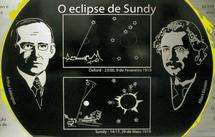
(PhysOrg.com) -- Today Oxford University scientists are joining in a special celebration of the first test of Albert Einstein’s theory of gravity on the remote African island where the ground-breaking experiment took place.
29 May is the 90th anniversary of the first test of Albert Einstein’s new theory of gravity: a test that paved the way for the gravitational lensing technique now used by astronomers to search for mysterious dark matter and dark energy.
Scientists will gather with local people on the Island of Principe, off the West coast of Africa, as it was here on 29 May 1919 that Arthur Eddington observed the positions of stars behind the sun during a total solar eclipse and proved that the sun’s gravity really did bend starlight just as Einstein’s theory of General Relativity said it would.
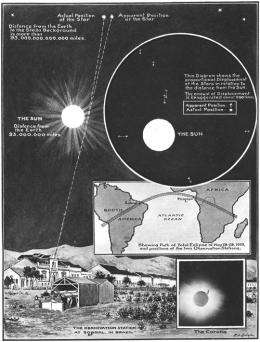
Einstein first proposed his General Theory of Relativity in 1915. It describes how any massive object, such as the Sun, creates gravity by bending space and time around it. Everything in that space is also bent: even rays of light. Consequently, distant light sources, behind the massive object, can appear in a different position or look brighter than they would otherwise.
The total eclipse of 29th May 1919 gave scientists the chance to test the theory for the first time. Eddington travelled to Príncipe to observe the eclipse and measure the apparent locations of stars near the Sun. Heavy clouds parted minutes before the eclipse and, with the Sun almost directly in front of them, the stars appeared to be shifted from the positions that Eddington had recorded in Oxford 4 months earlier - direct evidence that our nearest star shapes the space around it.
Celebrations will include a series of public talks, the installation of an interpretative plaque in the location where Eddington made his observations and an exhibition illustrating the science of gravitational lensing from 1919 to the present.
‘Without Eddington’s clever experiment and the fortuitous timing of this total eclipse it might have taken ages before Einstein’s theory of gravity, first proposed in 1915, was proven to be correct,’ said Professor Pedro Ferreira of Oxford University’s Department of Physics who is one of the event’s lead speakers.
‘The success of Eddington’s experiment sent shockwaves through the scientific establishment changing the goalposts for physicists and making us ask a series of new questions about what makes up the Universe around us and how time and space began.’
Eddington took his first observations at Oxford in January 1919 and then sent one team to view the total eclipse from Sobral in Brazil while he travelled to Principe in time for the 29 May eclipse. During the five minutes of totality both teams managed to take several clear photographs of the stars which, when compared with the earlier observations, would prove Einstein’s theory.
Dr Gisa Weszkalnys, an anthropologist from Keble College, Oxford and one of the event’s main organisers, said: ‘In 2009, the International Year of Astronomy, we felt it was particularly important that the role played by a tiny island like Principe in the history of science was not forgotten. Conversely, one of the world’s most important scientific experiments could in this way be transformed into a landmark attracting visitors and an occasion in Principe’s calendar to be celebrated for many years to come.’
Richard Massey from the Royal Observatory Edinburgh is also helping to organise the celebrations that have received support from the Royal Astronomical Society.
Provided by Oxford University (news : web)


