Robots with fins, tails demonstrate evolution
May 29, 2009 By MICHAEL HILL , Associated Press Writer Robots with fins, tails demonstrate evolution (AP)

Enlarge

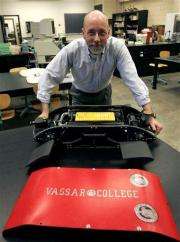
In this April 3, 2009 photo, Vassar biology and cognitive science professor John Long poses with Madeleine, a swimming robot, in a lab at Vassar College in Poughkeepsie, N.Y. Madeleine has four flippers sticking from its sides, and it was used to study a 45-ton marine reptile that patrolled the seas in the Jurassic Period. (AP Photo/Mike Groll)

(AP) -- Robots wag their tail fins and bob along like bathtub toys in a pool at a Vassar College lab. Their actions are dictated by microprocessors housed in round plastic containers, the sort you'd store soup in.

It hardly looks like it, but the two swimming robots were set loose in the little pool to study evolution, acting out predator-prey encounters from roughly 540 million years ago.

The prey , dubbed Preyro, can simulate evolution.

This is not like robot evolution in the "Terminator" movie sense of machines turning on their human masters. Instead, Vassar biology and professor John Long and his students can make changes to the tail of Preyro to see which designs help it avoid the predator robot.

"We're applying selection," Long explains, "just like natural selection."

Long is among a small group of researchers worldwide studying biology and evolution with the help of robots that can do things like shimmy through water or slither up shores. Long's robots, for instance, test theories on the development of stiffer backbones. The researchers believe the machines will catch on as technological advances allow robots to mimic animals far better than before.

Microprocessors are now tinier and more sophisticated. Building materials are more pliable. The same technology driving the use of electronic prosthetic limbs and vacuuming robots also is giving scientists a sophisticated tool to study biology.

"In the past, if you think about it, robots wouldn't work because we could only make these big metal things with rotating joints that were really stiff ... and that's not how nature is," said Robert J. Full, professor of integrative biology at the University of California, Berkeley.

Full's lab at Berkeley has built robots that can creep like cockroaches or climb like . In Switzerland, researchers built a bright yellow salamander robot a few years ago that can swim and walk to investigate vertebrates' transition from water to land. They posted a Web video of the robot squirming out of Lake Geneva.

At Harvard University, George Lauder, professor of organismic and evolutionary biology, studies fish locomotion with the aid of robotic fins. He says scientists are not trying to build spitting images of animals, but rather to mimic certain characteristics - a fin or a spinal column - to study how they work. Scientists then alter that characteristic to see how it affects performance.

The small amount of robot research performed so far has yet to dramatically alter evolutionary studies, but it has helped researchers evolve their understanding of some animals.

Consider Madeleine the swimming robot. Madeleine is roughly the size and shape of a big bed pillow with four flippers sticking from its sides, but it was used to study a 45-ton marine reptile that patrolled the seas in the Jurassic Period.

Fossil records show that the massive pliosaur, dubbed Predator X, had two sets of largely symmetrical flippers, indicating the animal used all four to swim. Long said that sets Predator X apart from modern animals like otters, sea lions and turtles, which tend to use one set of flippers for propulsion and the other for steering.

Researchers studying Predator X asked Long to investigate why the creature used all four flippers for swimming. Madeleine was programmed to swim with two flippers, then all four. The robot demonstrated that using four flippers to swim could be a bad proposition, energy-wise. But they do provide a sort of turbo-boost for quick accelerations - handy for catching dinner.

"The otter and the pliosaur both swim the same speed," Long said, "but, man, that pliosaur can really take off."

The Preyro robot experiment allows Long to take his evolutionary studies a step further.

By setting up Preyro in a pool with another autonomous robot - a predator named Tadiator - Long and his students simulated an evolutionary scenario. They wanted to examine qualities that would help vertebrate sea creatures of the Cambrian Period forage for food without becoming lunch for predators. Specifically, they wanted to test the hypothesis that the ancient creatures' need to scoot away fast from predators drove the evolution of stiffer tails.

Students could stiffen Preyro's backbone by fitting plastic rings (representing vertebrae) over a jelly-like column running down the tail designed to simulate the biological structures of ancient sea creatures. More rings made for a stiffer tail.

They found that changing the size of Preyro's tail fin had no effect, but that backbones stiffened with vertebrae helped Preyro swim away from danger faster. Seven vertebra worked the best; any more made the tail too stiff. They concluded that the of multiple vertebrae could have been influenced by the need to avoid predators while foraging.

Robot builders like Long still use computer simulations to complement their work. But Long says swimming robots like Madeleine and Preyro have advantages over computer simulations because it is extremely difficult to simulate the interaction between a flexible solid - like an animal's tail - and a liquid.

"The thing about robots is, robots can't violate the laws of physics," he said. "A computer program can."

Lauder said there's no substitute for building a device that can replicate the minutely complex features of an animal. He expects the rise of robots in biological research to accelerate as more advances are made.

"The next 20 years are going to be amazing, I think," Lauder said.

---

On the Net:

http://faculty.vassar.edu/jolong/jolong.html

©2009 The Associated Press. All rights reserved. This material may not be published, broadcast, rewritten or redistributed.


print this article email this article download pdf blog this article bookmark this article     Stumble it Digg this share on Facebook retweet share on Reddit add to delicious
Rate this story - 4.7 /5 (3 votes)

Rank Filter

Move the slider to adjust rank threshold, so that you can hide some of the comments.


Display comments: newest first

  • JCincy - May 29, 2009
    • Rank: 3.4 / 5 (5)
    "The prey robot, dubbed Preyro, can simulate evolution... John Long and his students can make changes to the tail of Preyro to see which designs help it avoid the predator robot."

    Great comedy. I believe this is called Intelligent Design, not evolution.
  • jolenaphillo - May 29, 2009
    • Rank: not rated yet
    Material evolve, intelligence evolve. I am curious when the first products will enter the market as already a lot of progress is reached the last 5 years

    http://www.lust4asia.com
    http://www.spunkjunks.com
  • Fakeer - May 30, 2009
    • Rank: 5 / 5 (1)
    The previous commentator seems to have gone off road with the usual creationist mandate. If the design was intelligent it would not require repeated trials to get it right. That point of the experiment is to pre-establish a basic Turing machine so as to give yes/no answers to the question of survival. Only after many trials a favorable trait is selected (which is basically the whole point of natural selection). So this is not to say the machines are evolving but they are simulating the process with the use of an accelerated learning framework that would not otherwise be available in nature for observations that could be made in such a short time frame.
  • Soylent - May 30, 2009
    • Rank: 5 / 5 (1)
    Great comedy. I believe this is called Intelligent Design, not evolution.


    I believe this post is called trolling; either that or dumber than drywall.
  • Quantum_Conundrum - Jun 02, 2009
    • Rank: not rated yet
    Fakeer:

    DESIGNING an experiment which ALLEGEDLY proves evolution is a contradiction.

    Designing a machine that can change itself or even add functionality to itself still does not prove evolution, since the changes themselves are part of a framework of design.

    I invented a scripting language one time which demonstrated this. Effectively, it was a scripting language that allowed the script to modify itself and save the modified version of itself to a new script file, which could then be run. It works using a integer-based code which was intended to simulate DNA.

    Now the code was designed in such a way that a random, yet "favorable" result WOULD happen.

    However, this is by no means evolution, because it was entirely "by design." Even though there were "random" factors involved, ultimately, the "randomness" itself is "by design."

    There is no way to make an "evolution experiment" because any "experiment" you can possibly propose is itself a "design".

    Thus, evolution cannot be proven by experiment via "scientific method" involving any man-made apparatus or procedure, as an entity seperate from an intelligent creator at some level of existence.


    If you use any man made environment, apparatus, or procedure of any kind, you have "contaminated" the results via the "design" of the man made environment, apparatus, or procedure.

    And this is the great contradiction of the psuedo-science of "evolution without design". As such a thing cannot be proved by experimentation. AGain, the experiment itself is a "design" and thus invalidates it's own internal results, having been "designed" by man.

May 29, 2009 all stories

Comments: 5

4.7 /5 (3 votes)
  • Stumble this up

  • Digg this

  • share this

  • hide
  • Related Stories

  • Robot Salamander May Give Evolution Clues
    created Mar 08, 2007 | popularity not rated yet | comments 0
  • Scientists study robot-human interactions
    created Aug 30, 2006 | popularity not rated yet | comments 0
  • Robots That Act Like Rats
    created Feb 15, 2005 | popularity not rated yet | comments 0
  • Researchers investigate evolving 'swarm' robots
    created Mar 13, 2008 | popularity not rated yet | comments 0
  • Japanese Firms Start Testing Robots In Office Buildings
    created Feb 07, 2009 | popularity not rated yet | comments 0


  • hide
  • Relevant PhysicsForums posts

  • Is the I-beam still favored overall?
    created 1hour ago
  • Relative pressure & specific volume
    created 8 hours ago
  • Making 4'x8' sign inkjet printer - need nozzles - help?
    created Nov 06, 2009
  • Calculating Velocity
    created Nov 06, 2009
  • shear stress distribution in triangular steel profile
    created Nov 06, 2009
  • Polygonal mirror reflection beam Problem
    created Nov 05, 2009
  • More from Physics Forums - General Engineering

Other News

Samsung launches a new vacuuming robot

Samsung launches a new vacuuming robot

Electronics / Consumer & Gadgets

created Nov 06, 2009 | popularity 4.4 / 5 (7) | comments 8

(PhysOrg.com) -- Samsung Electronics has launched its latest autonomous robot vacuum cleaner, the Tango, which is capable of vacuuming hardwood floors, carpets, and even beds without human assistance.


new iphone

Touchscreen smartphones being snatched up in US

Electronics / Consumer & Gadgets

created Nov 03, 2009 | popularity 2.7 / 5 (3) | comments 3

US smartphone buyers can't wait to get their hands on touchscreen devices, according to figures released Tuesday by industry tracker comScore.


Robot fish could monitor water quality

Robot fish could monitor water quality

Electronics / Robotics

created Nov 02, 2009 | popularity not rated yet | comments 2

Nature inspires technology for an engineer and an ecologist teamed up at Michigan State University. They're developing robots that use advanced materials to swim like fish to probe underwater environments.


Review: Motorola's Droid is a serious smart phone (AP)

Review: Motorola's Droid is a serious smart phone

Electronics / Consumer & Gadgets

created Nov 04, 2009 | popularity 4.6 / 5 (5) | comments 0

(AP) -- Since its debut in 2007, millions of people have gravitated toward Apple's iPhone, wooed by its sleek hardware, simple user interface and abundance of applications.


UCI robot to aid brain research

UCI robot to aid brain research

Electronics / Robotics

created Nov 04, 2009 | popularity 5 / 5 (1) | comments 0

(PhysOrg.com) -- A robot powered by a computerized model of a rodent brain will help researchers from UC Irvine and UC San Diego understand how people recognize and adapt to change.