Regular Light Bulbs Made Super-Efficient with Ultra-Fast Laser
May 29, 2009 Regular light bulbs made super-efficient with ultra-fast laser

Enlarge

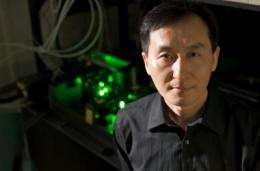
Chunlei Guo stands in front of his femtosecond laser, which can double the efficiency of a regular incandescent light bulb. Credit: University of Rochester

(PhysOrg.com) -- An ultra-powerful laser can turn regular incandescent light bulbs into power-sippers, say optics researchers at the University of Rochester. The process could make a light as bright as a 100-watt bulb consume less electricity than a 60-watt bulb while remaining far cheaper and radiating a more pleasant light than a fluorescent bulb can.

The laser process creates a unique array of nano- and micro-scale structures on the surface of a regular tungsten filament—the tiny wire inside a light bulb—and theses structures make the tungsten become far more effective at radiating light.

The findings will be published in an upcoming issue of the journal .

"We've been experimenting with the way ultra-fast lasers change metals, and we wondered what would happen if we trained the laser on a filament," says Chunlei Guo, associate professor of optics at the University of Rochester. "We fired the right through the glass of the bulb and altered a small area on the filament. When we lit the bulb, we could actually see this one patch was clearly brighter than the rest of the filament, but there was no change in the bulb's energy usage."

The key to creating the super-filament is an ultra-brief, ultra-intense beam of light called a femtosecond laser pulse. The laser burst lasts only a few quadrillionths of a second. To get a grasp of that kind of speed, consider that a femtosecond is to a second what a second is to about 32 million years. During its brief burst, Guo's laser unleashes as much power as the entire grid of North America onto a spot the size of a needle point. That intense blast forces the surface of the metal to form nanostructures and microstructures that dramatically alter how efficiently can radiate from the filament.

In 2006, Guo and his assistant, Anatoliy Vorobeyv, used a similar laser process to turn any metal pitch black. The surface structures created on the metal were incredibly effective at capturing incoming radiation, such as light.

"There is a very interesting 'take more, give more' law in nature governing the amount of light going in and coming out of a material," says Guo. Since the black metal was extremely good at absorbing light, he and Vorobyev set out to study the reverse process—that the blackened filament would radiate light more effectively as well.

"We knew it should work in theory," says Guo, "but we were still surprised when we turned up the power on this bulb and saw just how much brighter the processed spot was."

In addition to increasing the brightness of a bulb, Guo's process can be used to tune the color of the light as well. In 2008, his team used a similar process to change the color of nearly any metal to blue, golden, and gray, in addition to the black he'd already accomplished. Guo and Vorobeyv used that knowledge of how to control the size and shape of the nanostructures—and thus what colors of light those structures absorb and radiate—to change the amount of each wavelength of light the tungsten filament radiates. Though Guo cannot yet make a simple bulb shine pure blue, for instance, he can change the overall radiated spectrum so that the tungsten, which normally radiates a yellowish light, could radiate a more purely white light.

Guo's team has even been able to make a filament radiate partially polarized light, which until now has been impossible to do without special filters that reduce the bulb's efficiency. By creating nanostructures in tight, parallel rows, some light that emits from the filament becomes polarized.

The team is now working to discover what other aspects of a common light bulb they might be able to control. Fortunately, despite the incredible intensity involved, the femtosecond laser can be powered by a simple wall outlet, meaning that when the process is refined, implementing it to augment regular light bulbs should be relatively simple.

Guo is also announcing this month in Applied Physics Letters a technique using a similar femtosecond process to make a piece of metal automatically move liquid around its surface, even lifting a liquid up against gravity.

Source: University of Rochester (news : web)


print this article email this article download pdf blog this article bookmark this article     Stumble it Digg this share on Facebook retweet share on Reddit add to delicious
Rate this story - 4.5 /5 (39 votes)

Rank Filter

Move the slider to adjust rank threshold, so that you can hide some of the comments.


Display comments: newest first

  • weirmeir - May 29, 2009
    • Rank: 4.3 / 5 (6)
    Thank you Jackie Chan! That dude is amazing.
  • vanderMerwe - May 29, 2009
    • Rank: 3.5 / 5 (11)
    YES! Now we can get rid of those enviroNazi mandated mercury filled fluorescent abominations that they've pushed off on us! Wonderful!
  • vlam67 - May 29, 2009
    • Rank: 3 / 5 (8)
    Integrating the complexity of femtosecond laser and its associated electronics to a lightbulb while only reducing from power consumption of 100W to less than 60W does not seem to be a game-changing improvement. As for the light of fluorescent lights as being "unpleasant" it is a purely psychological effect. For me, and maybe others, I wouldn't have cared less, and found reading and working with white light to be of less eye strain. If people find their atavistic mood heartened by recreation of yellow light of fires in caves, that's fine by me. But stop preaching and each to his own.
  • dirk_bruere - May 29, 2009
    • Rank: 4.4 / 5 (9)
    Too late. The future is OLEDs
  • deatopmg - May 29, 2009
    • Rank: 5 / 5 (3)
    The crap cheap compact fluorescents available are exactly that because the color rendering index CRI is also crap (50's to 70's)and so bad that it is not listed anywhere on the package. If one is willing to pay more (ca. double usually) one can find excellent CFL's w/ CRI's in the 90's (100 being equal to sunlight) and color temps ranging from 3000 (a warm tone) to 6000 deg K (sunlight) but you have to look around. Search the internet.

    This new technology will be excellent for auto lights.
  • paulo - May 29, 2009
    • Rank: 4 / 5 (4)
    vlam67, they are altering the filament at the production level with the laser, not putting the laser and associated electronics inside the bulb.

    and Compact Fluorescent bulbs actually give off some rather nasty UV and should not be used to work under, unless you want skin cancer. this is not to mention the mercury content that makes disposal so much of a problem.

    LED is the only safe option available at the moment, unfortunately a very expensive one.

  • weewilly - May 29, 2009
    • Rank: 3.7 / 5 (3)
    OLED's are out. They screw up the power factor of the system really bad. Unless they redo their thinking and incorporate power factor correction in each OLED fixture we will have a problem that will pale in comparison to the inefficiencies of Incandescent bulbs used for lighting. Those lights are also only able to be used in certain temperature ranges. I wasn't impressed at all with the specs of them.
  • ThomasS - May 30, 2009
    • Rank: 5 / 5 (1)
    vlam67,
    Compact Fluorescent bulbs actually give off some rather nasty UV and should not be used to work under, unless you want skin cancer.


    I dont think artificial UV light has nearly enough power to cause skin cancer. Can you back it up with a source?
  • docknowledge - May 30, 2009
    • Rank: 5 / 5 (2)
    ...As for the light of fluorescent lights as being "unpleasant" it is a purely psychological effect. For me, and maybe others, I wouldn't have cared less, and found reading and working with white light to be of less eye strain. If people find their atavistic mood heartened by recreation of yellow light of fires in caves...

    Sunlight, and the closer to sunlight, the better. Our circadian clocks are regulated by it (especially mens'), plants grow best in it, digital cameras take the best photographs in it. Even lamp "temperature" is a very vague description of wildly irregular coverage across the visible spectrum. Firelight has a romantic association but the fluorescents are critically deficient in another way, too, in that they send rooms into darkness 60 times a second. This was supposed to be undetectable for humans, but that turned out not to be the case on the subconscious level.
  • Bob_Kob - May 30, 2009
    • Rank: 5 / 5 (1)
    Yeah considering theyre phasing out incandescent bulbs in 2010 or 2012 in Australia... its a little bit too late.
  • andyrdj - May 30, 2009
    • Rank: 5 / 5 (3)
    "As for the light of fluorescent lights as being "unpleasant" it is a purely psychological effect."

    Not for me, it isn't - they give me the most awful migraines, and I loathe the greenish sickly light they give out.
  • vos - May 30, 2009
    • Rank: 2.6 / 5 (5)
    from 100 watts to 60 watts hardly rates the "Super-Efficient" headline. Its really barely newsworthy in relation to the advances made in other lighting areas. As pure research this is an interesting step forward that may make some cool applications possible, think phased array light beaming or something.

    2 last things, quit whining about "light quality" its all in your head. and, ... I'm tired of vulvox do they even have any products or do they just put out press releases.
  • PPihkala - May 30, 2009
    • Rank: 5 / 5 (1)
    This article tell about getting about double efficiency from filament bulb, but that is not enough to make it to compete with CFLs and LEDs.

    Old fluorescent tubes with heavy ballasts do flicker at twice the grids frequency, either at 100Hz (Europe) or 120Hz (USA etc). Newer fixtures like CFLs have build in electronics that make them flicker above audible range somewhere like 30000Hz. That is not noticeable to human eye. Just a reminder, your television also flickers at 50/60Hz if it is not one of those new 100/120Hz or more frames per second models.
  • Nik_2213 - May 30, 2009
    • Rank: 5 / 5 (1)
    D'uh, I'm still waiting for a cost-effective way to replace 3', 4' & 5' fluorescent strip-lights. In theory, we've saved a yay-huge amount of electricity and umpteen regular bulb-changes since converting kitchen & bathroom from stupid incandescent spot-lights 20 years ago, but spot-lights now come as plug'n'play 'mains' LEDs...

    FWIW, IIRC, to help with sleep disturbance, melantonin cycle etc, now being suggested we have 'harsh' blue-ish lighting during day, then shift to 'warm' orange-ish lighting in evening-- Just like natural sun-light.
  • SMMAssociates - May 31, 2009
    • Rank: 5 / 5 (2)
    With respect to hacking incandescents with this technology, there probably are a few applications left where only a filament-type lamp will do, at least for now. Might help.

    It'd be nice if "science advisors" (who are often, so it seems, ambassadors for all kinds of junk science) would ask around before foisting technology off on us, like the new "digital" TV, fluorescent lights in standard fixtures, etc.

    The only good news is that it appears that LED's, which may not share some of the CFL's disadvantages, may drop in price enough to a better choice. And, although the LED is a little sloppy, if you have a couple dozen of them faking a big light bulb, you could "tune" the bulb's color a bit rather easily just by slightly different specs for some of the LED's....

    Just IMHO, of course.
  • paulo - May 31, 2009
    • Rank: 5 / 5 (1)
    http://www.choice...d=106679&catId=100570&tid=100008&p=1&title=Don't get too close to these CFLs
  • Soylent - May 31, 2009
    • Rank: not rated yet
    Sunlight, and the closer to sunlight, the better.


    The sun isn't 2700 K. Score one for "daylight" fluorescent lighting.

    Our circadian clocks are regulated by it (especially mens')


    Better gradually dim your light in the evening and not use your computer(or anything else bright) several hours before bed then.

    Me? Not a chance.


    plants grow best in it


    Most species do very well with hideous high pressure sodium lamps.

    Firelight has a romantic association but the fluorescents are critically deficient in another way, too, in that they send rooms into darkness 60 times a second.


    This has never been true. Crappy fluorescent lighting flickers at twice mains frequency; your typical fluorescent lighting with electronic ballast flickers at some inaudible frequency above 20 kHz.

    Normal light bulbs flicker quite a bit at double mains frequency because the wire isn't thick enough to stay at a steady temperature.
  • Soylent - May 31, 2009
    • Rank: 5 / 5 (1)
    With respect to hacking incandescents with this technology, there probably are a few applications left where only a filament-type lamp will do, at least for now.


    Wherever dirt cheap and able to tolerate tens of thousands of cycles is preferable to efficiency(bath room, garage and other places used frequently for short periods of time)

  • Adriab - Jun 01, 2009
    • Rank: not rated yet
    An interesting effect that can be shown in the lab, but before it can be used in the incandescent bulb market it'd need to be quite resilient(relative of course).
    How much use can the nanoscale structures take before breaking down? And, given the possible breakdown, will energy consumption increase?
    If the lifetime of the bulb is much less than its peers, then it will not fare well in the market.
    Still, might be a source of special-purpose bulbs.
  • Choice - Jun 01, 2009
    • Rank: not rated yet
    How do the emergies compare?
  • N_O_M - Jun 02, 2009
    • Rank: 5 / 5 (2)
    Have you ever managed to convincer anyone with your claims Neil?
  • CWFlink - Jun 06, 2009
    • Rank: 5 / 5 (1)
    The primary flaw in florescent bulbs in my experience has been the failure rate UNLESS they are left ON just about ALL of the time. The bathroom bulbs I've installed are rated 8 years, but seldom last 8 months! ...and cost at least 4 times the price of the incondenscents they replace.


    At first, I was pleased that the bulbs started out dim but warm up to full brilliance in 3 or 4 minutes. In a bathroom, when you wake up at night, you don't want to be hit with the full intensity when you turn on the switch.


    But then I realized that the reason was the gas was warming up in the bulb... thermal expansion => stress => short life!


    I suspect all the government mandated tests do not cycle the bulbs realistically.


    Another question: How much extra energy is wasted these days because people figure the bulb is efficient... thus they don't bother to turn off their lights as often? I find myself thinking that way... I suspect we all do.
  • JZippy - Jun 06, 2009
    • Rank: not rated yet
    Good thing our oil lamps, wax candles, and jars filled with fireflies are enough to light our house. All this is done without using any electricity.

    Must stop typing now... getting too tired from pedaling this electric generating cycle the powers the computer. :)


May 29, 2009 all stories

Comments: 23

4.5 /5 (39 votes)
  • Stumble this up

  • Digg this

  • share this

  • hide
  • Related Stories

  • Ultra-intense laser blast creates true 'black metal'
    created Nov 21, 2006 | popularity not rated yet | comments 0
  • Researchers create gold aluminum, black platinum, blue silver
    created Feb 01, 2008 | popularity not rated yet | comments 0
  • A Halogen Bulb
    created Sep 26, 2004 | popularity not rated yet | comments 0
  • Silicon Light Bulbs to Compete with Fluorescent Bulbs
    created Mar 06, 2008 | popularity not rated yet | comments 0
  • Wireless Nanocrystals: Another Step to More Efficient White LEDs
    created Jun 23, 2004 | popularity not rated yet | comments 0


  • hide
  • Relevant PhysicsForums posts

  • What is the most accepted beleif about the universe, in terms of how large it is etc
    created 1hour ago
  • coefficient of Friction
    created 4 hours ago
  • how can I collect power from a magnetic field?
    created 4 hours ago
  • Definite phase?
    created 6 hours ago
  • What is time?
    created 11 hours ago
  • spiral around cone
    created 11 hours ago
  • More from Physics Forums - General Physics

Other News

Stars Fueled by Dark Matter Could Hold Secrets to the Universe

Stars Fueled by Dark Matter Could Hold Secrets to the Universe

Physics / General Physics

created Nov 03, 2009 | popularity 4.5 / 5 (47) | comments 40

(PhysOrg.com) -- The first stars in the universe may have been very different from the stars we see today, yet they may hold clues to understanding some of the mysterious features of the universe. These "dark ...


Second Law of Thermodynamics May Explain Economic Evolution

Second Law of Thermodynamics May Explain Economic Evolution

Physics / General Physics

created Nov 02, 2009 | popularity 4.3 / 5 (29) | comments 26

(PhysOrg.com) -- Terms such as the "invisible hand," laissez-faire policy, and free-market principles suggest that economic growth and decline in capitalist societies seem to be somehow self-regulated. Now, ...


High-performance plasmas may make reliable, efficient fusion power a reality

High-performance plasmas may make reliable, efficient fusion power a reality

Physics / Plasma Physics

created Nov 02, 2009 | popularity 4.7 / 5 (36) | comments 31

In the quest to produce nuclear fusion energy, researchers from the DIII-D National Fusion Facility have recently confirmed long-standing theoretical predictions that performance, efficiency and reliability ...


'Teapot effect' solved

Solving Teapot Effect

Physics / General Physics

created Nov 02, 2009 | popularity 5 / 5 (9) | comments 10

(PhysOrg.com) -- A team of scientists from France have worked out why teapots dribble at low flow rates, and how to stop them. The effect is called the "teapot effect", and solving it could finally put an ...


Laser accelerated protons to the highest energies so far

Researchers use trident laser to accelerate protons to record energies

Physics / General Physics

created Nov 02, 2009 | popularity 4.3 / 5 (3) | comments 10

An international team of physicists at Los Alamos National Laboratory has succeeded in using intense laser light to accelerate protons to energies never before achieved. Using this technique, scientists can ...