Get a grip! Blistering new evidence on why we have fingerprints
May 29, 2009 fingerprint

Image credit: Wikimedia.

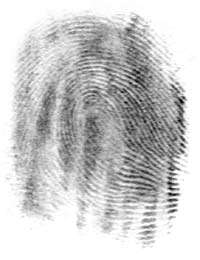
(PhysOrg.com) -- Fingerprints do not help primates grip, as previously thought, scientists have discovered. They actually reduce the friction needed to hold onto flat surfaces. Now Dr Roland Ennos and his team at The University of Manchester are trying to find out: why do we have them?

Dr Ennos, at the University’s Faculty of Life Sciences, said: “I have been thinking about this for years and, having played around with it for a bit, realised that skin is rubbery so the ridges in fingerprints might actually reduce grip.

“Our experiments - using a plastic cup, weights and strips of Perspex (acrylic glass) to develop a simple machine in the lab - proved me right.”

He added: “What is interesting is that not only primates have fingerprints. Koalas, which are marsupials, have fingerprints too, while there are in South America that have them on their tails.

“So what are these prints for? My preferred theory is that they allow the skin to deform and thus stop blistering. That is why we get blisters on the smooth parts of our hands and feet and not the ridged areas: our fingerpads, palms and soles.

“We are now testing that theory and two others, that fingerprints improve grip on rough surfaces and that they increase sensitivity.”

Dr Ennos disproved the long-held assumption that fingerprints help primates to grip with a simple machine, three strips of perspex and the right hand of Masters student Peter Warman. They tested Peter’s grip on each finger and thumb on three different widths of perspex as the machine pulled the perspex strips down via a weight in a plastic cup. They also tested grip at three different angles by bending the fingers and thumb. This wide range of testing conditions allowed them to separate pressing force from the contact area and overcome any confounding variables.

The team, whose results are published and discussed in the Journal of Experimental Biology (June 2009), found friction increased with , against the normal law of physics which states that friction does not change with surface area. This is because skin is rubbery and not a normal solid.

The team also measured the contact area by covering the fingers and thumb with ink and taking prints at different forces, aligning them with the results. This showed that fingerprints reduced contact area by one third compared with flat skin, which would have reduced friction.

The results showed that fingertips behaved more like rubbers than hard solids; their coefficients of friction fell at higher normal forces and friction was higher when fingers were held flatter against wider sheets and hence when contact area was greater. The shear stress was greater at higher pressures, suggesting the presence of a biofilm between the skin and the surface. Fingerprints reduced contact area by a factor of one third compared with flat skin, however, which would have reduced the friction. This casts severe doubt on their supposed frictional function.

Dr Ennos said: “The experiment was so simple, this discovery could have been made 100 years ago; but scientists make assumptions and tend to look at complicated things instead.

“I like to think differently, I am interested in the ‘why’ questions and look at things that affect people in their daily life. Everyone thinks science is all about the impossible but it’s not - it helps us understand the world around us.”

He added: “There are potential spin-offs for this work. For example some people who suffer nerve damage that prevents sweating have slippery fingers and cannot grip: we could develop something to treat that.”

He and the team will now test how fingerprints affect grip on rough surfaces and on wet surfaces, to see if their function is to channel water away via their grooves. They will also test if and how fingerprints prevent blisters.

More information: are Unlikely to Increase the of Primate Finger Pads,’ (June 2009)

Provided by University of Manchester (news : web)


print this article email this article download pdf blog this article bookmark this article     Stumble it Digg this share on Facebook retweet share on Reddit add to delicious
Rate this story - 4 /5 (11 votes)

Rank Filter

Move the slider to adjust rank threshold, so that you can hide some of the comments.


Display comments: newest first

  • El_Nose - May 29, 2009
    • Rank: not rated yet
    -- an experiment in senses ---
    read this then act it out

    spread your hands out and spread eagle your fingers
    then arch your palm as if you are holding a soccor ball fingerprints pointed outward
    bring both hands close together without touching
    close your eyes and move your hands around with out touching --- you will KNOW when your fingertips are close to each other and when they are across from open air -

    -- i have always wondered y this is true
  • El_Nose - May 29, 2009
    • Rank: not rated yet
    i think fingerprints are meant to reduce friction it makes sense if you look at it from a differnt context -- a non flat surface that is in contact with a lot of other area is less likely to blister and less likely to crack open or split -- splits and cracks in the skin are disease pathways to the body it makes sense that the parts we use to touch the world should be resiliant to shear stress and bruising
  • otto1923 - May 29, 2009
    • Rank: not rated yet
    Not many flat surfaces in nature- ridges engage imperfections in natural surfaces; macroscopic friction... Duh. Also, little finger evolved to pick your nose- how could it be wrong?
  • warmer - May 29, 2009
    • Rank: not rated yet
    El Nose, the answer is quite simple. You can feel the heat from the other finger tips and also the movement of air changes at the finger tip when they are close.
  • dbren - May 29, 2009
    • Rank: 5 / 5 (1)
    Even simpler - you brain knows where your hands are.

    This is why touching your nose with your eyes shut is a standard sobriety test. The brain loses track of where your finger tip in in space in relation to your nose.
  • jselin - May 29, 2009
    • Rank: not rated yet
    Repeat the testing with bark.
  • x646d63 - May 29, 2009
    • Rank: not rated yet
    Even simpler - you brain knows where your hands are.


    I agree with you there.

    But field sobriety tests are used to observe reflexes (like balance) and cognitive function (like being able to follow instructions.)

    General motor function is not greatly impaired when drunk. Most people can touch their nose just fine. But when drunk, they can't do it while trying to balance on one foot, and when drunk will usually attempt it immediately when asked to, even if they were told to wait until further instructions were given. These are tell-tale signs of drunkenness.
  • andyd - May 29, 2009
    • Rank: not rated yet
    Why do fingers have fingerprints? Perhaps for the same reason tyres (tires) have treads. The grooves serves to channel moisture away and paradoxically improve grip when normally they would hinder it. Maybe fingerprints serve the same purpose.

  • bmcghie - May 30, 2009
    • Rank: not rated yet
    The "brain knowing where fingers are" is termed proprioception. Thanks to these nifty nerves we have throughout our skeletons and muscles, we are able to receive reports as to the angle, torque, tension (among other things) of all of our body parts. VERY useful for hand eye coordination, or running without looking at your feet!

    As to the drunken buffoon questions, there is no evidence that this system malfunctions when intoxicated. As another poster mentioned, it's simply that the brain is not dealing with the incoming information as it normally does.
  • Fakeer - Jun 04, 2009
    • Rank: not rated yet
    In another research report somewhere I had read that the ridges improve the detection of texture and surface irregularities as opposed to touching something with a smooth surface. It probably has very little to do with grip and is more geared towards better sensitivity of the fingers which act as the first line of sensors that notify the brain of danger.

May 29, 2009 all stories

Comments: 10

4 /5 (11 votes)
  • Stumble this up

  • Digg this

  • share this

  • hide
  • Related Stories

  • Models present new view of nanoscale friction
    created Feb 25, 2009 | popularity not rated yet | comments 0
  • Why Do We Have Fingerprints?
    created Apr 04, 2009 | popularity not rated yet | comments 0
  • 'Fluidhand': Each finger can be moved separately
    created Apr 22, 2008 | popularity not rated yet | comments 0
  • Scientists develop 'clever' artificial hand
    created Sep 07, 2005 | popularity not rated yet | comments 0
  • Fingerprint analysis technique could be used to identify bombmakers
    created Aug 26, 2008 | popularity not rated yet | comments 0


  • hide
  • Relevant PhysicsForums posts

  • Questions about diffusion
    created 4 hours ago
  • Human Leukocyte Antigen (HLA) typing
    created 11 hours ago
  • Breeding program
    created Nov 20, 2009
  • How does a concentration gradient provide energy?
    created Nov 20, 2009
  • Eyesight and Neural Damage from Electronics
    created Nov 19, 2009
  • Quick question about the Golgi Apparatus?
    created Nov 19, 2009
  • More from Physics Forums - Biology

Other News

The Monarchs' annual migration ritual has yet to be scientifically explained

Tree-eating bugs threaten Monarch butterfly in Mexico

Biology / Ecology

created 12 hours ago | popularity 4 / 5 (1) | comments 0

The mysterious Monarch butterfly, which migrates en masse annually between Canada and Mexico, is now facing a new peril: another insect thriving in Western Mexican forests.


Bigger not necessarily better, when it comes to brains

Bigger not necessarily better, when it comes to brains

Biology / Plants & Animals

created Nov 17, 2009 | popularity 4.5 / 5 (17) | comments 11

(PhysOrg.com) -- Tiny insects could be as intelligent as much bigger animals, despite only having a brain the size of a pinhead, say scientists at Queen Mary, University of London.


Extinct goat Myotragus balearicus

Extinct goat was cold-blooded

Biology / Plants & Animals

created Nov 18, 2009 | popularity 4.9 / 5 (33) | comments 10

(PhysOrg.com) -- An extinct goat that lived on a barren Mediterranean island survived for millions of years by reducing in size and by becoming cold-blooded, which has never before been discovered in mammals.


Right-handed chimpanzees provide clues to the origin of human language

Biology / Plants & Animals

created Nov 16, 2009 | popularity 3 / 5 (1) | comments 7

Most of the linguistic functions in humans are controlled by the left cerebral hemisphere. A study of captive chimpanzees at the Yerkes National Primate Research Center (Atlanta, Georgia), reported in the January 2010 issue ...


The creature was found at a depth of 161 metres

Japanese researchers film rare baby fish 'fossil'

Biology / Plants & Animals

created Nov 17, 2009 | popularity 4.7 / 5 (7) | comments 4

Japanese marine researchers said Tuesday they had found and successfully filmed a young coelacanth -- a rare type of fish known as "a living fossil" -- in deep water off Indonesia.