Swedish pirates have wind in their sails for EU vote
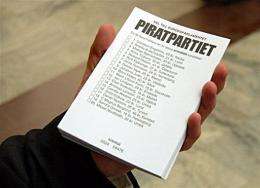
A Swedish party which wants an Internet filesharing free-for-all, the Pirate Party, could become one of the surprise new entrants to the European parliament this week.
The party, which also wants to beef up Internet privacy, was founded in January 2006 and quickly attracted members angered by controversial laws adopted in the Scandinavian country that criminalised filesharing and authorised monitoring of emails.
Its membership shot up after a Stockholm court on April 17 sentenced four Swedes to a year in jail for running one of the world's biggest filesharing sites, The Pirate Bay.
"When the verdict was announced at 11:00 am, we had 14,711 members," Rick Falkvinge, the 37-year-old founder of the party, told AFP.
"We tripled in a week, becoming the third-biggest party in Sweden in terms of numbers. All of a sudden we were everywhere."
Opinion polls ahead of the June 7 European parliament elections credit the party with between 5.5 and 7.9 percent of votes, well above the four percent required to win a seat.
In the 2006 general election, held eight months after it's creation, the Pirate Party won just 0.6 percent of votes.
"They have been very lucky because The Pirate Bay verdict came at the same time as the start of the election campaign, but I think The Pirate Party had the potential to grow anyway," a political scientist at Gothenburg University, Ulf Bjereld, told AFP.
"The Pirate Party has taken advantage of a new cleavage in Swedish politics, about civil liberties, about who should have the right to decide over knowledge, and that's not a left-right cleavage," Bjereld said.
"The traditional parties have been sleeping, they have underestimated the political potential in these issues," he added.
The European parliament election, with little at stake in Sweden and a low turnout expected, is considered the perfect opportunity for an election sensation, according to experts.
"People tend to think there are very few differences between the parties in the EU elections. If you could have a (unique) profile there, it's easier to succeed," said Toivo Sjoeren, head of the Sifo polling institute.
The typical Pirate Party supporter is a young, male Internet buff.
According to Sifo, some 13 percent of people under 30 plan to vote for the party, compared to seven percent of those aged 30 to 49, and only three percent of those over the age of 49.
The party garners some 10.5 percent support among male voters, but only 1.5 percent of women.
"It's a 'geek' party," admitted Brian Levinsen, a 31-year-old member, attending a recent campaign meeting in Stockholm.
"We use Twitter, Skype, we use blogs," explained Jan Lindgren, the party's campaign director in Stockholm.
"There is always someone (from the party) online, even at 2:00 or 4:00 in the morning," he added.
Many members say they joined not only because they are die-hard fans of the Internet and filesharing, but because they fear a "Big Brother" society.
"Sweden was built on protecting the freedom of its citizens. This pact is now disappearing," said Levinsen.
"They want to impose controls on what we're saying, like in China or in North Korea. We're not there yet, but we're on the way," said Robert Nyberg, a 29-year-old demolition worker clad in a purple tee-shirt bearing the party's black flag.
The Pirate Party, which has sister parties in 20 countries, is also standing in the European elections in Poland and Germany.
An estimated 375 million voters across the 27 nation bloc will elect 736 deputies for a five-year term at the parliament, which has an important role passing pan-European legislation and the EU commission's annual budget.
(c) 2009 AFP


