Wiping out the world's mass migrations
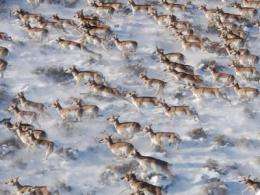
Densely packed wildebeests flowing over the Serengeti, bison teeming across the Northern Plains—these iconic images extend from Hollywood epics to the popular imagination. But the fact is, all of the world's large-scale terrestrial migrations have been severely reduced and a quarter of the migrating species are suspected to no longer migrate at all because of human changes to the landscape. A recently published research paper highlights this global change and presents the first analysis of the dwindling mass migrations.
"Conservation science has done a poor job in understanding how migrations work, and as a result many migrations have gone extinct," says Grant Harris of the Center for Biodiversity and Conservation at the American Museum of Natural History, first author of the paper in Endangered Species Research. "Fencing, for example, blocks migratory routes and reduces migrant's access to forage and water. Migrations can then stop, or be shortened, and animal numbers plummet."
Migrations of large-bodied herbivores (also called ungulates) occur when animals search for higher quality or more abundant food. Ecologically, there are two primary drivers of food availability. In temperate regions of the world, higher-quality food shifts predictably as the seasons change, and animals respond by moving along well-established routes. For savannah ecosystems, rain and fire allow higher-quality food to grow. This is a less predictable change that animals must track across expansive landscapes.
Human activity now prevents large groups of ungulates from following their food. Fencing, farming, and water restrictions have changed the landscape and over-harvesting of the animals themselves has played a role in reducing the number of migrants.
To assess the impact of human activity on migrations throughout the world, Harris and his co-authors gathered information on all 24 species of large (over 20 kilograms) ungulates known for their mass migrations. Animals included in the study, for example, range over Arctic tundra (Caribou), Eurasian steppes and plateaus (Chiru and Saiga), North American plains (bison and elk), and African savannahs (zebra and wildebeests). The fewest number of mass-migrating species live in the Americas, and this is the location where the most data exists. Evaluating the human impact on migratory species in Africa and Eurasia is hampered by a lack of scientific data: in Africa—where most of the large-scale migrations remain—three species have no scientific publications on their status, and in Eurasia half of the six remaining migratory species are very poorly documented.
All 24 species in the current study lost migration routes and were reduced in number of individuals. In North America, bison are still considered migratory, but their range is now restricted from the Great Plains to two small sites in Yellowstone and Alberta. Similar changes are found on other continents when human activity limits the ability of species to move to new patches of food. The analysis found even more drastic curbing for six species in particular. The springbok (Antidorcas marsupialis), black wildebeest (Connochaetes gnou), the blesbok (Damaliscus dorcas), and quagga (Equus quagga) of southern Africa; the kulan (Equus hemionus) of central Asia; and scimitar horned oryx (Oryx dammah) of northern Africa either no longer migrate or are impossible to evaluate as migratory animals.
"If we are going to conserve migrations and species, we need to identify what needs to be done: where migrations remain, how far animals move, their habitat needs and location, threats, and the knowledge gaps needed to be filled," says co-author Joel Berger of the Wildlife Conservation Society and the University of Montana. "For some of these species, such as the wildebeest and eland in Botswana, threats were identified decades ago. We as a society have made little progress at figuring out how to save migrations."
"A large part of this is an awareness issue. People don't realize what we have and are losing," says Harris. "We lose migrations and become biologically depauperate with farms and fences, even though there is no reason why humanity cannot technically and socially advance while maintaining natural phenomena. A balance can be struck—we just need to strike it."
Source: American Museum of Natural History


