Biomimetic-engineering design can replace spaghetti tangle of nanotubes in novel material
June 1, 2009
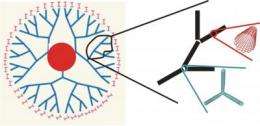
The figure illustrates a hierarchical network of carbon nanotubes mimicking a cell's protein network to connect a small heat source (red area) to a larger area that serves as a heat sink. Credit: Graphic / Markus Buehler, MIT
(PhysOrg.com) -- Nanoelectromechanical systems (NEMS) devices have the potential to revolutionize the world of sensors: motion, chemical, temperature, etc. But taking electromechanical devices from the micro scale down to the nano requires finding a means to dissipate the heat output of this tiny gadgetry.
In a paper appearing in Nano Letters, Professor Markus Buehler and postdoctoral associate Zhiping Xu of MIT's Department of Civil and Environmental Engineering say the solution is to build these devices using a thermal material that naturally dissipates heat from the device's center through a hierarchical branched network of carbon nanotubes. The template for this thermal material's design is a living cell, specifically, the hierarchical protein networks that allow a cell's nucleus to communicate with the cell's outermost regions.
"The structure now used when designing materials with carbon nanotubes resembles spaghetti," said Buehler, who studies protein-based materials at the nano and atomistic scales with the goal of using biomimetic-engineering principles to design human-made materials. "We show that a precise arrangement of carbon nanotubes similar to those found in the cytoskeleton of cells will create a thermal material that effectively dissipates heat, which could prevent a NEMS device from failing or melting."
NEMS devices are characterized by extremely small, high-density heat sources that can't be cooled by traditional means. Even the microelectromechanical systems (MEMS) devices used in automobiles and electronics are hard to cool, because conventional thermal management strategies such as fans, fluids, pastes and wiring often don't work at these small scales; heat buildup in MEMS frequently leads to catastrophic device failure, which limits the reliability of larger systems.
But the number of heat-conducting fibers or carbon nanotubes (CNTs) that can be connected to the heat source at the center of a NEMS device is limited by the physical size of the heat source itself. Buehler and Xu demonstrate that a simple geometric structure — a branched-tree hierarchy of at least two branches sprouting off each branch — is far more effective at heat dissipation than the non-hierarchical "spaghetti" of most existing CNT-based material.
They show that a single fiber (or branch) connected to the heat source, with 99 additional branched links between it and the heat sink, will provide the same dissipation effect as if 50 long fibers were connected directly to the heat source. If five carbon nanotubes are arranged in direct connection to the heat source, each of which uses this branched-tree hierarchical structure, the heat dissipation will be the equivalent of 250 direct connections from the heat source to an external heat sink.
"Our paper provides a breakthrough in the understanding of how nanostructural elements can be utilized effectively to bridge scales from the nano to macro through formation of hierarchical structures," said Xu. "The results could change the way nanodevices are designed and fabricated by enabling technological innovations for highly integrated systems."
More information: http://pubs.acs.or … urnal/nalefd
-
Nanotubes act as 'thermal Velcro' to reduce computer-chip heating
May 01, 2006 |
not rated yet |
0
-
New theory explains electronic and thermal behavior of nanotubes
Jan 19, 2006 |
not rated yet |
0
-
Fujitsu Pioneers Use of Carbon Nanotubes for Heatsinks for Semiconductors
Dec 05, 2005 |
not rated yet |
0
-
Nanotube forests grown on silicon chips for future computers, electronics
Oct 01, 2007 |
not rated yet |
0
-
Scientists Track Heat in Tiny Rolls of Carbon Atoms
Mar 02, 2009 |
not rated yet |
0
-
Engineers build first sub-10-nm carbon nanotube transistor
Feb 01, 2012 |
4.9 / 5 (30) |
30
-
Something old, something new: Evolution and the structural divergence of duplicate genes
Jan 31, 2012 |
4.6 / 5 (7) |
1
-
The hidden nanoworld of ice crystals: Revealing the dynamic behavior of quasi-liquid layers
Jan 30, 2012 |
5 / 5 (3) |
1
-
Stock market network reveals investor clustering
Jan 27, 2012 |
3.9 / 5 (23) |
8
-
Of microchemistry and molecules: Electronic microfluidic device synthesizes biocompatible probes
Jan 26, 2012 |
5 / 5 (1) |
0
-
polymer nanocomposites
10 hours ago
-
Corrosion Tests on Magnesium
23 hours ago
-
polyethylene copper nanocomposite
Feb 09, 2012
-
Output of xrd analysis
Feb 08, 2012
-
Transport phenomena problem based on problems 18.B11 and 19B.6 from Bird, stewart, lw
Feb 06, 2012
-
Help with material selection - Car Piston
Feb 05, 2012
- More from Physics Forums - Materials & Chemical Engineering
More news stories
What lies beneath: Mapping hidden nanostructures
The ability to diagnose and predict the properties of materials is vital, particularly in the expanding field of nanotechnology. Electron and atom-probe microscopy can categorize atoms in thin sheets of material, ...
3 hours ago |
5 / 5 (1) |
1
'Dark plasmons' transmit energy
Microscopic channels of gold nanoparticles have the ability to transmit electromagnetic energy that starts as light and propagates via "dark plasmons," according to researchers at Rice University.
19 hours ago |
5 / 5 (6) |
1
|
New kind of solar cell could capture significantly more energy than current cells
New solar cells could increase the maximum efficiency of solar panels by over 25%, according to scientists from the University of Cambridge.
Feb 08, 2012 |
4.5 / 5 (12) |
14
|
Nanoshell whispering galleries improve thin solar panels
Visitors to Statuary Hall in the U.S. Capitol Building may have experienced a curious acoustic feature that allows a person to whisper softly at one side of the cavernous, half-domed room and for another on ...
Nanotechnology / Nanomaterials
Feb 07, 2012 |
4.3 / 5 (6) |
6
|
Nanotube therapy takes aim at breast cancer stem cells
Wake Forest Baptist Medical Center researchers have again proven that injecting multiwalled carbon nanotubes (MWCNTs) into tumors and heating them with a quick, 30-second laser treatment can kill them.
Nanotechnology / Bio & Medicine
Feb 09, 2012 |
5 / 5 (1) |
0
|
New understanding of DNA repair could eventually lead to cancer therapy
A research group in the Faculty of Medicine & Dentistry at the University of Alberta is hoping its latest discovery could one day be used to develop new therapies that target certain types of cancers.
Hovering not hard if you're top-heavy, researchers find
Top-heavy structures are more likely to maintain their balance while hovering in the air than are those that bear a lower center of gravity, researchers at New York University's Courant Institute of Mathematical Sciences ...
Grass to gas: Researchers' genome map speeds biofuel development
Researchers at the University of Georgia have taken a major step in the ongoing effort to find sources of cleaner, renewable energy by mapping the genomes of two originator cells of Miscanthus x giganteus, a large perenn ...
Night, weekend delivery OK for babies with birth defects
Weekday delivery is no better than night or weekend delivery for infants with birth defects, according to a new study presented today at The Pregnancy Meeting, the Society for Maternal-Fetal Medicine's annual conference. ...
Sonic Cradle lands spot in TED exhibition
A Simon Fraser University graduate student project that melds music, meditation and modern technology has landed a rare spot as an exhibit at TEDActive 2012 in Palm Springs, California this month.
Drug halts organ damage in inflammatory genetic disorder
A new study shows that Kineret (anakinra), a medication approved for the treatment of rheumatoid arthritis, is effective in stopping the progression of organ damage in people with neonatal-onset multisystem inflammatory disease ...