Scientists Recreate Bach’s Forgotten Horn (w/Video)
June 1, 2009
Scientists recreate Bach's forgotten horn

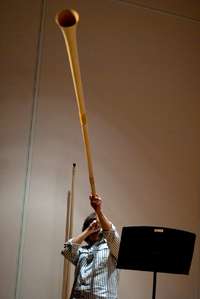
Bach's forgotten horn - the recreated instrument in action

(PhysOrg.com) -- Cutting-edge computer modelling software has enabled a long-lost, trumpet-like instrument to be recreated - allowing a work by Bach to be performed as the composer may have intended for the first time in nearly 300 years.

The software was originally developed by a University of Edinburgh PhD student, funded by the Engineering and Physical Sciences Research Council (EPSRC), with the aim of optimising the design of modern brass instruments.

Computer modelling is an emerging technology in manufacture, but the new software offers unprecedented accuracy in terms of ensuring a brass instrument's design delivers the required shape, pitch and tone.

Following its use to improve trombone design, the software has been deployed to help the Schola Cantorum Basiliensis (SCB), who asked the University to recreate the instrument, which is called the Lituus - even though no-one alive today has heard, played or even seen a picture of this forgotten instrument.

This video is not supported by your browser at this time.

The SCB are a Swiss-based music conservatoire specialising in early music, they gave the Edinburgh team their expert thoughts on what the Lituus may have been like in terms of the notes it produced, its tonal quality and how it might have been played. They also provided cross-section diagrams of instruments they believed to be similar to the Lituus.

"The software used this data to design an elegant, usable instrument with the required acoustic and tonal qualities," says Dr Alistair Braden, the software's designer. "The key was to ensure that the design we generated would not only sound right but look right as well."

Professor Murray Campbell, who supervised the software's development, adds: "Crucially, the final design produced by the software could have been made by a manufacturer in Bach's time without too much difficulty."

SCB has now used Edinburgh's designs to build two identical examples of the long-lost instrument. Two and a half metres long, made from pine and with a mouthpiece made of cow horn, the instruments are thin, completely straight and have a flared 'bell' at the end.

Both were used in an experimental performance of the cantata 'O Jesu Christ, meins lebens licht' in Switzerland earlier this year. Written by Bach in the 1730s, it is thought that this is the only piece of music still existing that specifies the use of the Lituus - and has almost certainly not been performed using the Lituus since Bach's time.

"Sophisticated computer modelling has a huge role to play in the way we make music in the future," comments Professor Campbell.

Source: Engineering and Physical Sciences Research Council (news : web)

3.3 /5 (4 votes)  

Rank 3.3 /5 (4 votes)
Related Stories
Relevant PhysicsForums posts
  • Calling function with no input argument
    created14 hours ago
  • Force free body diagram problem on gym equipment
    created15 hours ago
  • Empirical data regarding shower heads and water
    created23 hours ago
  • feed hold button on CNC lathe
    createdFeb 09, 2012
  • RFAC in Fortran
    createdFeb 09, 2012
  • dynamics 2/32
    createdFeb 08, 2012
  • More from Physics Forums - General Engineering

More news stories

Anonymous knocks CIA website offline (Update)

The website of the Central Intelligence Agency was inaccessible on Friday after the hacker group Anonymous claimed to have knocked it offline.

Technology / Internet

created 9 hours ago | popularity 5 / 5 (9) | comments 14

Google users warned of threat to smartphone wallets

Users of Google smartphone wallets were being warned on Friday that there is a way to crack pass codes intended to thwart thieves from going on illicit shopping sprees.

Technology / Internet

created 7 hours ago | popularity 5 / 5 (2) | comments 0

New error-correcting codes guarantee the fastest possible rate of data transmission

Error-correcting codes are one of the triumphs of the digital age. They’re a way of encoding information so that it can be transmitted across a communication channel — such as an optical fiber o ...

Technology / Computer Sciences

created 17 hours ago | popularity 4.9 / 5 (8) | comments 6 | with audio podcast

New power source discovered

(PhysOrg.com) -- Researchers at the Massachusetts Institute of Technology (MIT) and RMIT University have made a breakthrough in energy storage and power generation.

Technology / Energy & Green Tech

created 16 hours ago | popularity 4.8 / 5 (27) | comments 8 | with audio podcast

Small modular reactor design could be a 'SUPERSTAR'

(PhysOrg.com) -- Though most of today's nuclear reactors are cooled by water, we've long known that there are alternatives; in fact, the world's first nuclear-powered electricity in 1951 came from a reactor ...

Technology / Energy & Green Tech

created 17 hours ago | popularity 4.3 / 5 (12) | comments 22 | with audio podcast


Humans may have helped the decline of African rainforests 3000 years ago

(PhysOrg.com) -- Large areas of rainforests in Central Africa mysteriously disappeared over three thousand years ago, to be replaced by savannas. The prevailing theory has been that the cause was a change ...

The power of estrogen -- male snakes attract other males

A new study has shown that boosting the estrogen levels of male garter snakes causes them to secrete the same pheromones that females use to attract suitors, and turned the males into just about the sexiest ...

Complex wiring of the nervous system may rely on a just a handful of genes and proteins

Researchers at the Salk Institute have discovered a startling feature of early brain development that helps to explain how complex neuron wiring patterns are programmed using just a handful of critical genes. ...

Could Venus be shifting gear?

(PhysOrg.com) -- ESA’s Venus Express spacecraft has discovered that our cloud-covered neighbour spins a little slower than previously measured. Peering through the dense atmosphere in the infrared, the ...

Putting the squeeze on planets outside our solar system

(PhysOrg.com) -- Using high-powered lasers, scientists at Lawrence Livermore National Laboratory and collaborators discovered that molten magnesium silicate undergoes a phase change in the liquid state, abruptly ...

Advanced power-grid model finds low-cost, low-carbon future in West

(PhysOrg.com) -- The least expensive way for the Western U.S. to reduce greenhouse gas emissions enough to help prevent the worst consequences of global warming is to replace coal with renewable and other ...