53 million-year-old high Arctic mammals wintered in darkness

June 1, 2009
A hippo-like mammal known as Coryphodon was one of several ancient mammal groups that endured twilight winters in the high Arctic 53 million year ago, according to a new study led by the University of Colorado at Boulder. Credit: Image copyright American Museum of Natural History/D. Finnin.
(PhysOrg.com) -- Ancestors of tapirs and ancient cousins of rhinos living above the Arctic Circle 53 million years ago endured six months of darkness each year in a far milder climate than today that featured lush, swampy forests, according to a new study led by the University of Colorado at Boulder.
CU-Boulder Assistant Professor Jaelyn Eberle said the study shows several varieties of prehistoric mammals as heavy as 1,000 pounds each lived on what is today Ellesmere Island near Greenland on a summer diet of flowering plants, deciduous leaves and aquatic vegetation. But in winter's twilight they apparently switched over to foods like twigs, leaf litter, evergreen needles and fungi, said Eberle, curator of fossil vertebrates at the University of Colorado Museum of Natural History and chief study author.
The study has implications for the dispersal of early mammals across polar land bridges into North America and for modern mammals that likely will begin moving north if Earth's climate continues to warm. A paper on the subject co-authored by Henry Fricke of Colorado College in Colorado Springs and John Humphrey of the Colorado School of Mines in Golden appears in the June issue of Geology.
The team used an analysis of carbon and oxygen isotopes extracted from the fossil teeth of three varieties of mammals from Ellesmere Island -- a hippo-like, semi-aquatic creature known as Coryphodon, a second, smaller ancestor of today's tapirs and a third rhino-like mammal known as brontothere. Animal teeth are among the most valuable fossils in the high Arctic because they are extremely hard and better able to survive the harsh freeze-thaw cycles that occur each year, Eberle said.
Telltale isotopic signatures of carbon from enamel layers that form sequentially during tooth eruption allowed the team to pinpoint the types of plant materials consumed by the mammals as they ate their way across the landscape through the seasons, Eberle said.
"We were able to use carbon signatures preserved in the tooth enamel to show that these mammals did not migrate or hibernate," said Eberle. "Instead, they lived in the high Arctic all year long, munching on some unusual things during the dark winter months." The study was funded by the National Science Foundation.
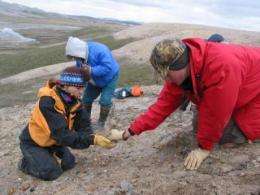
University of Colorado at Boulder Assistant Professor Jaelyn Eberle, left, searches for early mammal fossils in the high Arctic with Brendan Postnikoff of the University of Saskatchewan (blue parka) and Joe Kudlack, right, from Banks Island in the Northwest Territories. Credit: Image courtesy University of Colorado
An analysis of oxygen isotopes from the fossil teeth helped determine seasonal changes in surface drinking water tied to precipitation and temperature, providing additional climate information, said Eberle. The results point to warm, humid summers and mild winters in the high Arctic 53 million years ago, where temperatures probably ranged from just above freezing to near 70 degrees Fahrenheit, Eberle said.The environment on central Ellesmere Island, located at about 80 degrees north latitude, was part of a much larger circumpolar Arctic region at the time, she said. It probably was similar to swampy cypress forests in the southeast United States today and still contains fossil tree stumps as large as washing machines, Eberle said.
On central Ellesmere Island in today's high Arctic -- a polar desert that features tundra, permafrost, ice sheets, sparse vegetation and a few small mammals -- the temperature ranges from roughly minus 37 degrees F in winter to 48 degrees F in summer and is the coldest, driest environment on Earth. There is sunlight in the high Arctic between October and February, and the midnight sun is present from mid-April through the end of August.
The year-round presence of mammals such as the hippo-like Coryphodon, tapirs and brontotheres in the high Arctic was a "behavioral prerequisite" for their eventual dispersal across high-latitude land bridges that geologists believe linked Asia and Europe with North America, Eberle said. Their dietary chemical signatures, portly shapes and fossil evidence for babies and juveniles in the Arctic preclude the idea of long, seasonal migrations to escape the winter darkness, she said.
"In order for mammals to have covered the great distances across land bridges that once connected the continents, they would have required the ability to inhabit the High Arctic year-round in proximity to these land bridges," Eberle said.
Instead, the animals likely made their way south from the Arctic in minute increments over millions of years as the climate shifted. "This study may provide the behavioral smoking gun for how modern groups of mammals like ungulates -- ancestors of today's horses and cattle -- and true primates arrived in North America," said Eberle, also an assistant professor in CU-Boulder's geological sciences department.
The surprising menagerie of Arctic creatures during the early Eocene epoch, which lasted from roughly 50 million to 55 million years ago, first became evident in 1975 when a team led by Mary Dawson of the Carnegie Museum of Natural History in Pittsburg discovered fossil alligator jaw bones. Since then, fossils of aquatic turtles, giant tortoises, snakes and even flying lemurs -- one of the earliest forms of primates -- have been found on Ellesmere Island, said Eberle.
The new Geology study also foreshadows the impacts of continuing global warming on Arctic plants and animals, Eberle said. Temperatures in the Arctic are rising twice as fast as those at mid-latitudes as greenhouse gases build up in Earth's atmosphere from rising fossil-fuel burning, and air temperatures over Greenland have risen by more than 7 degrees F since 1991, according to climate scientists.
"We are hypothesizing that lower-latitude mammals will migrate north as the temperatures warm in the coming centuries and millennia," she said. If temperatures ever warm enough in the future to rival the Eocene, there is the possibility of new intercontinental migrations by mammals."
Because the oldest known tapir fossils are from the Arctic, there is the possibility that some prehistoric mammals could have evolved in the circumpolar Arctic and then dispersed through Asia, Europe and North America, said Eberle. "We may have to re-think the world of the early Eocene, when all of the Arctic land masses were connected in a supercontinent of sorts," she said.
Source: University of Colorado at Boulder (news : web)


Dang ol' global warming . . .
"There is sunlight in the high Arctic between October and February,"
proof reading anyone?
There's something I'm not getting here. If the world's temperatures were much higher 53 million years ago then the sea levels would have would also have been much higher. Therefore no land bridge (or ice bridge) across the Bering Strait/North Atlantic? Therefore no large land animal migration?
A lot can happen in 10 years, let alone several million years. There were over 140 periods of substantial glaciation from that point until the mammalian migration.
You can't have a "year-round behavioural prescence prerequisite for migration" in the Arctic, and low sea levels at the same time.
No you can't, but at no point in the article is it stated that the prerequisite was enforced during that period of high temp and high sea level. Evolutionary pre-reqs take hold over thousands or millions of years. A year round behavioral presence prereq can lead to migratory behavior as terrain changes.
Secondly, the prior poster appears to be referring to the Asiatic land bridge that is theorized as being in existence thousands of years ago as being contemporary with the articles time period of 53 million years ago.
Only if the North American plate was located further south in the Eocene would these animals have been able to cross over. But if that was indeed the case then the warm period detailed in the article would have been unnecessary for the migration.
The article gives me the impression that they're arguing that the animals were living all the year round in the Arctic in the especially warm period, and then as the temperatures lowered migrated slowly down into North America, which I'm saying couldn't happen. In the warm period the Sea blocks their path, in the cold periods the Ice.
53 million years ago the mammals lived in the artic circle. The differences in geography from 53 mya to now are not very striking, however, if you'll notice, a lot of land is above the arctic circle both then and now. Over time the temperature starts to shift, the anmials start migrating southward in the winter and north in the summer.
Years/decades/centuries/millenia pass and now there is a large amount of ice building up at the poles taking up water from the oceans enough to expose a land bridge. The native creatures still migrate north and south, however, one group migrates north over a land bridge, maybe their navigator is a bit off in the head, or something happens, like an advancing glacier, or a river re-routes. When they return south, they're in a new land.
I hope that clarifies it. The above is one of many possible examples.
Only if the continents of Europe and North America were joined together (as they suggest in the last paragraph of the article) could the animals make the crossover from the East. But this completely contradicts the model of tectonic plates that the geologists have compiled. See this animation (16.7MB)
http://www.ucmp.b...l1_4.avi
53 million years ago according to this animation Europe and America were hundreds of miles apart. Enough said.
When it gets very warm the animals in Siberia, say, can live in the arctic all year round. Because it's very warm there is water in the Bering Strait. The animals stay in northern Siberia. Then gradually it gets colder, the animals move out of the Arctic because they cannot feed off ice. They are still in Siberia. Eventually it gets so cold that sea levels fall so low that there is a land bridge over the Bering Strait. Before the sea levels got to be so low, the Arctic ice cap has grown to cover the Strait with thousands of feet of ice. The animals are now in southern Siberia. No inter-continental migration.
Warm period - blocked by sea
Cold period - blocked by ice
Bering Strait impassable *at any time* for these kinds of animals.
She's dreaming.
So as soon as the sea level is low enough for the land bridge to be present ice HAS to cover the land bridge entirely?
You'd have to explain that to the paleoindians.
Opps. I meant to say that precession has been glacial for 6000 years and still has several thousand years to go.
http://en.wikiped...h_cycles
The last time all Milankovitch cycles were in non glacial stage was aprox 125,000 years ago. That is NOT the case now.
Yes, however, Milankovich cycles aren't reliable due to the problems with correlation due to a lack of reliable data, as well as the various problems in calculation. They're an acceptable rough guide, but actual trending will rely on a connection between milankovich cycles and additional possible forcings.
So what difference does it make if it is off by 1000 years or so? Precession is still currently in it's glacial stage. It's still impossible for our orbit to be the cause of current climate change. If you are trying to make that claim anyway then you are making the claim that we are getting more heat from the sun. That excess shortwave radiation would be VERY easily detected. Co2 is the only thing left.
Ptolemy had the orbits of most planets off by only a few arc lengths, does that mean we should still be saying that the Earth is the center of the solar system?
Actually it appears we were getting more heat from the Sun during the periods with the most pronounced warming. The sun is fairly erratic.
It was easily detected, it allowed us to revise the idea that there was a solar constant into a solar average.
As for CO2 being the only thing left, sure it is.* You're absolutely correct.
*As long as you ignore plate tectonics, cosmic radiation, water vapor, diffusion, refraction, aerosols, methane, water upwelling, thermodynamic wind shifts, glacial advances, biomaterial decay, solar irradiance, intrasolar dust, solar invariance, the Urban Heat island effect, atmospheric seeding, high altitude ice crystal formation, nitrogen trifluoride, pending magnetic reversal, orbital variation, orbital decay, lunar orbital variation, lunar orbital decay, land use changes, deforestation, electromagnetic core flux, and a whole host of other unstudied phenomina.
Not when it lasts over 20,000 years and we are only 6000 years into it.
That dosn't make any sense. That was 1900 years ago. Science advanced just a bit since then.
impossible
It most certainly was not. (not at the levels hot enough to cause the current climate change)
http://lwf.ncdc.n...html#q10
As long as you believe junk science funded by greedy oil companies
http://www.exxposeexxon.com/
One theme propaganda site. The IPCC and pro-AGM supporters are financed by $billions of tax payers money. A few millions to research science to find what is causing climate change as opposed to billions to try to show that Man is the cause.
Ok then, we're done here. Thanks for playing, but if you're going to completely ignore established science then one will never be able to debate the topic with you. Best part is you're trying to use Milankovich cycles to establish that global warming is real when according to the cycles we're mathematically at an interglacial warm period.
You were done when you lied about incoming solar heat.
The fact that oil companies have been funding junk science is pretty old news
http://www.exxposeexxon.com/&q=oil companies funding junk science&btnG=Google Search&aq=f&oq=&aqi=/
Just like the tobacco industries once did.
'Aliens' picked these critters up and simply dropped them off in a new location when they were done with them. This was all a part of their research. The 'aliens' wanted to see how the animals would adapt in a different environment.
The sun isn't static, sorry to break your theoretical framework with those horrible things we call facts.
I never said it was static. You just now brought it up to try to hide your lie that excess heat from the sun is the cause of the current climate change.
So Means that excess thermal heat was transmitted by the sun causing the prior warming?
Maybe you're referring to my statements of solar irradiance against previous warm periods in Earth's history.
To which you replied
Stating that the sun is not erratic, meaning the sun has to be stable.
So who's the liar now?
You're employing a well known propagandist trick where you try to twist my statements into incredulous and ridiculous interpretations that I never intended to attempt to discredit my view. That ship doesn't sail on these seas, my friend.
That wasn't my statement. Here's my statement again:
Read it and understand it. I'm not playing the sophistry game with you.
Back it up or shut it up!
You can't prove your theory so instead you demand I prove mine. Priceless. Well, here you go:
http://books.goog...nWjEUjQC&pg=PA8&lpg=PA8&dq=solar irradiance during interglacial&source=bl&ots=zd0_bl8NRy&sig=eZfqZzboRdSKdSQEBckSzxvupC4&hl=en&ei=QqIzSqHdLc-ntgfgh5H5Dg&sa=X&oi=book_result&ct=result&resnum=2
http://www.scienc...ticleURL&_udi=B6WPN-45N44H3-5&_user=10&_rdoc=1&_fmt=&_orig=search&_sort=d&view=c&_acct=C000050221&_version=1&_urlVersion=0&_userid=10&md5=a39e7203138800f2cbf41a185a0ab9f1
http://www.cosis....1910.pdf
http://stratus.as...e16.html
http://data.giss....Fig4.gif
But how can it be down if it's static as you say?
FYI: a small change in solar irradiance is a hugh change in incomming solar energy for the Earth. Size matters.
An incredibly small change in the sun is a huge change in the solar average on Earth. This is the problem if you only read the AGW proponent articles, you lose a huge insight in size and scope of changes as the terminology isn't explained properly. Small changes on the sun are giant changes on earth. Large changes in trace CO2 content are incredibly small compared to our massive atmosphere.
http://www.ncdc.n...ial.html
So when the sun changes only specific regions are changed? That would imply that the Earth receives its energy from somewhere other than the sun. Can you explain this to me in further detail?
As it stands I'm not understanding how the Greenhouse Effect, which relies on solar irradiance, would show no effect, or a decoupled effect, from solar irradiance changes.
FYI: your reference is based on figures from 1984.
http://www.epa.go...use.html
Did you read it? You didn't answer my question.
I'm waiting.
http://www.indepe...966.html
Can you live on the moon?
Well these bacteria can't live in the ocean. Your method of deduction is horribly inaccurate. So you're still not answering the question.
How would a change in the relationship between the sun and earth provide only localized warming, and not global warming?
http://www.ncdc.n...ial.html
So I ask you, were is NOAA in error?
"Page not found", so at least their IIS installation is.
Your written answer is nonsensical. Write out your answer, not NOAA's.
If you look closely at the map, none of the proxy measurements agree. Two striking examples can be seen off the western coast of Africa. One example being further south showing a huge disparity between the Fourier and Coccolith measurements. The former indicating lower temperatures in excess of a degree while the latter shows higher temperatures jsut shy of 4 degrees.
A variation of measurement of more than 5 degrees, making your touted image too obtuse to derive any real information.
So to answer your question, no, NOAA is not in error, nor are they agreeing with your hypothesis. So the question comes back again, and will continue to come back until you can answer it yourself:
How would a change in the relationship between the sun and earth provide only localized warming, and not global warming?
When Northern Hemisphere summers are coolest (farthest from the Sun due to precession and greatest orbital eccentricity) and winters are warmest (minimum tilt), snow can accumulate on and cover broad areas of northern America and Europe.
http://www.homepa...nkov.htm
But the climate remains magically stable on the southern hemisphere?
What happens there when the north warms? One would assume the opposite happens in an opposite situation. What would create a disparity? So far you've simply reinforced my argument and made yours weaker.
Orbital eccentricity and precessional events would cause GLOBAL climate change, not just change in the northern hemisphere. If the precessional you explain above occurs, the southern hemisphere would either undergo the same cooling, or opposite heating depending on the perihelial axis placement.
If you don't have any background in physics this conversation is going to get very hairy for you. So answer the question. Don't jsut state a half-fact. Explain the entirety of the system, if you can.
So are you saying that it takes thousands of years for heat in the northern hemisphere to reach the southern hemisphere? Or are you saying that the orbits of the southern and northern hemisphere are not joined? What mechanic delays the Sun/Earth energy dynamic inhomogenously over the two hemispheres?
So you're saying there is no thermal transport between the northern and southern hemispheres of the planet?
So you're saying "There is no mechanic supporting thermal transport between the northern and southern hemispheres"?
I want you to be explicit and answer the question as posed to you.
Not enough to cause something like significant polar ice melt in one hemisphere when it is occuring in the other. (when calculating the orbital effects) You just don't understand how the greenhouse effect works. A lot of the heat will escape into space during an interglacial peak if there is no pronounced amounts of greenhouse gasses to trap the heat and therefore will have little effect on the opposite hemisphere.
You keep repeating that I don't understand the greenhouse effect, and I think the converse is true. No one here is denying the greenhouse effect. Why don't you explain how large a role CO2 plays in the greenhuse effect? Last I checked it was less than 1% of the atmosphere and has a small absorption profile than water vapor, which is responsible for up to 98% of the greenhouse effect.
http://www.geocra...ata.html
Do some reading so you can see the percentages involved here.
Ok DT, you win by attrition. I just can't stand to talk to you about this anymore. If you want to refuse the evidence, that's fine. Enjoy your bliss.
Dumb enough to believe that the petatons of water vapor released by man has a smaller effect than the gigtons of CO2.
No! Only you seem to follow the theory of "Oh! It's so small so it can't be tangable." That kind of ideology has no place in the scientific community.
Keep touting the greenhouse theory when you don't understand it. That's a sure way to win.
http://www.nytime...ate.html
The GE that we all know and love is estimated to be up to 66% due to water vapor, not CO2.
Influenza kills about 500,000 a year.
Winter cold kills about 890,000 a year.
Tobacco use kills about 5,400,000 a year.
Motor Vehicle Accidents kill about 2,400,000 a year
Malaria kills about 1,000,000 a year
HIV/AIDS kills about 7,000,000 a year
Poverty kills about 18,000,000 a year
I'd say all of the above are far better causes to focus on, as opposed to a figure of 300,000 which is less than a single yearly flooding of the Yangtzee can be responsible for, and is mainly comprised of the elderly and asthmatics who would have died that following winter anyway.
I'm guessing 300,000 Europeans and Americans without AC are more important than the millions who die of malaria in Africa. Maaybe you're a just a racist.
So the 300,000 should not be an issue because AIDS kills more? So is 300K just below the minimum then? Is that how we should deal with things like H1N1 and any future disease? Ignore it till it kills at least half a mill? Who was your science professor? A cartoon character?
If you want to fight the moral argument with me and try to upset me by telling me that global warming kills 300,000 a year, which it doesn't, then be prepared to face figures of millions dying from other more pressing issues that are PROVEN to exist and CAN be solved right now.
You need to go back to school and learn the difference between Co2 and water.
Listing the amount of people who died during a warm period does not mean that the warm period was responsible.
Conversely, millions die each year from winter cold. Should we fight against winter?
The difference is quite clear. Water is responsible for a far greater amount of the greenhouse effect. The more water in the atmosphere, the stronger the effect (or at least that's what you would have me believe is the effect of CO2).
You forgot to mention Alpha Draconis, which was the last star at which the north pole pointed before it pointed to Polaris.
You are kidding, right??? I do not know of any ice cores going back that far. In addition, just 120,000 years ago sea level was at least 6 meters higher than at present. Just how do you think that happened, especially considering that CO2 levels were lower at that time than at present?