New Solar Cycle Prediction
June 1, 2009 by Dr. Tony Phillips
New Solar Cycle Prediction

Enlarge

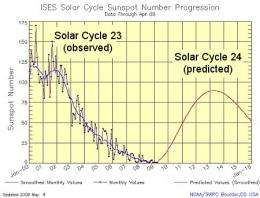
This plot of sunspot numbers shows the measured peak of the last solar cycle in blue and the predicted peak of the next solar cycle in red. Credit: NOAA/Space Weather Prediction Center.

(PhysOrg.com) -- An international panel of experts led by NOAA and sponsored by NASA has released a new prediction for the next solar cycle. Solar Cycle 24 will peak, they say, in May 2013 with a below-average number of sunspots.

"If our prediction is correct, Solar Cycle 24 will have a peak sunspot number of 90, the lowest of any cycle since 1928 when Solar Cycle 16 peaked at 78," says panel chairman Doug Biesecker of the NOAA Space Weather Prediction Center.

It is tempting to describe such a cycle as "weak" or "mild," but that could give the wrong impression.

"Even a below-average cycle is capable of producing severe space weather," points out Biesecker. "The great geomagnetic storm of 1859, for instance, occurred during a solar cycle of about the same size we’re predicting for 2013."

The 1859 storm--known as the "Carrington Event" after astronomer Richard Carrington who witnessed the instigating solar flare--electrified transmission cables, set fires in telegraph offices, and produced Northern Lights so bright that people could read newspapers by their red and green glow. A recent report by the National Academy of Sciences found that if a similar storm occurred today, it could cause $1 to 2 trillion in damages to society's high-tech infrastructure and require four to ten years for complete recovery. For comparison, Hurricane Katrina caused "only" $80 to 125 billion in damage.

The latest forecast revises an earlier prediction issued in 2007. At that time, a sharply divided panel believed solar minimum would come in March 2008 followed by either a strong solar maximum in 2011 or a weak solar maximum in 2012. Competing models gave different answers, and researchers were eager for the sun to reveal which was correct.

"It turns out that none of our models were totally correct," says Dean Pesnell of the Goddard Space Flight Center, NASA's lead representative on the panel. "The sun is behaving in an unexpected and very interesting way."

Researchers have known about the solar cycle since the mid-1800s. Graphs of sunspot numbers resemble a roller coaster, going up and down with an approximately 11-year period. At first glance, it looks like a regular pattern, but predicting the peaks and valleys has proven troublesome. Cycles vary in length from about 9 to 14 years. Some peaks are high, others low. The valleys are usually brief, lasting only a couple of years, but sometimes they stretch out much longer. In the 17th century the sun plunged into a 70-year period of spotlessness known as the Maunder Minimum that still baffles scientists.

Right now, the solar cycle is in a valley--the deepest of the past century. In 2008 and 2009, the sun set Space Age records for low counts, weak solar wind, and low solar irradiance. The sun has gone more than two years without a significant .

"In our professional careers, we've never seen anything quite like it," says Pesnell. "Solar minimum has lasted far beyond the date we predicted in 2007."

In recent months, however, the sun has begun to show timorous signs of life. Small sunspots and "proto-sunspots" are popping up with increasing frequency. Enormous currents of plasma on the sun’s surface ("zonal flows") are gaining strength and slowly drifting toward the sun’s equator. Radio astronomers have detected a tiny but significant uptick in solar radio emissions. All these things are precursors of an awakening 24 and form the basis for the panel's new, almost unanimous forecast.

According to the forecast, the sun should remain generally calm for at least another year. From a research point of view, that's good news because has proven to be more interesting than anyone imagined. Low solar activity has a profound effect on Earth’s atmosphere, allowing it to cool and contract. Space junk accumulates in Earth orbit because there is less aerodynamic drag. The becalmed solar wind whips up fewer magnetic storms around Earth's poles. Cosmic rays that are normally pushed back by solar wind instead intrude on the near-Earth environment. There are other side-effects, too, that can be studied only so long as the sun remains quiet.

Meanwhile, the sun pays little heed to human committees. There could be more surprises, panelists acknowledge, and more revisions to the forecast.

"Go ahead and mark your calendar for May 2013," says Pesnell. "But use a pencil."

Source: by Dr. Tony Phillips, Science@NASA

Filter


Move the slider to adjust rank threshold, so that you can hide some of the comments.


Display comments: newest first

deatopmg
Jun 01, 2009

Rank: 2.3 / 5 (3)
http://landscheid...m-graph/ et al seem to do an excellent job of fitting a model to solar activity in the past and will likely do a good job predicting what will happen in the future...better than any of the other theories or models.
Have any of these scientists taken a look at the successful prediction of solar activity based on the total angular momentum of the solar system? My guess would be no.


lomed
Jun 01, 2009

Rank: 3.8 / 5 (4)
Have any of these scientists taken a look at the successful prediction of solar activity based on the total angular momentum of the solar system? My guess would be no.


Except in rare circumstances, the solar system can be considered a closed system (with regard to angular momentum and celestial mechanics in general.) In any reasonable physical theory, at least on large scales, total momentum is conserved. Therefore, the total angular momentum of the solar system should be constant (to a high degree of precision.)

The main way I know of transferring angular momentum from a planet to the Sun is via tidal forces. The tidal force on an object is due to the non-uniformity of the gravitational field acting on that object (i.e. gravitational force goes like 1/r^2 so there will be a difference in force due to a difference in distance from another mass.) The tidal force on an object goes like 1/r^3 (since the distance difference is small with respect to the distance, the derivative of 1/r^2 (= -1/r^3) is a good approximation to the difference in force.) Since the gravitational force between two objects is the same for each object (the resulting accelerations may differ due the masses having unequal mass values), the tidal force will also be the same for each object (e.g. the tidal force of the Moon on the Earth is the same at that of the Earth on the Moon.) Therefore, since the tidal effects of the Sun on the Earth are small (about half that of the Moon), the Earth cannot have much effect on the Sun. Jupiter is 5 times farther away from the Sun than Earth so its effect per unit mass will be 1/125 that of Earth. The diameter of Jupiter is about 10 times that of Earth, so even if it had the same average density as the Earth (which it doesn't, its density is significantly less) it would only have 1000 times its mass and thus produce 8 times as much tidal force on the Sun. The other planets beyond Jupiter are less massive than it and considerably farther away. Consideration of the inner planets shows that (assuming it is this massive) Jupiter would have the greatest tidal effects of any of the planets. Thus, a very rough (factor of ten, but probably a rather high estimate) estimation shows all the planets in alignment would produce no more than about 16 times the tidal force of the Sun on the Earth (i.e. less than 8 times the tidal force of the Moon on the Earth.) Since the tidal force of the Moon on the Earth changes the Earths angular momentum by a small amount (and that mostly due to the viscosity of Earth's crust and the presence of continents impeding the ocean's tides), even 8 times the effect would result in only a tiny fraction of the Earth's angular momentum changing each year/century. Since the Sun rotates more than once in 50 Earth days and is over 1,000,000 times as massive (as Earth) its angular momentum is over 20,000 times as much as the Earth's and any effects due to the tidal influence of the planets will be vanishingly small.
steelfire2
Jun 01, 2009

Rank: 4 / 5 (4)
So sunspots cycles effect solar wind, why not our atmosphere's temperature too?

Maybe we should mark May of 2013 when the while "Global Warming" phenomenon disappear.
Noumenon
Jun 02, 2009

Rank: 4.7 / 5 (29)
LoL, yes don't mention that rather large nuclear ball of fire, you'll upset the delicate balance that is AlGores consensus on AGW.
deatopmg
Jun 02, 2009

Rank: 3 / 5 (2)
@iomed Thanks. Though the planets effect on the sun's movement (thru conservation of AM) appears small from your calculations, from the copious data it also appears sufficient to be a significant contributor to the solar cycle. Evidence always trumps theory (or back of the envelope calculations which I am known for.)
I suggest you read what others have done at the Landscheidt site and others.
Shootist
Jun 02, 2009

Rank: 5 / 5 (1)
http://science.na...adlines/
y2009/29may_noaaprediction.htm

"If our prediction is correct, Solar Cycle 24 will have a peak sunspot number of 90, the lowest of any cycle since 1928 when Solar Cycle 16 peaked at 78," says panel chairman Doug Biesecker of the NOAA Space Weather Prediction Center."Even a below-average cycle is capable of producing severe space weather," points out Biesecker. "The great geomagnetic storm of 1859, for instance, occurred during a solar cycle of about the same size we%u2019re predicting for 2013."In recent months, however, the sun has begun to show timorous signs of life. Small sunspots and "proto-sunspots" are popping up with increasing frequency. Enormous currents of plasma on the sun%u2019s surface ("zonal flows") are gaining strength and slowly drifting toward the sun%u2019s equator. Radio astronomers have detected a tiny but significant uptick in solar radio emissions.

All these things are precursors of an awakening Solar Cycle 24 and form the basis for the panel's new, almost unanimous forecast.

June 1 Frost in upstate New York

http://www.uticao...rchive/x
1175994993/May-to-go-out-under-a-freeze-watch

Local gardeners may want to take special measures to protect their plants this evening as a frost advisory has been issued for much of New York state, including Oneida County.

The advisory issued by the National Weather Service remains in effect until 8 a.m. Monday.

Temperatures are expected to fall into the mid-to-low 30s overnight, and a hard frost is likely as temperatures in colder areas approach freezing.
jonnyboy
Jun 02, 2009

Rank: 3 / 5 (6)
I am absolutely certain that mankind is causing the abnormally low level of sunspots by emitting such a high concentration of CO2 into the atmosphere.

Does anyone know where I can apply for a government grant to further my research?
omatumr
Jun 02, 2009

Rank: 2.3 / 5 (6)
Does anyone know where I can apply for a government grant to further my research?


With a keen analytical mind like that, you might as well apply directly to NAS, the National Academy of Sciences. NAS reviews the budgets and projects of federal research agencies for the US Congress anyway.

With kind regards,
Oliver K. Manuel
http://myprofile....anuelo09
omatumr
Jun 02, 2009

Rank: 1.8 / 5 (5)
"http://landscheid...m-graph/ et al seem to do an excellent job of fitting a model to solar activity in the past and will likely do a good job predicting what will happen in the future...better than any of the other theories or models.

Have any of these scientists taken a look at the successful prediction of solar activity based on the total angular momentum of the solar system? "

Yes, we have. The link between changes in Earth's climate, solar inertial motion, and solar surface magnetic activity is caused by shifts in the position of the Sun's dense, energetic neutron core as the Sun is jerked, like a yo-yo on a string, about the center of mass of the solar system. See: http://arxiv.org/pdf/0905.0704

With kind regards,
Oliver K. Manuel
http://www.omatumr.com
omatumr
Jun 03, 2009

Rank: 3.4 / 5 (5)
CONGRATULATIONS TO NOAA & NASA!

I was pleased to notice a new tone of humility and honesty in this news report from NOAA and NASA:

1. "If our prediction is correct, Solar Cycle 24 will have a peak sunspot number of 90, the lowest of any cycle since 1928 when Solar Cycle 16 peaked at 78."

2. "The latest forecast revises an earlier prediction issued in 2007."

3. "It turns out that none of our models were totally correct."

4. "The sun is behaving in an unexpected and very interesting way."

5. "In our professional careers, we've never seen anything quite like it."

CONGRATULATIONS! Old dogs can learn new tricks. They may even earn back the trust of the public.

I hope that the consensus scientists that work for the UN's IPCC will learn from your new approach that they should not ignore the Sun in making predictions of global climate.

With kind regards,
Oliver K. Manuel
http://www.omatumr.com

GrayMouser
Jun 03, 2009

Rank: 5 / 5 (3)
The sun is behaving in an unexpected and very interesting way.

Excuse me. Since we don't truly understand the dynamics involved, the Sun ALWAYS acts in unexpected and interesting ways.
deatopmg
Jun 04, 2009

Rank: 3.7 / 5 (3)
@omatumr is the solar core neutrons or iron? Me thinks Fe, though much of the energy and lack of neutrinos comes from neutron decay.
I notice that the consensus scientists (sic) also vote and flag at this web site.
Velanarris
Jun 04, 2009

Rank: 5 / 5 (1)
@omatumr is the solar core neutrons or iron? Me thinks Fe, though much of the energy and lack of neutrinos comes from neutron decay.

I notice that the consensus scientists (sic) also vote and flag at this web site.


At that pressure and density it'd be very tough to call it Iron.
lomed
Jun 04, 2009

Rank: 3 / 5 (2)
@iomed Thanks. Though the planets effect on the sun's movement (thru conservation of AM) appears small from your calculations, from the copious data it also appears sufficient to be a significant contributor to the solar cycle. Evidence always trumps theory (or back of the envelope calculations which I am known for.)

I suggest you read what others have done at the Landscheidt site and others.

Landscheidt (at least in the paper posted on the website, which says it was published in 1981) suggests that the plasma that the Sun is made of is caused to circulate by (or at least the circulation is modulated by) the "heteromorphous oscillations" of the center of mass (CM) of the solar system caused by the motions of the planets. However, he asserts that the restoring forces are greatest when the CM is closest to the center of the Sun, when the force (obviously due to gravity) may be less in that case (in fact it has little to do with the CM since the force due to each planet goes as 1/r^2 while the CM is computed by a weighted average that goes like r.) Furthermore, there are no equations describing the forces involved, the entire paper seems to be mostly pictures and assertions. I would not deny that the planets have some effect on the Sun; however, any such effect is probably insignificant in the face of the electric and magnetic fields, as well as the shear massiveness, of the Sun.
daqman
Jun 07, 2009

Rank: 2.3 / 5 (3)
steelfire2.... repeat after me, no matter the evidence.... the sun and its cycle do not influence global warming... if it did, Al Gore would be out of a job, liberals need man made global warming, its their religion..... http://www.democr...joke.com
You sir are a fool.
omatumr
Jun 07, 2009

Rank: 1 / 5 (2)
SOLAR NEUTRON CORE IS EMPIRICAL, NOT FOOLISH

@omatumr is the solar core neutrons or iron? Me thinks Fe, though much of the energy and lack of neutrinos comes from neutron decay.

I notice that the consensus scientists (sic) also vote and flag at this web site.


The Sun reformed on the neutron star (pulsar) that remained after ejecting the material that now orbits the Sun. See: "Strange Xenon, Extinct Superheavy Elements, and the Solar Neutrino Puzzle," Science 14 January 1977: 208-209
http://tinyurl.com/otckep or
http://www.scienc...74/208-b

You sir are a fool.


Well-established, well-funded scientists at the University of Chicago implied that I too was a fool when Science published our interpretation of the close association of primordial He with excess Xe-136 in the early solar system.

Thirty years later the Galileo Probe observed excess Xe-136 in Jupiter's He-rich atmosphere. See: "Isotopic ratios in Jupiter confirm intra-solar diffusion",
Meteoritics and Planetary Science 33, A97, abstract 5011 (1998). http://tinyurl.com/q3bndo or
http://www.lpi.us...5011.pdf

With kind regards,
Oliver K. Manuel
http://myprofile....anuelo09


Rank 4 /5 (20 votes)
Related Stories
Relevant PhysicsForums posts
  • Scale of the Universe
    created7 hours ago
  • Titan's lack of impact craters
    createdFeb 09, 2012
  • Real pictures of black hole eating a star?
    createdFeb 08, 2012
  • Hypothetical way to travel faster than light, but not technically exceed lightspeed
    createdFeb 06, 2012
  • How do scientists monitor the Sun's activity?
    createdFeb 05, 2012
  • Search patterns in observational studies
    createdFeb 05, 2012
  • More from Physics Forums - General Astronomy

More news stories

Humans may have helped the decline of African rainforests 3000 years ago

(PhysOrg.com) -- Large areas of rainforests in Central Africa mysteriously disappeared over three thousand years ago, to be replaced by savannas. The prevailing theory has been that the cause was a change ...

Space & Earth / Environment

created 18 hours ago | popularity 4.3 / 5 (11) | comments 12 | with audio podcast report

Could Venus be shifting gear?

(PhysOrg.com) -- ESA’s Venus Express spacecraft has discovered that our cloud-covered neighbour spins a little slower than previously measured. Peering through the dense atmosphere in the infrared, the ...

Space & Earth / Space Exploration

created 14 hours ago | popularity 5 / 5 (7) | comments 7 | with audio podcast

NASA budget will axe Mars deal with Europe: scientists

US President Barack Obama's budget proposal to be submitted next week for 2013 will cut NASA's budget by 20 percent and eliminate a major partnership with Europe on Mars exploration, scientists said Thursday.

Space & Earth / Space Exploration

created 17 hours ago | popularity 5 / 5 (2) | comments 18

Mars Science Laboratory computer issue resolved

(PhysOrg.com) -- Engineers have found the root cause of a computer reset that occurred two months ago on NASA's Mars Science Laboratory and have determined how to correct it.

Space & Earth / Space Exploration

created 15 hours ago | popularity 4.7 / 5 (6) | comments 3 | with audio podcast

NASA sees wide-eyed cyclone Jasmine

Cyclone Jasmine's eye has opened wider on NASA satellite imagery, as it moves through the Southern Pacific Ocean.

Space & Earth / Earth Sciences

created 6 hours ago | popularity 3.5 / 5 (2) | comments 1


Google users warned of threat to smartphone wallets

Users of Google smartphone wallets were being warned on Friday that there is a way to crack pass codes intended to thwart thieves from going on illicit shopping sprees.

Anonymous knocks CIA website offline (Update)

The website of the Central Intelligence Agency was inaccessible on Friday after the hacker group Anonymous claimed to have knocked it offline.

New error-correcting codes guarantee the fastest possible rate of data transmission

Error-correcting codes are one of the triumphs of the digital age. They’re a way of encoding information so that it can be transmitted across a communication channel — such as an optical fiber o ...

Complex wiring of the nervous system may rely on a just a handful of genes and proteins

Researchers at the Salk Institute have discovered a startling feature of early brain development that helps to explain how complex neuron wiring patterns are programmed using just a handful of critical genes. ...

New power source discovered

(PhysOrg.com) -- Researchers at the Massachusetts Institute of Technology (MIT) and RMIT University have made a breakthrough in energy storage and power generation.

The power of estrogen -- male snakes attract other males

A new study has shown that boosting the estrogen levels of male garter snakes causes them to secrete the same pheromones that females use to attract suitors, and turned the males into just about the sexiest ...