Making realistic sounds for computer animation (w/Video)
June 1, 2009 By Bill Steele Making realistic sounds for computer animation

Enlarge

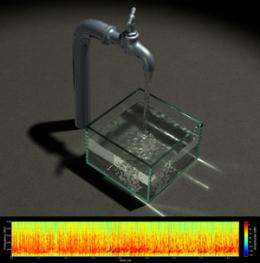
The sounds produced by pouring and splashing water actually result from the vibration of trapped air bubbles. Cornell researchers can simulate those sounds by computing how the bubbles would behave. Image: Doug James

(PhysOrg.com) -- Splash, splatter, babble, sploosh, drip, drop, bloop and ploop!

Those are some of the sounds that have been missing from computer graphic simulations of and other fluids, according to researchers in Cornell's Department of Computer Science, who have come up with new algorithms to simulate such sounds to go with the images.

The work by Doug James, associate professor of , and graduate student Changxi Zheng will be reported at the 2009 ACM SIGGRAPH conference Aug. 3-7 in New Orleans. It is the first step in a broader research program on sound synthesis supported by a $1.2 million grant from the Human Centered Computing Program of the National Science Foundation (NSF) to James, assistant professor Kavita Bala and associate professor Steve Marschner.

FLV player

Film for SIGGRAPH 2009 Computer Animation Festival. Fluid sounds, such as splashing and pouring, are ubiquitous and familiar but we lack physically based algorithms to synthesize them in computer animation or interactive virtual environments.

In computer-animated movies, sound can be added after the fact from recordings or by Foley artists. But as virtual worlds grow increasingly interactive and immersive, the researchers point out, sounds will need to be generated automatically to fit events that can't be predicted in advance. Recordings can be cued in, but can be repetitive and not always well matched to what's happening.

"We have no way to efficiently compute the sounds of water splashing, paper crumpling, hands clapping, wind in trees or a wine glass dropped onto the floor," the researchers said in their research proposal.

Along with fluid sounds, the research also will simulate sounds made by objects in contact, like a bin of Legos; the noisy vibrations of thin shells, like trash cans or cymbals; and the sounds of brittle fracture, like breaking glass and the clattering of the resulting debris.

All the simulations will be based on the physics of the objects being simulated in computer graphics, calculating how those objects would vibrate if they actually existed, and how those vibrations would produce acoustic waves in the air. Physics-based simulations also can be used in design, just as visual simulation is now, James said. "You can tell what it's going to sound like before you build it," he explained, noting that a lot of effort often goes into making things quieter.

In their SIGGRAPH paper, Zheng and James report that most of the sounds of water are created by tiny air bubbles that form as water pours and splashes. Moving water traps air bubbles on the scale of a millimeter or so. Surface tension contracts the bubbles, compressing the air inside until it pushes back and expands the bubble. The repeated expansion and contraction over milliseconds generates vibrations in the water that eventually make its surface vibrate, acting like a loudspeaker to create sound waves in the air.

The simulation method developed by the Cornell researchers starts with the geometry of the scene, figures out where the bubbles would be and how they're moving, computes the expected vibrations and finally the sounds they would produce. The simulation is done on a highly parallel computer, with each processor computing the effects of multiple bubbles. The researchers have fine-tuned the results by comparing their simulations with real water sounds.

The current methods still require hours of offline computing time, and work best on compact sound sources, the researchers noted, but they said further development should make possible the real-time performance needed for interactive virtual environments and deal with larger sources such as swimming pools or perhaps even Niagara Falls. They also plan to approach the more complex collections of bubbles in foam or plumes.

The research reported in the SIGGRAPH paper was supported in part by an NSF Faculty Early Career Award to James, and by the Alfred P. Sloan Foundation, Pixar, Intel and Autodesk.

Provided by Cornell University (news : web)


print this article email this article download pdf blog this article bookmark this article     Stumble it Digg this share on Facebook retweet share on Reddit add to delicious
Rate this story - 4.3 /5 (3 votes)

Rank Filter

Move the slider to adjust rank threshold, so that you can hide some of the comments.


Display comments: newest first

  • jldb - Jun 01, 2009
    • Rank: 5 / 5 (2)
    This is cute. It would be neat to use the model in reverse. i.e. fit the model to recorded sound from real fluid flows to infer properties of the fluid (viscosity etc). I seem to remember some work along these lines applied to diagnosing various issues related to vascular flows.

    If you think about it, the common Systolic and Diastolic measurements associated with blood pressure are a first order solution of this inverse problem. In principle there is a great deal more information about the vascular system hidden in the details of the pressure waves (sound) generated by blood flow.


June 1, 2009 all stories

Comments: 1

4.3 /5 (3 votes)
  • Stumble this up

  • Digg this

  • share this

  • hide
  • Related Stories

  • Panasonic Develops Advanced Low-Range Sound Reproduction Technology for Compact Speakers
    created Jul 30, 2007 | popularity not rated yet | comments 0
  • Researchers produce 'neural fingerprint' of speech recognition
    created Nov 10, 2008 | popularity not rated yet | comments 0
  • Scientists develop better method for converting sounds to electronic signals
    created Feb 23, 2006 | popularity not rated yet | comments 0
  • Swedish research can make Super Mario more realistic
    created Mar 06, 2009 | popularity not rated yet | comments 0
  • Modeling the Sound of Music
    created Oct 03, 2005 | popularity not rated yet | comments 0


  • hide
  • Relevant PhysicsForums posts

  • Read multiple binary files to ascii
    created 20 hours ago
  • Engineering Translation software
    created Nov 06, 2009
  • Changing the language options on your phone.
    created Nov 03, 2009
  • HP strange RPN operation???
    created Nov 02, 2009
  • Computational physics problems that involve nontrivial CS concepts?
    created Nov 01, 2009
  • Databases in physics
    created Oct 31, 2009
  • More from Physics Forums - Computing & Technology

Other News

Microsoft websites were the most visited in September

Microsoft websites top spots in September: comScore

Technology / Internet

created 17 hours ago | popularity 2.3 / 5 (3) | comments 0

Industry tracker comScore on Friday released a study showing that Internet users in September spent more time at Microsoft websites that at any other online properties.


Brazil blackouts result of cyber hacking: report

Technology / Internet

created 17 hours ago | popularity 2.5 / 5 (2) | comments 0

Massive power outages in Brazil in 2005 and 2007 that impacted millions were caused by cyber hackers attacking control systems, the US television network CBS said Sunday.


The Beatles perform in 1964 at the Olympia in Paris

Bluebeat to battle EMI over Beatles songs

Technology / Internet

created 16 hours ago | popularity 4 / 5 (1) | comments 0

US online music service Bluebeat said it plans to fight British recording label EMI over rights to stream and sell versions of Beatles songs.


airpod

Car That Runs on Compressed Air Questioned by Critics (w/ Video)

Technology / Energy

created Nov 03, 2009 | popularity 3.8 / 5 (18) | comments 26

(PhysOrg.com) -- As electric cars begin breaking into the short-distance vehicle market, one French company thinks that it has an alternative to the electric vehicle: a car that runs on compressed air. Motor ...


Sahara

Will Europe Be Powered by the Sahara

Technology / Energy

created Nov 04, 2009 | popularity 4.1 / 5 (19) | comments 24

(PhysOrg.com) -- Europe has long been interested in developing alternative energy sources. And, one of the more interesting places that some Europeans are looking for solar power is the Sahara. With the vast ...