'Cold' Mars Could Have Harbored Liquid Water
June 1, 2009 by Ruth Dasso Marlaire Mars

Enlarge

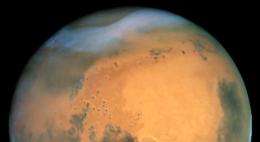
Mars, as seen by the Hubble Space Telescope. Image credit: NASA

(PhysOrg.com) -- A new NASA study provides further evidence that Martian minerals dissolved in water could have kept that water from freezing, even on a cold, early Mars.

NASA scientists modeled freezing conditions on to test whether liquid could have been present to form the surface features of the Martian landscape.

Researchers report that fluids loaded with dissolved minerals containing elements such as silicon, iron, magnesium, and , can remain in a liquid state at temperatures well below freezing. The results of this research appear in the May 21 issue of Nature magazine entitled "Stability Against Freezing of Aqueous Solutions on Early Mars."

"We found that the salts in water solutions can reduce the melting point of water, which may help explain how existed in a frozen Martian environment," said Alberto Fairén, a space scientist at NASA Ames Research Center, Moffett Field, Calif. and the lead author of the study.

To understand what formed the surface features on Mars, scientists have focused on the early Martian conditions. Was early Mars warm and wet, or cold and dry? Surface features throughout most of the Martian landscape suggest the presence of water ponds ranging from seas to lakes, and rivers and gullies formed by flowing water, which imply that early Mars was wet.

But there also is some evidence that suggests that Mars may have been permanently cold, with global temperatures well below the freezing point of pure water. To study the 'liquidity' of water on Mars, climate modelers first simulated various concentrations of greenhouse gases in its atmosphere. They found that these gases cannot efficiently raise the surface temperature above freezing.

A greenhouse atmosphere produced by carbon dioxide and water would have been saturated well below freezing. In addition, the amount of methane needed to raise the surface temperature above freezing, implies the planet had a terrestrial-like biological source for its methane supply, according to previous investigations.

Scientists then took another approach and looked at water solutions containing weathering basalts, similar to those seen at the Mars landing sites. They calculated these fluids' freezing points and evaporative processes. Results showed that a significant amount of weathering fluids containing silicon, iron, , calcium, chloride, sodium, potassium and aluminum remain in the liquid at temperatures well below freezing.

In addition, they studied the minerals that precipitated in the liquid solutions over time. These minerals are similar to those actually found on the Martian surface. Scientists concluded that salty liquid water on Mars may explain the stability of fluids against freezing on the Martian surface at temperatures below 0°C.

"Our goal was to learn how a combination of different processes of evaporation and freezing affect the freezing point of a hypothetical Martian solution. We also wanted to see how the liquid phases formed and destabilized over the evolution of different solutions," added Alfonso Davila, a co-author of the paper at NASA Ames Research Center, Moffett Field, Calif.

Provided by JPL/NASA (news : web)


print this article email this article download pdf blog this article bookmark this article     Stumble it Digg this share on Facebook retweet share on Reddit add to delicious
Rate this story - 4.3 /5 (9 votes)

Rank Filter

Move the slider to adjust rank threshold, so that you can hide some of the comments.


Display comments: newest first

  • retro - Jun 01, 2009
    • Rank: 4 / 5 (1)
    Surface water on early Mars seems to have been highly acidic. That, alone, would have lowered the freezing point. Sulfuric acid solutions can have a VERY low freezing point.
  • Torbjorn_Larsson_OM - Jun 02, 2009
    • Rank: 4 / 5 (1)
    Um, so according to this paper introducing enough methanogens would make Mars comfortably habitable for other prokaryotes than extremophiles, assuming enough organics et cetera? Interesting.

    Unfortunately AFAIU most (or all?) methanogens aren't extremophiles despite being archaean, but perhaps some gene surgery will fix that.
  • deatopmg - Jun 03, 2009
    • Rank: not rated yet
    This work is just more obfuscation from this agency. "Global temperature" means what? They don't differentiate between "air" temperature and ground temperature. The water saturated "air" (w/ a pressure low enough for it to act as an insulator, like in a "thermos" bottle) temperature is reported to be
  • deatopmg - Jun 03, 2009
    • Rank: not rated yet
    so to try to complete this:
    to be
  • deatopmg - Jun 03, 2009
    • Rank: not rated yet
    so to try to complete this again:
    to be
  • deatopmg - Jun 03, 2009
    • Rank: not rated yet
    so to try to complete this for a 3rd time:
    to be
  • deatopmg - Jun 03, 2009
    • Rank: not rated yet
    pointing out glaring inconsistencies, possible agendas, and poor quality work is clearly not acceptable to this gov't agency.

June 1, 2009 all stories

Comments: 7

4.3 /5 (9 votes)
  • Stumble this up

  • Digg this

  • share this

  • hide
  • Related Stories

  • Methane doesn't necessarily mean life on Mars
    created Jun 07, 2005 | popularity not rated yet | comments 0
  • Simulations Show Liquid Water Could Exist on Mars
    created Nov 08, 2005 | popularity not rated yet | comments 0
  • NASA Study Shows Water Could Create Gullies on Mars
    created Aug 26, 2005 | popularity not rated yet | comments 0
  • Model Suggests Origins of Mars Gullies
    created Feb 09, 2009 | popularity not rated yet | comments 0
  • Water May Not Have Formed Mars' Recent Gullies
    created Mar 16, 2006 | popularity not rated yet | comments 0


  • hide
  • Relevant PhysicsForums posts

  • The shape of our solar system's orbits.
    created 15 hours ago
  • Above or Below the Line of Nodes
    created 19 hours ago
  • Supernova vs. Nova?
    created Nov 07, 2009
  • Supernova's Gamma Rays and Comets
    created Nov 06, 2009
  • More from Physics Forums - General Astronomy

Other News

Deep creep means milder, more frequent earthquakes along Southern California's San Jacinto fault

Deep creep means milder, more frequent earthquakes along Southern California's San Jacinto fault

Space & Earth / Earth Sciences

created 1hour ago | popularity 4 / 5 (1) | comments 0

With an average of four mini-earthquakes per day, Southern California's San Jacinto fault constantly adjusts to make it a less likely candidate for a major earthquake than its quiet neighbor to the east, the ...


Success in 'space elevator' competition (AP)

Success in 'space elevator' competition (Update 3)

Space & Earth / Space Exploration

created Nov 05, 2009 | popularity 4.3 / 5 (33) | comments 50

(AP) -- A robot powered by a ground-based laser beam climbed a long cable dangling from a helicopter on Wednesday to qualify for prize money in a $2 million competition to test the potential reality of the ...


'Dropouts' pinpoint earliest galaxies

'Dropouts' pinpoint earliest galaxies

Space & Earth / Astronomy

created Nov 06, 2009 | popularity 4.1 / 5 (9) | comments 12

Astronomers, conducting the broadest survey to date of galaxies from about 800 million years after the Big Bang, have found 22 early galaxies and confirmed the age of one by its characteristic hydrogen signature ...


Space hotel taking bookings for 2012 opening

Space hotel taking bookings for 2012 opening

Space & Earth / Space Exploration

created Nov 05, 2009 | popularity 4.4 / 5 (20) | comments 11

(PhysOrg.com) -- The first orbiting space hotel is on track to open for its first customers in 2012, but hurry, as bookings are filling fast.


In a Galaxy Far, Far Away...

In a Galaxy Far, Far Away...

Space & Earth / Astronomy

created Nov 06, 2009 | popularity 4.8 / 5 (4) | comments 11

(PhysOrg.com) -- Astronomers have published the discovery of the farthest known object in the cosmos: a star that exploded when the universe was only 630 million years old -- only 4.6% of its current age. ...