Airliners could save fuel by taking a hint from birds flying in formation
(PhysOrg.com) -- From Leonardo da Vinci to the Greek tragedy of Icarus, birds have emboldened scientific minds to master flight. Now, Stanford researchers can be added to the list of ornithologically inspired innovators.
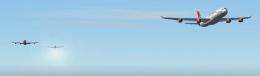
A team of five doctoral students from the Aeronautics and Astronautics program has conceptualized a way for commercial planes to save fuel by flying in formation. The concept of formation flight for drag reduction, which the team says can increase fuel efficiency and reduce harmful engine emissions, is borrowed from migratory birds.
The Stanford Aircraft Aerodynamics and Design Group will fly to France this June to pitch their vision as finalists in a design contest sponsored by aircraft manufacturer Airbus. The "Fly Your Ideas" contest, which serves as an international call for original concepts to make commercial flight more environmentally responsible, has inspired various possibilities, such as solar cells for aircraft, and planes with windowless cabins.
The aerodynamics of formation flight allows birds to spend less energy while flying south together for the winter; the same science can be applied to commercial planes, according to the team.
"People have known about this for a long time," said team member Geoff Bower. But while formation flight is notable in military operations, little has been done to explore this concept in commercial flight.
"It melds well with all our research," Emily Schwartz, another team member, said of the contest. Different members of the team shared interests in formation flight as well as designing environmentally friendly aircraft.
During the act of flight, the lifting force that carries a wing also creates little tornadoes, or vortices, which trail behind the wing. These byproducts of flight counteract the lifting force, resulting in what aerodynamicists call induced drag. A single flying object, such as a bird, needs to expend more energy to overcome induced drag. However, when birds migrate together, a bird can fly on top of the little tornadoes created by the bird ahead, thus conserving energy.
When applied to commercial flight, this same principle can save fuel and curb greenhouse gas emissions, according to Stanford ADG. To investigate, the team studied one day of Virgin Atlantic flight schedules from the United States to the United Kingdom.
The team proposed that flights leaving from the same general area make slight adjustments to their departure times, rendezvous in midair at a point close to each plane's origin and fly to their destination in formations of two or three aircraft. There would be about two to five miles separating each plane in the formation.
To illustrate, Schwartz imagined flights from San Francisco, Los Angeles and Las Vegas taking off, meeting around Utah and flying toward England in formation.
To calculate differences in fuel efficiency, the team used performance models of the airline's planes. Flight plans similar to what the team proposes could yield fuel savings of up to 12 percent, Schwartz said.
"Airlines really kill for a one percent improvement in fuel burned," Bower said. "Twelve percent is actually very large."
In addition to saving fuel, formation flight can cut emissions of the greenhouse gases known as nitrogen oxides by one fourth.
"It's a significant saving in global warming," Schwartz said.
Designing more advanced planes can take years. One of the strong points of the team's formation-flight concept is that it can be tested and applied immediately using existing planes. Testing could start with cargo planes, such as those flown by United Parcel Service and FedEx, before going into commercial airlines, Bower said.
The speed in execution is important considering that historic trends point to a five percent annual increase in air traffic, Bower said.
After entering the contest in October of 2008, Stanford ADG passed through two rounds of stiff international competition. The first round included 225 teams, and the second round, 86 teams, which have since been whittled down to five finalists, according to Airbus. Stanford ADG, the only finalist from the United States, will join the other four teams in Paris, where they will make their final presentations before a jury comprised of Airbus representatives and independent experts on June 18. First prize is 30,000 euros (about $42,000.)
The winners will be announced the following day at the Paris Air Show, which the team looks forward to attending. "It's much better than being in our cubicles," team member Andrew Ning said with a laugh. Jia Xu and Tristan Flanzer are also members of the team.
Provided by Stanford University (news : web)


