Researchers find breast cancer gene that's blocked by blood pressure drug
June 1, 2009
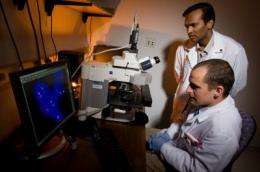
These are researchers Arul Chinnaiyan and Scott Tomlins. Credit: University of Michigan Health System
Researchers have identified a gene that is overexpressed in up to 20 percent of breast cancers and that could be blocked in the lab by a currently available blood pressure drug, according to a new study from the University of Michigan Comprehensive Cancer Center.
The gene, called AGTR1, caused normal breast cells to behave like cancer cells. This behavior was reversed by treatment with the blood pressure drug losartan. Tumors in mice that expressed AGTR1 shrunk by 30 percent eight weeks after treatment with losartan, a drug approved by the U.S. Food and Drug Administration to treat high blood pressure.
"We suspect our analysis has uncovered a new crop of potentially important breast cancer genes. What's also exciting is this gene is blocked by a drug that's already available on the market," says study author Arul Chinnaiyan, M.D., Ph.D., director of the Michigan Center for Translational Pathology and S.P. Hicks Endowed Professor of Pathology at the U-M Medical School.
Results of the study appear online the week of June 1 in the Proceedings of the National Academy of Sciences.
The researchers looked at gene expression profiling data from nearly 3,200 microarrays available in the Oncomine database, a tool that allows rapid comparison of thousands of genes in human cancers. The researchers found genes that were dramatically overexpressed within subsets of tumors.
The gene that came up most often was ERBB2, which is better known as HER2, a gene that is overexpressed in 25 percent to 30 percent of all human breast cancers. HER2 is blocked by the targeted therapy Herceptin.
The next most commonly seen gene behind ERBB2 was AGTR1, which was seen in 10 percent to 20 percent of breast tumors. Specifically, AGTR1 was overexpressed only in tumors that were ERBB2-negative and that expressed the estrogen receptor, known as ER-positive. AGTR1 was found to be as much as 100-fold overexpressed in some tumors.
"AGTR1 is very analogous to HER2 or ERBB2. HER2 is a bona fide treatment target for patients with that type of breast cancer. This research defines a novel subtype of ER-positive breast cancer that we hope can be similarly targeted for treatment," says Chinnaiyan, a Howard Hughes Medical Institute investigator.
The researchers tested in cell cultures and in mice the effect of losartan on AGTR1-positive tumors. When losartan was introduced, the AGTR1-positive tumors were reduced, while AGTR1-negative tumors were not affected. In the mice studies, losartan shrank AGTR1-positive tumors by 20 percent after two weeks and by 30 percent after eight weeks.
"Losartan may be a viable therapy for women with AGTR1 over-expressing breast tumors. This study lays the groundwork for a clinical trial to test losartan to treat breast cancers positive for AGTR1," Chinnaiyan says.
Researchers are discussing a possible clinical trial, but one is not currently designed or recruiting for participants.
Breast cancer statistics: 194,280 Americans will be diagnosed with breast cancer this year and 40,610 will die from the disease, according to the American Cancer Society.
-
Herceptin targets breast cancer stem cells
Jul 09, 2008 |
not rated yet |
0
-
Five-year U.K. breast cancer trial starts
Jan 16, 2008 |
not rated yet |
0
-
Scientists identify protein key to breast cancer spread, potential new drug target
Apr 09, 2007 |
not rated yet |
0
-
Gene profiling predicts resistance to breast cancer drug Herceptin
Feb 20, 2007 |
not rated yet |
0
-
Even tiny breast tumors can be aggressive and may require maximum therapy
Dec 16, 2007 |
not rated yet |
0
-
Engineers build first sub-10-nm carbon nanotube transistor
Feb 01, 2012 |
4.9 / 5 (33) |
30
-
Something old, something new: Evolution and the structural divergence of duplicate genes
Jan 31, 2012 |
4.6 / 5 (7) |
1
-
The hidden nanoworld of ice crystals: Revealing the dynamic behavior of quasi-liquid layers
Jan 30, 2012 |
5 / 5 (5) |
1
-
Stock market network reveals investor clustering
Jan 27, 2012 |
3.9 / 5 (23) |
8
-
Of microchemistry and molecules: Electronic microfluidic device synthesizes biocompatible probes
Jan 26, 2012 |
5 / 5 (2) |
0
-
Is Everyday Technology Killing Us?
Feb 08, 2012
-
Exercise and weight loss
Feb 08, 2012
-
Why do we have head aches? Our brains can't feel anything.
Feb 07, 2012
-
"The end of diseases" by David Agus, interview from Daily Show with Jon Stewart
Feb 04, 2012
-
Oncolytic adenovirus
Feb 04, 2012
-
Nutrition label stuffs and diets
Feb 02, 2012
- More from Physics Forums - Medical Sciences
More news stories
Cognitive impairment in older adults often unrecognized in the primary care setting
A new study published in the Journal of the American Geriatrics Society reveals that brief cognitive screenings combined with offering further evaluation increased new diagnoses of cognitive impairment in older veterans two to ...
1 hour ago |
not rated yet |
0
Botox developer rues missing out on billions
Botox developer Alan Scott says he rues the day he handed over rights to the best-selling wrinkle-smoothing drug to a US company for just $4.5 million, saying he might have become a billionaire.
Medicine & Health / Medications
2 hours ago |
not rated yet |
0
Primary care program helps obese teen girls manage weight, improve body image and behavior
Teenage girls gained less weight, improved their body image, ate less fast food, and had more family meals after participating in a 6- month program that involved weekly peer meetings, consultations with primary care providers ...
1 hour ago |
not rated yet |
0
Young adults allowed to stay on parents' health insurance have improved access to care
Researchers from Mount Sinai School of Medicine have found that laws permitting children to stay on their parents' health insurance through age 26 result in improved access to health care compared to states without those ...
2 hours ago |
not rated yet |
0
Cancer rate 4 times higher in children with juvenile arthritis
New research reports that incident malignancy among children with juvenile idiopathic arthritis (JIA) is four times higher than in those without the disease. Findings now available in Arthritis & Rheumatism, a journal publis ...
2 hours ago |
not rated yet |
0
Ordered planar polymers created for the first time
(PhysOrg.com) -- Scientists under the direction of ETH Zurich have created a minor sensation in synthetic chemistry. They succeeded for the first time in producing regularly ordered planar polymers that form ...
New European rocket lifts off on maiden flight
A new lightweight rocket, Vega, lifted off from Europe's space base Monday carrying nine satellites on its inaugural flight, mission control said.
Hacker claims porn site users compromised
A hacker claims to have compromised the personal information of more than 350,000 users after breaking into a disused website operated by pornography provider Brazzers.
Chinese city seizes Apple iPads in name dispute
(AP) -- Authorities have seized Apple iPads from retailers in a city in northern China due to a dispute with a domestic company that says it owns the iPad name, an official said Monday. The Chinese company said it is asking ...
Microsoft India retail site down after 'cyber attack'
Microsoft India's retail website was down on Monday after reportedly being hacked by a Chinese group calling itself Evil Shadow Team.
Rapunzel, Leonardo and the physics of the ponytail
(PhysOrg.com) -- New research provides the first mathematical understanding of the shape of a ponytail and could have implications for the textile industry, computer animation and personal care products.
Jun 02, 2009
Rank: not rated yet