Mosquito evolution spells trouble for Galapagos wildlife
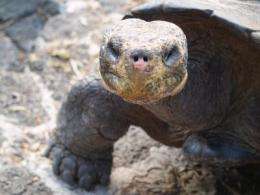
The Galapagos giant tortoise and other iconic wildlife are facing a new threat from disease, as some of the islands' mosquitoes develop a taste for reptile blood.
Scientists from the University of Leeds, the Zoological Society of London (ZSL) and the Galapagos National Park have discovered that while its mainland ancestors prefer the blood of mammals and the occasional bird, the Galapagos form of the black salt marsh mosquito (Aedes taeniorhynchus) has shifted its behaviour to feed mainly on reptiles - primarily Galapagos giant tortoises and marine iguanas.
The findings raise fears that these changes could devastate the islands' unique native wildlife if a new mosquito-borne disease is introduced - a scenario which is increasingly likely with the continuing rise in tourism.
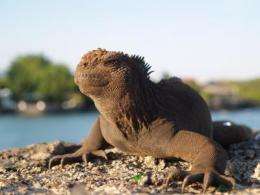
Using genetic techniques, the researchers showed that the mosquito colonised the Galapagos around 200,000 years ago and was not introduced by humans as previously thought, giving them time to adapt to conditions in Galapagos. They have also found that unlike the mainland populations that normally live in mangroves and salt marshes along the coast, the Galapagos form of the mosquito can also breed up to 20 km inland and at altitudes of up to 700 metres. The research team believe the shift in feeding behaviour is an adaptation to life in Galapagos, since the islands had few mammal species prior to the arrival of Man some 500 years ago.
"When we started the work we thought that this species was also introduced by humans, so it was a surprise that it turned out to be so ancient," says Arnaud Bataille, the University of Leeds and ZSL PhD student who carried out the work. "The genetic differences of the Galapagos mosquitoes from their mainland relatives are as large as those between different species, suggesting that the mosquito in Galapagos may be in the process of evolving into a new species."
Mosquitoes are known to transmit important wildlife diseases, such as avian malaria and West Nile fever. While there is no evidence that such diseases are currently present on Galapagos, the widespread presence of the mosquito, and the fact that it feeds on a broad range of the native species, means that any new disease that arrives from the continent could spread rapidly to a wide variety to wildlife throughout the islands. Due to its long isolation, Galapagos wildlife is not likely to have much immunity to new diseases, so the effects could be devastating.
"With tourism growing so rapidly the chance of a disease-carrying mosquito hitching a ride from the mainland on a plane is also increasing, since the number of flights grows in line with visitor numbers" says Dr Andrew Cunningham, from the Zoological Society of London, one of the authors of the study. "If a new disease arrives via this route, the fear is that Galapagos' own mosquitoes would pick it up and spread it throughout the archipelago."
Rather than implementing control measures against Galapagos' own unique mosquito, the research team argues that it is imperative that measures are taken to avoid introducing new diseases to the islands.
The Ecuadorian government recently introduced a requirement for planes flying to Galapagos to have a residual insecticide treatment on the interior surfaces, and spraying in the hold and cabin on each flight. However, similar controls are yet to be implemented for ships.
Co-author Dr Simon Goodman, of Leeds' Faculty of Biological Sciences says: "It is absolutely vital that these control measures are maintained and carried out rigorously, otherwise the consequences could be very serious indeed."
The research is published online this week in the US journal Proceedings of the National Academy of Sciences (PNAS).
Source: University of Leeds (news : web)


