Spanish researchers describe new hominid
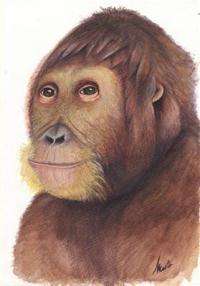
Researchers from the Institut Català de Paleontologia (ICP), from Universitat Autňnoma de Barcelona, directed by professor Salvador Moyà-Solà, publish this week in Proceedings of the National Academy of Sciences (PNAS) the results of their research regarding the find of a new genus of hominoid primate at els Hostalets de Pierola, l'Anoia.
This fossil remains displays very interesting particularities, such as an extraordinarily flat face, and further combines primitive with derived traits, characteristic of great apes. This find significantly enables to take a step forward in the understanding of the origin of our own family, the Hominidae. It demonstrates that kenyapithecines are the sister taxon of extant hominids and shows that the Mediterranean region was the source area of our family.
2004 was an important year regarding the finds of fossil hominids in the area of the Abocador de Can Mata (ACM, els Hostalets de Pierola, l'Anoia, Barcelona). Besides being the year that Pierolapithecus catalaunicus (familiarly known as Pau) was published in Science magazine, this coincided with the find of the first maxillary remains of Dryopithecus fontani thus far known, as well as with the find of the extraordinary remains that we present today: the find in the site C3-Aj from ACM of a face with mandible from the same fossil great ape individual, thus far unknown for science, and which provides us an extraordinary information for clarifying the issue of the phylogenetic and geographic origin of our family, the Hominidae, which is made up by orangutans, chimpanzees, bonobos, gorillas and humans.
The study based on this Middle Miocene genus (11.9 Ma, or million years before present) is reported on a publication by Moyà-Solà and co-authors in the next issue of the renowned scientific journal Proceedings of the National Academy of Sciences, USA (PNAS). The team of researchers that have been involved in this publication, coordinated by Salvador Moyà-Solà, director of the Institut Català de Paleontologia (ICP), which has the Universitat Autňnoma de Barcelona and the Generalitat de Catalunya as patrons, further includes: David M. Alba, collaborator of the ICP; Sergio Almécija, predoctoral researcher of the ICP; Isaac Casanovas, postdoctoral researcher of the ICP; Meike Köhler, researcher and chief of a research group of the ICP; Soledad De Esteban, postdoctoral researcher of the ICP; Josep M. Robles, collaborator of the ICP; Jordi Galindo, curator of the ICP; and Josep Fortuny, predoctoral researcher of the ICP.
The new hominid has been given the scientific name of Anoiapithecus brevirostris, in reference to the region where the town of els Hostalets is situated (l'Anoia) and also to the fact that the new taxon has a very modern facial morphology, characterized by a very reduced facial prognathism, i.e. by a very short face. Colloquially we have named it as Lluc (since it is a male individual). This name stems from the fact that Lluc in Latin means "the one who illuminates", and certainly, the information provided by this new fossil is so important that it permits to solve some key questions on the origin of the family Hominidae, which the previous find of Pierolapithecus had left unanswered. At the same time, in a time of crisis, such as the one into we are immersed, it is very welcome that somebody illuminates the path to follow; and the find of Lluc is, perhaps, a good augury.
The new genus and species, Anoiapithecus brevirostris, has been described on the basis of a partial cranium that preserves most of the face and the associated mandible. This cranium was recovered during the works of paleontological control that are customarily carried out at ACM, due to the fossiliferous richness of the area of els Hostalets de Pierola. The process of preparation was long-lasting and complicated, due to the fragility of the remains, but once the material were available for analysis, the surprise was enormous. The specimen (IPS43000) combined a set of features that until now had never been found from the fossil record.
On the one hand, Anoiapithecus displays a very modern facial morphology, with a muzzle prognathism so reduced that, within the family Hominidae, we can only find comparable values within the genus Homo, whereas the remaining great apes are notoriously more prognathic. This extraordinary fact does not indicate that Anoiapithecus has any relationship with Homo, but it might be a case of convergence. Probably, the evolutionary meaning of this finding is a different one, but not for this reason it is less interesting.
The second surprise provided by Lluc is that it enabled to solve two key questions regarding the origin of our family: what group it is derived from, and which is the geographic area where the family Hominidae originated.
Until now, we merely suspected that a group of primitive hominoids known as kenyapithecines (recorded from the Middle Miocene of Africa and Eurasia) might be the ancestral group that hominids would have derived from. This hypothesis could never be verified, because the adequate paleontological material required to do so was unavailable.
The detailed morphological study of the cranial remains of Lluc showed that, together with the modern anatomical features that characterized the family Hominidae (among others, nasal aperture wide at the base, high zygomatic rood, deep palate), and which permit to consider it a member of this family, it displays a set of primitive features, such as thick dental enamel, teeth with globulous cusps, very robust mandible and very procumbent premaxilla, which are primitive features that characterize a group of primitive hominoids from the African Middle Miocene, known as afropithecids. However, the most interesting fact is that, together with this mixture of hominid and primitive afropithecid features, it displays other characteristics, such as a very anterior position of the zygomatic, a very strong mandibular torus and, especially, a very reduced maxillary sinus, which are derived features that it uniquely shares with the only kenyapithecines that ever dispersed outside the African continent and colonized the Mediterranean region, by about 15 million years ago, the genera Kenyapithecus and Griphopithecus. As such, even though in the past kenyapithecines had been already proposed as the likely sister group of hominids (i.e., the group most closely related to them), the fragmentary nature of the previously available material had thus far precluded testing this hypothesis. Now, we have data that support it.
And that is the key of the issue: this discovery enables to identify two probable candidates to be the ancestral form to our family (Kenyapithecus and Griphopithecus); and taking into account that these two genera cannot be considered members of the family Hominidae yet, because they lack its basic diagnostic features, it is obvious that the origin of our family is a phenomenon that took place on the Mediterranean region during the time span comprised between their arrival from Africa by about 15 Ma, and about 13 Ma, when we began to find in els Hostalets the first members of our family. As such, the team of Salvador Moyà and his collaborators consider that hominids might have originally radiated in Eurasia from kenyapithecine ancestors of African origin. The several taxa represented at ACM, the dryopithecins, would testimony this initial great-ape radiation, as shown by the combination of a modern facial pattern with primitive features such as thick enamel. Later on, the ancestors of African great apes and humans would have dispersed again into Africa. This notwithstanding, the authors do not completely rule out the possibility that pongines (orangutans and related forms) and hominines (African apes and humans) separately evolved in Eurasia and Africa, respectively, from different kenyapithecine ancestors. The project at els Hostalets de Pierola goes on and, surely, more fossil remains will be found in the future (at ACM or elsewhere in the world), which will provide new key information that will enable to test the latter hypothesis.
Source: Universitat Autonoma de Barcelona


