Trading energy for safety, bees extend legs to stay stable in wind
June 2, 2009 Bee

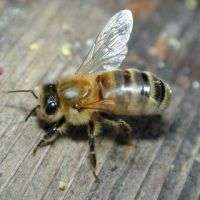
New research shows some bees brace themselves against wind and turbulence by extending their sturdy hind legs while flying. But this approach comes at a steep cost, increasing aerodynamic drag and the power required for flight by roughly 30 percent, and cutting into the bees' flight performance.

The findings are detailed in the .

"Wind is a universal part of life for all flying animals," says Stacey Combes, assistant professor of organismic and in Harvard University's Faculty of Arts and Sciences. "Yet we know remarkably little about how animals navigate windy conditions and unpredictable airflows, since most studies of animal flight have taken place in simplified environments, such as in still air or perfect laminar flows. Our work shows clearly that the effect of environmental turbulence on flight stability is an important and previously unrecognized determinant of flight performance."

Together with Robert Dudley of the University of California, Berkeley, and the Smithsonian Tropical Research Institute, Combes studied 10 species of wild orchid bees that fly at high speeds for tens of kilometers each day seeking food and other resources. Males of these species are especially motivated to collect aromatic scents in pouches on their oversized hind legs, which are then used in mating displays that attract females.

Because male orchid bees are so strongly attracted by scents, they will readily traverse severe conditions, such as those created when Combes and Dudley set up powerful air jets in the bees' Panamanian jungle habitats. Using high-speed video, the scientists measured the bees' maximum flight speed as they were buffeted by varying levels of environmental turbulence. In every case, the bees displayed a side-to-side rolling motion at high flight speeds, negotiating the turbulence by extending their rear legs while in flight.

"This increases the bees' moment of inertia and reduces rolling," Combes says, "much like a spinning ice skater who extends her arms to slow down."

This rolling increased with flight speed until the bees were rolled to one side or the other roughly 80 percent of the time, at which point the bees would become unstable and either crash to the ground or be blown from the airstream. Bees were able to reach higher speeds when flying in lower levels of turbulence, altered through the use of different types of screens to deflect air flow in the air jet.

While Combes and Dudley only studied 10 species of euglossine bees, Combes says that this stabilizing behavior is likely to be seen across Hymenoptera, the order of insects that includes , wasps, ants, and sawflies, and that turbulent airflow may decrease the flight performance of many other flying insects as well.

Source: Harvard University (news : web)


print this article email this article download pdf blog this article bookmark this article     Stumble it Digg this share on Facebook retweet share on Reddit add to delicious
Rate this story - 5 /5 (3 votes)


June 2, 2009 all stories

Comments: 0

5 /5 (3 votes)
  • Stumble this up

  • Digg this

  • share this

  • hide
  • Related Stories

  • Flying tip of bees: Leave your legs dangling!
    created Apr 04, 2006 | popularity not rated yet | comments 0
  • The cost of long tongues
    created Apr 16, 2007 | popularity not rated yet | comments 0
  • Study: City bees better than rural bees
    created Jan 17, 2006 | popularity not rated yet | comments 0
  • Halictid bees' social behavior studied
    created Mar 13, 2006 | popularity not rated yet | comments 0
  • Fast learning bumblebees reap greater nectar rewards
    created Jan 16, 2008 | popularity not rated yet | comments 0


  • hide
  • Relevant PhysicsForums posts

  • What is transpulmonary pressure?
    created Nov 24, 2009
  • Is there a gay gene?
    created Nov 23, 2009
  • Super quick question about Starling forces?
    created Nov 22, 2009
  • Questions about diffusion
    created Nov 22, 2009
  • More from Physics Forums - Biology

Other News

Variable Temperatures Leave Insects wtih a Frosty Reception

Biology / Plants & Animals

created 11 hours ago | popularity not rated yet | comments 0

(PhysOrg.com) -- For the first time, scientists at The University of Western Ontario have shown that insects exposed to repeated periods of cold will trade reproduction for immediate survival.


When camouflage is a plant's best protection

Rare woodland plant uses 'cryptic coloration' to hide from predators

Biology / Plants & Animals

created 14 hours ago | popularity 4.3 / 5 (3) | comments 0

It is well known that some animal species use camouflage to hide from predators. Individuals that are able to blend in to their surroundings and avoid being eaten are able to survive longer, reproduce, and ...


Cells defend themselves from viruses, bacteria with armor of protein errors

Biology / Cell & Microbiology

created 15 hours ago | popularity 5 / 5 (7) | comments 0

When cells are confronted with an invading virus or bacteria or exposed to an irritating chemical, they protect themselves by going off their DNA recipe and inserting the wrong amino acid into new proteins to defend them ...


Researchers discover biological basis of 'bacterial immune system'

Biology / Cell & Microbiology

created 16 hours ago | popularity 4.7 / 5 (3) | comments 0

Bacteria don't have easy lives. In addition to mammalian immune systems that besiege the bugs, they have natural enemies called bacteriophages, viruses that kill half the bacteria on Earth every two days.


'Safety valve' protects photosynthesis from too much light

Biology / Cell & Microbiology

created 15 hours ago | popularity 4.7 / 5 (3) | comments 0

Photosynthetic organisms need to cope with a wide range of light intensities, which can change over timescales of seconds to minutes. Too much light can damage the photosynthetic machinery and cause cell death. Scientists ...