How to get obese mice moving -- and cure their diabetes
June 2, 2009 How to get obese mice moving -- and cure their diabetes

Enlarge

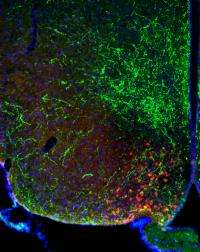
This image, used on the cover of Cell Metabolism, shows activated POMC neurons in red, in a transgenic mouse model from the laboratory of Christian Bjorbaek. Image courtesy Cell Metabolism and Christian Bjorbaek

Mice lacking the fat hormone leptin or the ability to respond to it become morbidly obese and severely diabetic—not to mention downright sluggish. Now, a new study in the June Cell Metabolism shows that blood sugar control in those animals can be completely restored by returning leptin sensitivity to a single class of neurons in the brain, which account for only a small fraction of those that normally carry the hormone receptors.

"Just the receptors in this little group of neurons are sufficient to do the job," said Christian Bjorbaek of Harvard Medical School.

What's more, animals with leptin receptors only in the so-called pro-opiomelanocortin (POMC) neurons spontaneously increase their physical activity levels despite the fact that they remain profoundly obese. While understanding exactly how the POMC neurons act on other organs remains a future challenge, the discovery suggests that drugs designed to tap into the pathway—turning up or down the dial, so to speak—might have benefit for those with severe diabetes and obesity, according to the researchers.

Such drugs might even encourage obese individuals to get moving. "This gives us the opportunity to search for drugs that might induce the desire or will to voluntarily exercise," Bjorbaek said.

Leptin was first identified 15 years ago and made famous for its ability to curb appetite and lead to weight loss. It is known to play a pivotal role in energy balance through its effects on the central nervous system, specifically by acting on a hypothalamic brain region known as the arcuate nucleus (ARC). The ARC contains two types of leptin-responsive neurons, the POMC neurons, which cause a loss of appetite, and the so-called Agouti-related peptide (AgRP) neurons, which do the opposite.

Studies had also revealed a role for leptin in blood sugar control and activity level, also via effects on the ARC. However, scientists still didn't know which neurons were responsible, until now.

When the researchers restored leptin receptor activity in POMC neurons of otherwise leptin-resistant, obese, and diabetic mice, the animals began eating about 30 percent fewer calories and lost a modest amount of weight. Remarkably, the researchers report, their levels returned to normal independently of any change in their eating habits or weight. The animals also doubled their activity levels.

Whether this particular bunch of neurons also plays a similarly important role in animals that are lean remains uncertain, Bjorbaek said. "It may be that in the context of severe obesity and diabetes, these do something they don't normally do," he said. But, he added, even if that were the case, it may not matter when it comes to its potential as a therapeutic target.

Source: Cell Press (news : web)


print this article email this article download pdf blog this article bookmark this article     Stumble it Digg this share on Facebook retweet share on Reddit add to delicious
Rate this story - 5 /5 (1 vote)


June 2, 2009 all stories

Comments: 0

5 /5 (1 vote)
  • Stumble this up

  • Digg this

  • share this

  • hide
  • Related Stories

  • In obesity, brain becomes 'unaware' of fat
    created Mar 06, 2007 | popularity not rated yet | comments 0
  • Researchers find clue to safer obesity drugs
    created Nov 25, 2008 | popularity not rated yet | comments 0
  • Obesity may be wired in the brain, rat study suggests
    created Feb 05, 2008 | popularity not rated yet | comments 0
  • Battle of the bulge: Low leptin levels undermine successful weight loss
    created Jun 21, 2008 | popularity not rated yet | comments 0
  • Combining exercise with hormone could prevent weight gain
    created May 27, 2008 | popularity not rated yet | comments 0


  • hide
  • Relevant PhysicsForums posts

Other News

Scientists visualize how bacteria talk to one another

Scientists visualize how bacteria talk to one another

Biology / Cell & Microbiology

created 12 hours ago | popularity 4.9 / 5 (8) | comments 1

Using imaging mass spectrometry, researchers at the University of California, San Diego have developed tools that will enable scientists to visualize how different cell populations of cells communicate. Their ...


W. Africa's last giraffes make surprising comeback (AP)

W. Africa's last giraffes make surprising comeback

Biology / Ecology

created 21 hours ago | popularity not rated yet | comments 0

(AP) -- A crisp African dawn is breaking overhead, and Zibo Mounkaila is on the back of a pickup truck bounding across a sparse landscape of rocky orange soil.


W. Africa's last giraffes make surprising comeback (AP)

China sends panda expert to Taiwan to aid breeding

Biology / Plants & Animals

created 21 hours ago | popularity not rated yet | comments 0

(AP) -- Nothing like a little time apart to rekindle the affections that could lead to a baby panda.


Laser etching safe alternative for labeling grapefruit

Laser etching safe alternative for labeling grapefruit

Biology / Other

created Nov 03, 2009 | popularity 4.4 / 5 (14) | comments 8

Laser labeling of fruit and vegetables is a new, patented technology in which a low-energy carbon dioxide laser beam is used to label, or "etch" information on produce, thereby eliminating the need for common ...


Wolves, moose and biodiversity: An unexpected connection

Wolves, moose and biodiversity: An unexpected connection

Biology / Ecology

created Nov 02, 2009 | popularity 4.9 / 5 (7) | comments 4

Moose eat plants; wolves kill moose. What difference does this classic predator-prey interaction make to biodiversity?