Interactive Data Eyeglasses
June 2, 2009
Interactive Data Eyeglasses

Enlarge

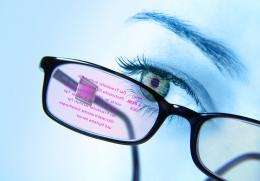
The data eyeglasses display information and respond to commands. © Fraunhofer IPMS

(PhysOrg.com) -- The data eyeglasses can read from the engineer's eyes which details he needs to see on the building plans. A CMOS chip with an eye tracker in the microdisplay makes this possible. The eyeglasses are connected to a PDA, display information and respond to commands.

For car designers, secret agents in the movies and jet fighter pilots, data eyeglasses - also called head-mounted displays, or HMDs for short - are everyday objects. They transport the wearer into virtual worlds or provide the user with data from the real environment. At present these devices can only display information.

“We want to make the eyeglasses bidirectional and interactive so that new areas of application can be opened up,” says Dr. Michael Scholles, business unit manager at the Fraunhofer Institute for Photonic Microsystems IPMS in Dresden. A group of scientists at IPMS is working on a device which incorporates eye tracking - users can influence the content presented by moving their eyes or fixing on certain points in the image.

Without having to use any other devices to enter instructions, the wearer can display new content, scroll through the menu or shift picture elements. Scholles believes that the bidirectional data eyeglasses will yield advantages wherever people need to consult additional information but do not have their hands free to operate a keyboard or mouse. The Dresden-based researchers have integrated their system’s eye tracker and image reproduction on a CMOS chip. This makes the HMDs small, light, easy to manufacture and inexpensive.

The chip measuring 19.3 by 17 millimeters is fitted on the prototype eyeglasses behind the hinge on the temple. From the temple the image on the microdisplay is projected onto the retina of the user so that it appears to be viewed from a distance of about one meter. The image has to outshine the ambient light to ensure that it can be seen clearly against changing and highly contrasting backgrounds. For this reason the research scientists use OLEDs, organic light-emitting diodes, to produce microdisplays of particularly high luminance.

In industry and in the medical field, the interactive data eyeglasses could enable numerous tasks to be performed more simply, efficiently and precisely. Many scenarios are possible, including patients’ vital functions, MRT and x-ray images for the operating surgeon, construction drawings for erection engineers and installation instructions for service technicians. Some users have already tried out conventional HMDs, but the results were not very impressive. In most cases they were found to be too expensive, too heavy, too bulky and not very ergonomic. “We have now overcome these hurdles,” says Scholles. With his team and colleagues from other Fraunhofer institutes he is already working on the next development stage of the bidirectional .

Provided by Fraunhofer-Gesellschaft (news : web)

4.5 /5 (11 votes)  

Filter


Move the slider to adjust rank threshold, so that you can hide some of the comments.


Display comments: newest first

Fazer
Jun 02, 2009

Rank: 4.3 / 5 (4)
I have looked into the crystal ball on my iPod Touch (there's an app for that) and seen the future:

Desktops will disappear, followed shortly by laptops. The smartphone is the wave of the future and in 5-10 years we will all be wearing a computing device and a pair of glasses like these. We will walk through a virtual world, probably Google Earth that is laid over the real world. Augmented Reality is a bullet with our name on it.

The App has spoken!
jsovine
Jun 02, 2009

Rank: 5 / 5 (1)
I have looked into the crystal ball on my iPod Touch (there's an app for that) and seen the future:


Desktops will disappear, followed shortly by laptops. The smartphone is the wave of the future and in 5-10 years we will all be wearing a computing device and a pair of glasses like these. We will walk through a virtual world, probably Google Earth that is laid over the real world. Augmented Reality is a bullet with our name on it.


The App has spoken!


Sounds sweet, bring it on :D
barkster
Jun 02, 2009

Rank: 5 / 5 (1)
yeah, baby!
dan42day
Jun 03, 2009

Rank: 5 / 5 (1)
Stay away from the red pills Fazer!
DeadCorpse
Jun 03, 2009

Rank: 3.5 / 5 (2)
Taking Fazer prediction one step further, said data terminals will one day be available in an implantable form.

Said system would not only allow a VR "overlay" on the real world, but will allow whole new levels of sensory data augmentation.
OBSL33t
Jun 03, 2009

Rank: not rated yet
@Fazer
I think 5-10 years is a bit of stretch.
Maybe 20.
Until it's practical to make miniature computers more powerful than their larger counterparts I don't think that desktop computers are going anywhere anytime soon.
Joe1058
Jun 03, 2009

Rank: not rated yet
I'm SO ready for a pair of these!
Fazer
Jun 03, 2009

Rank: not rated yet
@Fazer
I think 5-10 years is a bit of stretch.
Maybe 20.
Until it's practical to make miniature computers more powerful than their larger counterparts I don't think that desktop computers are going anywhere anytime soon.


Ah, but you are not taking into account the Texting Phenomenon. Why would people take a step down to text messages when they could talk, video conference, send multimedia, etc? Because they found a technology that fit their needs, simple as it is. They can text on the sly while working, they can hold multiple text conversations instead of speaking with just one person.

There is no way to know what people will latch onto. My point is that folks will take a performance hit if they get something that they really want.

Chats rooms are so popular, imagine taking that chat room with you everywhere you go? Not my cup of tea, but I am sure it is for some. And it won't require CPU speed or GPU power...very much like texting.

I think that once people see how much information is accessible to them just walking down the street, they will want the video glass interface, and the associated freedom, and will opt to spend their money on that, rather than a new desktop or laptop.

Then there is the coolness factor. How dumb will they feel when their friends are all wearing the latest trend while they are lugging around a laptop?

Consensual Viewing could also be big: sharing what you are viewing so that all of your friends see the same thing without having to cluster around a screen, though it would require more bandwidth.

Just wait till they try to ban video glasses: how do you know someone is using their video glass interface while driving, working, etc? Do you ban all but prescription lenses? Suddenly there will appear a slew of new opticians and fitting stores/booths at the mall, just like the cell phone booths now, and they will give out "convenience prescriptions" to anyone who wants one, ideally with the purchase of a pair of video glasses with a very slight correction factor.

In fact, current banning of texting while driving could lead to a newer technology like this being adopted...unintended consequences. All that is required is a drop in price and a desire for the product to fuel and explosion.

There is no end to the craziness we can expect as technological and social changes accelerate.
Rank 4.5 /5 (11 votes)
Related Stories
Relevant PhysicsForums posts
  • feed hold button on CNC lathe
    created6 hours ago
  • Mechanics of Solids ( Final exam question) plz help!
    created8 hours ago
  • RFAC in Fortran
    created10 hours ago
  • dynamics 2/32
    created16 hours ago
  • dynamics
    created16 hours ago
  • Vibration Absorbtion Problem
    created21 hours ago
  • More from Physics Forums - General Engineering

More news stories

Model analyzes shape-memory alloys for use in earthquake-resistant structures

Recent earthquake damage has exposed the vulnerability of existing structures to strong ground movement. At the Georgia Institute of Technology, researchers are analyzing shape-memory alloys for their potential ...

Technology / Engineering

created 1 hour ago | popularity not rated yet | comments 0 | with audio podcast

Digital photos could put kids at risk

A study published in the International Journal of Electronic Security and Digital Forensics this month suggests that parents and carers could be putting children at risk if they upload digital photos that are automatically "geota ...

Technology / Internet

created 54 minutes ago | popularity not rated yet | comments 1

New battery could lead to cheaper, more efficient solar energy

A joint research project between the University of Southampton and lithium battery technology company REAPsystems has found that a new type of battery has the potential to improve the efficiency and reduce the cost of solar ...

Technology / Energy & Green Tech

created 1 hour ago | popularity not rated yet | comments 1

Fuel from market waste

Mushy tomatoes, brown bananas and overripe cherries -- to date, waste from wholesale markets has ended up on the compost heap at best. In future it will be put to better use: Researchers have developed a new ...

Technology / Energy & Green Tech

created 44 minutes ago | popularity 5 / 5 (1) | comments 0

Google launches Chrome browser for Android smartphones

With more and more people connecting to the Internet through a phone or a tablet instead of a PC, Google Inc. is bringing its fast-growing browser, Chrome, to the newest Android-powered mobile devices.

Technology / Software

created 3 hours ago | popularity 5 / 5 (3) | comments 0


New Kindle Touch is an impressive e-reader

When it comes to reading digital books, tablets are all the rage. But there's a lot to like about simple e-readers, which over the past year have become both a lot cheaper and a lot less clunky.

Genetic risks for type 2 diabetes span multiple ethnicities

A recent large and comprehensive analysis of 50,000 genetic variants across 2,000 genes linked to cardiovascular and metabolic function has identified four genes associated with type 2 diabetes (T2D) and six independent disease-associated ...

Ocean warming causes elephant seals to dive deeper

Global warming is having an effect on the dive behaviour and search for food of southern elephant seals. Researchers from the Alfred Wegener Institute for Polar and Marine Research in the Helmholtz Association cooperating ...

Fresh city tomatoes, any time

Why not produce lettuce, beans and tomatoes where most of the consumers are to be found: in the city? The flat roofs of many buildings are well-suited for growing vegetables. Rooftop greenhouses can also make ...

Apple to debut 'iPad 3' in March: report

Apple will unveil a new version of its market-ruling iPad table computer in March, according to a report in Dow Jones-owned technology blog All Things D.

Tidal forces could squeeze out planetary water

Alien planets might experience tidal forces powerful enough to remove all their water, leaving behind hot, dry worlds like Venus, researchers said.