Transparent solar cells
June 2, 2009
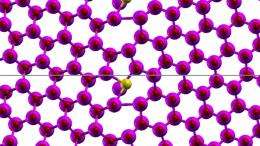
Irregularity in an ordered crystal structure. © Fraunhofer IWM
(PhysOrg.com) -- If solar cells were transparent they could be fitted to windows and building facades. Physical modeling helps in the development of suitable materials for transparent electronics and thus in creating the basis for transparent solar cells.
Offering a view of the garden and an adjacent field, it looks like any other window. But this window offers an additional feature: it also produces electricity. The facades of the house, too, harness solar energy to supply the occupants with electrical power. This is what the domestic power supply of the future could look like. The surface area used to produce energy would increase greatly with transparent solar cells.
To translate the vision of see-through solar cells and transparent electronics into reality, two different transparent coatings would be required - one to conduct the electricity via electrons, the n-conductors, and one in which electron holes enable the electricity to flow, the p-conductors. To produce these coatings the engineers dope the base material with a few other atoms. Depending on which atoms they use, they obtain the differently conducting coatings. N-conducting transparent materials are state of the art, but the p-conductors are problematic. Their conductivity is too low and often their transparency is poor. Manufacturers need a transparent base material which is amenable to both n- and p-doping.
At present, indium tin oxide is mainly used for the n-conductors, but this is costly. Indium has become a rare commodity and its price has increased tenfold since 2002. The search for substitute materials is therefore in full swing. At the same time, various questions need to be answered, such as which materials would be best suitable, what they should be doped with to obtain good conductivity, and how good their transparency is. Research scientists at the Fraunhofer Institute for Mechanics of Materials IWM working in cooperation with other Fraunhofer colleagues have developed material physics models and methods which help in the search.
“If transparent p-conductors with adequate conductivity could be produced, it would be possible to realize completely transparent electronics,” says Dr. Wolfgang Körner, research scientist at the IWM. Using electron microscope images, the researchers initially determine the grain boundaries which most frequently occur in the material - i.e. irregularities in the ordered crystal structure. These defect structures are modeled atom by atom. Special simulation methods calculate how the electrons are distributed in the structures and thus in the solid body. From the data the researchers extract how conductive and transparent the material is. “We have found, for example, that phosphorus is suitable for p-doping zinc oxide, but that nitrogen is more promising,” says Körner.
-
Window display
Apr 14, 2009 |
not rated yet |
0
-
Materials can come from the mind, not just the mines
Feb 04, 2008 |
not rated yet |
0
-
Electricity from a thin film
Feb 01, 2008 |
not rated yet |
0
-
Will carbon nanotubes replace indium tin oxide?
Mar 09, 2009 |
not rated yet |
0
-
Carbon nanotubes made into conductive, flexible 'stained glass'
Apr 09, 2008 |
not rated yet |
0
-
Engineers build first sub-10-nm carbon nanotube transistor
Feb 01, 2012 |
4.9 / 5 (33) |
30
-
Something old, something new: Evolution and the structural divergence of duplicate genes
Jan 31, 2012 |
4.6 / 5 (7) |
1
-
The hidden nanoworld of ice crystals: Revealing the dynamic behavior of quasi-liquid layers
Jan 30, 2012 |
5 / 5 (4) |
1
-
Stock market network reveals investor clustering
Jan 27, 2012 |
3.9 / 5 (23) |
8
-
Of microchemistry and molecules: Electronic microfluidic device synthesizes biocompatible probes
Jan 26, 2012 |
5 / 5 (2) |
0
-
How to determine zinc in a plant.
Feb 11, 2012
-
Stoichiometry
Feb 10, 2012
-
Boiling and melting point of impure substances
Feb 10, 2012
-
Safe nitrogen compound to decompose a 500 deg C in a furnace?
Feb 09, 2012
-
[ask]electron inside drinking water
Feb 08, 2012
-
How to avoid formation of Lithium Chromate ???
Feb 08, 2012
- More from Physics Forums - Chemistry
More news stories
Scientists discover molecular secrets of 2,000-year-old Chinese herbal remedy
For roughly two thousand years, Chinese herbalists have treated Malaria using a root extract, commonly known as Chang Shan, from a type of hydrangea that grows in Tibet and Nepal. More recent studies suggest that halofuginone, ...
6 hours ago |
4.4 / 5 (16) |
6
|
New method to examine batteries -- MRI from the inside
There is an ever-increasing need for advanced batteries for portable electronics, such as phones, cameras, and music players, but also to power electric vehicles and to facilitate the distribution and storage of energy derived ...
Chemistry / Analytical Chemistry
6 hours ago |
5 / 5 (5) |
0
|
Hydrogen from acidic water: Researchers develop potential low cost alternative to platinum for splitting water
A technique for creating a new molecule that structurally and chemically replicates the active part of the widely used industrial catalyst molybdenite has been developed by researchers with the Lawrence Berkeley ...
Feb 09, 2012 |
4.8 / 5 (16) |
21
|
Fool's gold may prove an unlikely alternative to overexploited catalytic materials
Catalytic materials, which lower the energy barriers for chemical reactions, are used in everything from the commercial production of chemicals to catalytic converters in car engines. However, with current catalytic materials ...
Feb 10, 2012 |
4.4 / 5 (8) |
8
|
Research provides octagonal window of opportunity for carbon capture
(PhysOrg.com) -- Filtering carbon dioxide, a greenhouse gas, from factory smokestacks is a necessary, but expensive part of many manufacturing processes. However, a collaborative research team from the National ...
Feb 08, 2012 |
5 / 5 (2) |
5
|
Overeating may double risk of memory loss
New research suggests that consuming between 2,100 and 6,000 calories per day may double the risk of memory loss, or mild cognitive impairment (MCI), among people age 70 and older. The study was released today and will be ...
A mitosis mystery solved: How chromosomes align perfectly in a dividing cell
Although the process of mitotic cell division has been studied intensely for more than 50 years, Whitehead Institute researchers have only now solved the mystery of how cells correctly align their chromosomes during symmetric ...
Lab study raises questions over nano-particle impact
Tests involving chickens have raised questions about the impact on health from engineered nano-particles, the ultra-fine grains commonly used in drugs and processed foods, scientists said on Sunday.
Google might launch Drive for cloud storage soon
(PhysOrg.com) -- Google's next big move, according to the Wall Street Journal, is a cloud storage service called Drive. Hardly first to the plate, Google is simply catching up to introducing its cloud reposi ...
Starve a virus, feed a cure? Findings show how some cells protect themselves against HIV
A protein that protects some of our immune cells from the most common and virulent form of HIV works by starving the virus of the molecular building blocks that it needs to replicate, according to research published online ...
Researchers find extensive RNA editing in human transcriptome
In a new study published online in Nature Biotechnology, researchers from BGI, the world's largest genomics organization, reported the evidence of extensive RNA editing in a human cell line by analysis of RNA-seq data, demons ...
Jun 02, 2009
Rank: not rated yet
Jun 02, 2009
Rank: 5 / 5 (1)
Jun 02, 2009
Rank: 5 / 5 (2)
Jun 03, 2009
Rank: not rated yet
Jun 03, 2009
Rank: not rated yet
Jul 24, 2009
Rank: not rated yet
Not entirely true. If the solar cell only converts infrared or ultraviolet photons to energy then the apparent transparency of the material is not affected. Of course this would mean low efficiency, but with cheap production and large window areas it might still be worth it (especially if you think of large office towers)