Ancient mammals shifted diets as climate changed
A new University of Florida study shows mammals change their dietary niches based on climate-driven environmental changes, contradicting a common assumption that species maintain their niches despite global warming.
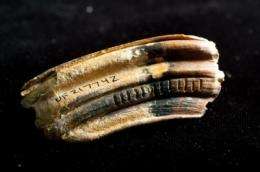
Led by Florida Museum of Natural History vertebrate paleontologist Larisa DeSantis, researchers examined fossil teeth from mammals at two sites representing different climates in Florida: a glacial period about 1.9 million years ago and a warmer, interglacial period about 1.3 million years ago. The researchers found that interglacial warming resulted in dramatic changes to the diets of animal groups at both sites. The study appears in the June 3 issue of the open-access, peer-reviewed journal PLoS ONE.
"When people are modeling future mammal distributions, they're assuming that the niches of mammals today are going to be the same in the future," DeSantis said. "That's a huge assumption."
Co-author Robert Feranec, curator of vertebrate paleontology at the New York State Museum, said scientists cannot predict what species will do based on their current ecology.
"The study definitively shows that climate change has an effect on ecosystems and mammals, and that the responses are much more complex than we might think," Feranec said.
The two sites in the study, both on Florida's Gulf Coast, have been excavated quite extensively, DeSantis said. During glacial periods, lower sea levels nearly doubled Florida's width, compared with interglacial periods. But because of Florida's low latitude, no ice sheets were present during the glacial period. Despite the lack of glaciers in Florida, the two sites show dramatic ecological changes occurred between the two periods.
Both sites include some of the same animal groups, allowing DeSantis, Feranec and Bruce MacFadden, Florida Museum curator of vertebrate paleontology, to clarify how mammals and their environments responded to interglacial warming.
The research examined carbon and oxygen isotopes within tooth enamel to understand the diets of medium to large mammals, including pronghorn, deer, llamas, peccaries, tapirs, horses, mastodons, mammoths and gomphotheres, a group of extinct elephant-like animals.
Differences in how plants photosynthesize give them distinct carbon isotope ratios. For example, trees and shrubs process carbon dioxide differently than warm-season grasses, resulting in different carbon isotope ratios. These differences are incorporated in mammalian tooth enamel, allowing scientists to determine the diets of fossil mammals. Lower ratio values suggest a browsing diet (trees and shrubs) while a higher ratio suggests a grazing diet (grasses).
Animals at the glacial site were predominantly browsing on trees and shrubs, while some of those same animals at the warmer interglacial site became mixed feeders that also grazed on grasses. Increased consumption of grasses by mixed feeders and elephant-like mammals indicates Florida's grasslands likely expanded during interglacial periods.
Tooth enamel locks in the chemical signatures of the plants and water an animal consumes, allowing paleontologists to understand the diets and associated climate of fossil specimens that are millions of years old. To find these signatures, researchers run samples of tooth enamel through a mass spectrometer.
DeSantis and her collaborators analyzed enamel samples from 115 fossil teeth. For two of the specimens she took serial samples, small samples that run perpendicular to the growth axis and give insight into how the diet and climate changed over a specific period of time.
"That's one of the cool things about using mammal teeth," she said. "We can actually look at how variable the climate was within a year, millions of years ago."
The study highlights the importance of the fossil record in understanding long-term ecological responses to changes over time, DeSantis said. While ecological studies of modern impacts can cover only limited spans of time, "this study emphasizes the importance of using the fossil record to look at how mammals and other animals responded to climate change in the past, also helping us gain a better understanding of how they might respond in the future."
More information: DeSantis LRG, Feranec RS, MacFadden BJ (2009) Effects of Global Warming on Ancient Mammalian Communities and Their Environments. PLoS ONE 4(6): e5750. doi:10.1371/journal.pone.0005750, dx.plos.org/10.1371/journal.pone.0005750
Source: Public Library of Science (news : web)


