Physicists demonstrate quantum entanglement in mechanical system
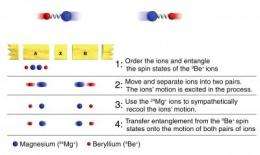
Physicists at the National Institute of Standards and Technology have demonstrated entanglement--a phenomenon peculiar to the atomic-scale quantum world--in a mechanical system similar to those in the macroscopic everyday world. The work extends the boundaries of the arena where quantum behavior can be observed and shows how laboratory technology might be scaled up to build a functional quantum computer.
The research, described in the June 4 issue of Nature, involves a bizarre intertwining between two pairs of vibrating ions (charged atoms) such that the pairs vibrate in unison, even when separated in space. Each pair of ions behaves like two balls connected by a spring (see figure), vibrating back and forth in opposite directions. Familiar objects that vibrate this way include pendulums and violin strings.
The NIST achievement provides insights into where and how "classical" objects may exhibit unusual quantum behavior. The demonstration also showcased techniques that will help scale up trapped-ion technology to potentially build ultra-powerful computers relying on the rules of quantum physics. If they can be built, quantum computers may be able to solve certain problems, such as code breaking, exponentially faster than today's computers.
"Where the boundary is between the quantum and classical worlds, no one really knows," says NIST guest researcher John Jost, a graduate student at the University of Colorado at Boulder and first author of the paper. "Maybe we can help answer the question by finding out what types of things can—and cannot be—entangled. We've entangled something that has never been entangled before, and it's the kind of physical, oscillating system you see in the classical world, just much smaller."
Mechanical oscillators like two pendulum-based clocks have previously been synchronized, but their vibrations can still be independent, so that changes in one have no effect on the other. Quantum entanglement—"spooky action at a distance," in Einstein's words—is a far more counterintuitive process: If two objects are entangled, then manipulating one instantaneously affects the other, no matter how far away it is. Entangled objects do not necessarily have identical properties, just properties that are linked in predictable ways.
Jost and colleagues entangled the vibrational motions of two separated mechanical oscillators, each consisting of one beryllium and one magnesium ion. Each pair behaves like two objects connected by a spring 4 micrometers (millionths of a meter) long, with the beryllium and magnesium moving back and forth in opposite directions, first toward each other, then away, then back again. The two pairs perform this motion in unison, even though they are 240 micrometers apart and are located in different zones of an ion trap. The scientists created the desired entangled state at least 57 percent of the time they tried, and have identified ways to improve the success rate.
The NIST experiments suggest that mechanical oscillators can take part in both the quantum and classical worlds, possessing some features of each, depending in part on the energy and other properties of the vibrations. The experiments also achieved the first combined demonstration of arranging different ions into a desired order, separating and re-cooling them while preserving entanglement, and then performing subsequent quantum operations on the ions. These techniques could help scientists build large-scale quantum computers that use hundreds of ions to store data and perform many computational steps. The same NIST group has previously demonstrated the basic building blocks of a quantum computer using ion traps, as well as rudimentary logic operations.
To entangle the motion of the two oscillators, the NIST group first placed four ions together in one trap zone in a particular linear order (Be-Mg-Mg-Be), and entangled the internal energy states of the two beryllium ions. The team then separated the four ions into two pairs, with each pair containing one of the entangled ions. Finally, the scientists transferred the entanglement from the beryllium ions' internal states to the oscillating motions of the separated ion pairs.
More information: J.D. Jost, J.P. Home, J.M. Amini, D. Hanneke, R. Ozeri, C. Langer, J.J. Bollinger, D. Leibfried & D.J. Wineland. 2009. Entangled Mechanical Oscillators. Nature. June 4, 2009.
Source: National Institute of Standards and Technology (news : web)


