Ghost alps of Antarctica are glimpsed after 14 million years
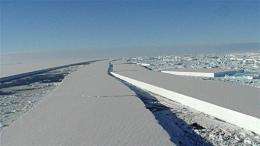
June 3, 2009 A chunk of ice that started to break away from the Antarctic Wilkins Ice Shelf in 2008

Enlarge

Handout photo released in 2008 by the British Antarctic Survey shows of a chunk of ice that started to break away from the Antarctic Wilkins Ice Shelf. Millions of years ago, rivers ran in Antarctica through craggy mountain valleys that were strangely similar to the European Alps of today, Chinese and British scientists reported on Wednesday.

Millions of years ago, rivers ran in Antarctica through craggy mountain valleys that were strangely similar to the European Alps of today, Chinese and British scientists reported on Wednesday.

In a study published by the British journal Nature, they gave a snapshot of terrain that for aeons has lain hidden beneath ice up to several kilometres (nearly two miles) thick.

The imaging comes from a gruelling effort by Chinese glaciologists to probe the mysterious realm beneath the East Antarctic heights, one of the most forbidding places in the world.

In 2004-5 and again in 2007-8, the team hauled deep-penetrating ground radar around a box-shaped sector, measuring 30 kilometers (18 miles) by 30 kilometres, at a point called Dome Argus, or Dome A.

Dome A lies at 4,093 metres (13,302 feet) above sea level and has an average of -58.4 degrees Celsius (-73 degrees Fahrenheit).

Beneath it is an ice sheet between 1,649 and 3,135 metres thick that smothers the Gamburtsev mountains, a range named after a Soviet geophysicist, Grigoriy Gamburtsev, who detected the peaks in 1958.

The radar reflections revealed "classic Alpine topography" similar to Europe's Alps, showing that once there were river valleys that cut their way through the mountains.

Later, these valleys were gouged and deepened by glaciers.

"The landscape has probably been preserved beneath the ice sheet for around 14 million years," says the paper.

The research chimes with deep-sea isotope records that give insights into how Earth got its polar caps.

These suggest there was a period of global cooling, called the Eocene, between 52 and 34 million years ago.

Then came two progressively sharper periods of cooling, linked to a fall in levels of naturally-produced greenhouse gases in the atmosphere -- the same gases that, man-made, are today blamed for warming.

Changes in Earth's orbit and the formation of the frigid current that flows around Antarctica contributed to the process of placing the continent in a deep freeze.

The first of the big chills came at the start of what is called the Oligocene period, around 34 million years ago, when first started to form in Antarctica.

The Gamburtsev mountains, because of their high altitude, were probably one of the places where glaciation first began, the scientists believe. At the time, there would have been a mean summer temperature of three degrees C (37 degrees F), they estimate.

The second cooling spurt came some 14 million years ago, characterised by a plunge in temperatures of around six to seven degrees C (10.8-12.6 degrees F), reaching up to eight degrees C (14.4 degrees F) in the Transantarctic Mountains, the spine that divides East from West Antarctica.

(c) 2009 AFP


print this article email this article download pdf blog this article bookmark this article     Stumble it Digg this share on Facebook retweet share on Reddit add to delicious
Rate this story - 3.6 /5 (18 votes)

Rank Filter

Move the slider to adjust rank threshold, so that you can hide some of the comments.


Display comments: newest first

  • GrayMouser - Jun 03, 2009
    • Rank: 5 / 5 (6)
    Then came two progressively sharper periods of cooling, linked to a fall in levels of naturally-produced greenhouse gases in the atmosphere

    Leading or trailing? Warming periods have been shown to precede GHG increases and it would be interesting to see if the pattern is regular.
  • gwargh - Jun 04, 2009
    • Rank: 5 / 5 (1)
    for some reason this made me think of "Mountain of Madness".

    Interesting research though. Maybe if the Antarctic thaws we'll have new ski resorts down there?


June 3, 2009 all stories

Comments: 2

3.6 /5 (18 votes)
  • Stumble this up

  • Digg this

  • share this

  • hide
  • Related Stories

  • Origin of Alps-size Antarctic mountain range unknown
    created Oct 15, 2008 | popularity not rated yet | comments 0
  • Snowball Antarctica -early Drake passage opening led to global change
    created Aug 30, 2005 | popularity not rated yet | comments 0
  • Team confirms Alps-like mountain range under East Antarctic Ice Sheet
    created Feb 24, 2009 | popularity not rated yet | comments 0
  • First evidence of under-ice volcanic eruption in Antarctica
    created Jan 20, 2008 | popularity not rated yet | comments 0
  • AGAP team poised to probe one of Antarctica's last unexplored places
    created Oct 14, 2008 | popularity not rated yet | comments 0


  • hide
  • Relevant PhysicsForums posts

  • Which countries around the world cause the most destruction to the rain forest
    created 10 hours ago
  • HadleyCru data hacked
    created Nov 20, 2009
  • Younger Dryas Caused by Ice Dam Collapse?
    created Nov 17, 2009
  • Modeling rainfall and flooding
    created Nov 15, 2009
  • More from Physics Forums - Earth

Other News

Astronauts finish another spacewalk, still no baby (AP)

Astronauts finish another spacewalk, still no baby

Space & Earth / Space Exploration

created 9 hours ago | popularity 3 / 5 (2) | comments 0

(AP) -- A spacewalking astronaut put aside the impending birth of his daughter and blazed through his first-ever venture outside the International Space Station on Saturday.


Unseasonably hot and dry weather combined with strong winds to fan scores of blazes in the country's southeastern states

Australia issues 'catastrophic' alerts as fires rage

Space & Earth / Environment

created 16 hours ago | popularity 4 / 5 (3) | comments 0

Australia has issued "catastrophic" alerts after record-breaking temperatures and wild lightning storms sparked more than 100 fires across the country, officials said Saturday.


Commuters wait on the platform shrouded by fog in London

Climate change not man-made, say majority of Britons: poll

Space & Earth / Environment

created Nov 15, 2009 | popularity 3.3 / 5 (15) | comments 46

Less than half of Britons believes that human activity is to blame for global warming, according to a poll carried out for The Times newspaper and published on Saturday.


Mysteriously warm times in Antarctica

Mysteriously warm times in Antarctica

Space & Earth / Earth Sciences

created Nov 18, 2009 | popularity 4.2 / 5 (21) | comments 28

(PhysOrg.com) -- A new study of Antarctica's past climate reveals that temperatures during the warm periods between ice ages (interglacials) may have been higher than previously thought. The latest analysis ...


UN: Fight climate change with free condoms (AP)

UN: Fight climate change with free condoms

Space & Earth / Environment

created Nov 18, 2009 | popularity 3.1 / 5 (11) | comments 24

(AP) -- The battle against global warming could be helped if the world slowed population growth by making free condoms and family planning advice more widely available, the U.N. Population Fund said Wednesday.