Oxygen + MRI might help determine cancer therapy success, researchers find
June 3, 2009
Oxygen + MRI might help determine cancer therapy success, researchers find

Enlarge

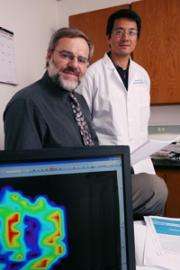
Drs. Ralph Mason (left) and Dawen Zhao, both radiologists, have demonstrated that blood oxygen level dependent MRIs might help oncologists determine the best treatment for some cancer patients. Credit: UT Southwestern Medical Center

A simple magnetic resonance imaging (MRI) test involving breathing oxygen might help oncologists determine the best treatment for some cancer patients, report researchers at UT Southwestern Medical Center.

Prior research has shown that the amount of present in a tumor can be a predictor of how well a patient will respond to treatment. Tumors with little oxygen tend to grow stronger and resist both radiotherapy and chemotherapy. Until now, however, the only way to gauge the oxygen level in a tumor, and thus determine which treatment might be more effective, was to insert a huge needle directly into the cancerous tumor.

The new technique, known as BOLD (blood oxygen level dependent) MRI, can detect oxygen levels in tumors without the need for an . The patient need only be able to breathe in oxygen when undergoing an MRI.

"The patient simply inhales pure oxygen, which then circulates through the bloodstream, including to the tumors," said Dr. Ralph Mason, professor of radiology, director of the UT Southwestern Cancer Imaging Center and senior author of a study appearing online and in a future edition of Magnetic Resonance in Medicine. "Using MRI, we can then go in and estimate how much oxygen a particular tumor is taking up, providing us some insight into how the tumor is behaving and what sort of treatment might be effective."

The most important finding, Dr. Mason said, is that BOLD MRI performed as well as the standard yet more invasive procedure for viewing tumors. That method, known as FREDOM (fluorocarbon relaxometry using echo planar imaging for dynamic oxygen mapping) MRI, requires the injection of a chemical called a reporter molecule directly into the tumor.

"The BOLD technique appears to indicate accurately the oxygen levels in tumors," Dr. Mason said. "Because BOLD is immediately applicable to patients, this holds promise as a new method for predicting response to therapy."

BOLD MRI has been used extensively in studying brain function, but the procedure has only recently begun to be used to assess blood oxygenation and vascular function in tumors.

Physicians at UT Southwestern are already testing BOLD MRI in patients with cervical, prostate, and head and neck cancer. They have proposed using it in lung cancer patients as well, Dr. Mason said. Previous research has shown that those specific tumor types are more likely to have little oxygen.

In the published study, researchers took multiple images of breast tumors implanted just below the skin of rats, which were given anesthesia to help them remain still during the imaging process. Humans do not require anesthesia, Dr. Mason said.

Dr. Mason said the team took the research back to the preclinical stage because they needed to better define what physicians were seeing in the clinic and whether the findings were reproducible.

Dr. Mason said that examining each form of cancer in this way presents its own technical challenges. For example, the motion of the lungs or the design of a face mask for breathing oxygen must be taken into account.

"If we can prove that the test is meaningful in animals, then it is that much more worthwhile to argue for doing it in a patient. This preclinical work provides the foundation for future clinical studies," Dr. Mason said. "It helps justify doing a larger clinical trial with the goal of ultimately becoming a diagnostic test for oncologists."

Researchers currently are trying to determine how much oxygen must be inhaled by a patient in order to be effective. The next step is to expand studies in patients and prove the relevance to more types.

Source: UT Southwestern Medical Center (news : web)


Rank 5 /5 (1 vote)
Related Stories
Relevant PhysicsForums posts
  • Is Everyday Technology Killing Us?
    createdFeb 08, 2012
  • Exercise and weight loss
    createdFeb 08, 2012
  • Why do we have head aches? Our brains can't feel anything.
    createdFeb 07, 2012
  • "The end of diseases" by David Agus, interview from Daily Show with Jon Stewart
    createdFeb 04, 2012
  • Oncolytic adenovirus
    createdFeb 04, 2012
  • Nutrition label stuffs and diets
    createdFeb 02, 2012
  • More from Physics Forums - Medical Sciences

More news stories

Starve a virus, feed a cure? Findings show how some cells protect themselves against HIV

A protein that protects some of our immune cells from the most common and virulent form of HIV works by starving the virus of the molecular building blocks that it needs to replicate, according to research published online ...

Medicine & Health / Research

created 9 hours ago | popularity 5 / 5 (2) | comments 0 | with audio podcast

Overeating may double risk of memory loss

New research suggests that consuming between 2,100 and 6,000 calories per day may double the risk of memory loss, or mild cognitive impairment (MCI), among people age 70 and older. The study was released today and will be ...

Medicine & Health / Neuroscience

created 6 hours ago | popularity 5 / 5 (2) | comments 0 | with audio podcast

Injured boomers beware: Know when to see doctor

(AP) -- It happened to nurse Jane Byron years after an in-line skating fall, business owner Haralee Weintraub while doing "men's" push-ups, and avid cyclist Gene Wilberg while lifting a heavy box.

Medicine & Health / Health

created 11 hours ago | popularity 5 / 5 (1) | comments 0

Declining health-care productivity in England: Who says so?

Reports that the National Health Service in England has been declining in productivity in the last decade appear to have been accepted as fact. However, a Viewpoint published Online First by The Lancet disputes this. The Vi ...

Medicine & Health / Health

created 4 hours ago | popularity not rated yet | comments 0

FDA-approved drug rapidly clears amyloid from the brain, reverses Alzheimer's symptoms in mice

Neuroscientists at Case Western Reserve University School of Medicine have made a dramatic breakthrough in their efforts to find a cure for Alzheimer's disease. The researchers' findings, published in the journal Science, show t ...

Medicine & Health / Neuroscience

created Feb 09, 2012 | popularity 4.9 / 5 (58) | comments 17 | with audio podcast


Scientists discover molecular secrets of 2,000-year-old Chinese herbal remedy

For roughly two thousand years, Chinese herbalists have treated Malaria using a root extract, commonly known as Chang Shan, from a type of hydrangea that grows in Tibet and Nepal. More recent studies suggest that halofuginone, ...

New method to examine batteries -- MRI from the inside

There is an ever-increasing need for advanced batteries for portable electronics, such as phones, cameras, and music players, but also to power electric vehicles and to facilitate the distribution and storage of energy derived ...

Google might launch Drive for cloud storage soon

(PhysOrg.com) -- Google's next big move, according to the Wall Street Journal, is a cloud storage service called Drive. Hardly first to the plate, Google is simply catching up to introducing its cloud reposi ...

A mitosis mystery solved: How chromosomes align perfectly in a dividing cell

Although the process of mitotic cell division has been studied intensely for more than 50 years, Whitehead Institute researchers have only now solved the mystery of how cells correctly align their chromosomes during symmetric ...

Lab study raises questions over nano-particle impact

Tests involving chickens have raised questions about the impact on health from engineered nano-particles, the ultra-fine grains commonly used in drugs and processed foods, scientists said on Sunday.

Researchers find extensive RNA editing in human transcriptome

In a new study published online in Nature Biotechnology, researchers from BGI, the world's largest genomics organization, reported the evidence of extensive RNA editing in a human cell line by analysis of RNA-seq data, demons ...