Cassini Finds Titan's Clouds Hang on to Summer
June 3, 2009 Cassini Finds Titan's Clouds Hang on to Summer

Enlarge

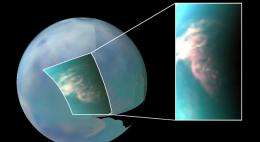
This infrared image of Saturn’s moon Titan shows a large burst of clouds in the moon’s south polar region. Image credit: NASA/JPL/University of Arizona/University of Nantes

(PhysOrg.com) -- Cloud chasers studying Saturn's moon Titan say its clouds form and move much like those on Earth, but in a much slower, more lingering fashion.

Their forecast for Titan's early autumn -- warm and wetter.

Scientists with NASA's mission have monitored Titan's for three-and-a-half years, between July 2004 and December 2007, and observed more than 200 . They found that the way these clouds are distributed around matches scientists' global circulation models. The only exception is timing -- clouds are still noticeable in the southern hemisphere while fall is approaching.

"Titan's clouds don't move with the seasons exactly as we expected," said Sebastien Rodriguez of the University of Paris Diderot, in collaboration with Cassini visual and infrared mapping spectrometer team members at the University of Nantes, France. "We see lots of clouds during the in the , and this summer weather seems to last into the early fall. It looks like Indian summer on , even if the mechanisms are radically different on Titan from those on Earth. Titan may then experience a warmer and wetter early autumn than forecasted by the models."

On Earth, abnormally warm, dry weather periods in late autumn occur when low-pressure systems are blocked in the winter hemisphere. By contrast, scientists think the sluggishness of temperature changes at the surface and low atmosphere on Titan may be responsible for its unexpected warm and wet, hence cloudy, late summer.

The new infrared images showing the global cloud pattern are now available at: http://www.nasa.gov/cassini .

As summer changes to fall at the equinox in August 2009, Titan's clouds are expected to disappear altogether. But, circulation models of Titan's weather and climate predict that clouds at the southern latitudes don't wait for the equinox and should have already faded out since 2005. However, Cassini was still able to see clouds at these places late in 2007, and some of them are particularly active at mid-latitudes and the equator.

Titan is the only moon in our solar system with a substantial atmosphere, and its climate shares Earth-like characteristics. Titan's dense, nitrogen-methane atmosphere responds much more slowly than Earth's atmosphere, as it receives about 100 times less sunlight because it is 10 times farther from the sun. Seasons on Titan last more than seven Earth years.

Scientists will continue to observe the long-term changes during Cassini's extended mission, which runs until the fall of 2010. Cassini is set to fly by Titan on May 6.

Provided by JPL/NASA (news : web)


print this article email this article download pdf blog this article bookmark this article     Stumble it Digg this share on Facebook retweet share on Reddit add to delicious
Rate this story - 4.8 /5 (4 votes)


June 3, 2009 all stories

Comments: 0

4.8 /5 (4 votes)
  • Stumble this up

  • Digg this

  • share this

  • hide
  • Related Stories

  • Titan Weather: Cloudy Every 15 Years
    created Nov 01, 2005 | popularity not rated yet | comments 0
  • Predicting the weather on Titan?
    created Jan 23, 2006 | popularity not rated yet | comments 0
  • Titan's icy climate mimics Earth's tropics
    created Oct 02, 2007 | popularity not rated yet | comments 0
  • Cassini Finds Hydrocarbon Rains May Fill Titan Lakes
    created Jan 30, 2009 | popularity not rated yet | comments 0
  • Cassini images mammoth cloud engulfing Titan’s North Pole
    created Feb 01, 2007 | popularity not rated yet | comments 0


  • hide
  • Relevant PhysicsForums posts

  • The shape of our solar system's orbits.
    created 5 hours ago
  • Above or Below the Line of Nodes
    created 9 hours ago
  • Supernova vs. Nova?
    created 16 hours ago
  • Supernova's Gamma Rays and Comets
    created Nov 06, 2009
  • More from Physics Forums - General Astronomy

Other News

Seattle team wins $900,000 in Space Elevator Games (AP)

Seattle team wins $900,000 in Space Elevator Games

Space & Earth / Space Exploration

created 19 hours ago | popularity 5 / 5 (8) | comments 4

(AP) -- A Seattle team has collected a $900,000 prize in a NASA-backed competition to develop the concept of an elevator to space - an idea spurred by science fiction novels.


Russian rocket to launch from French Guiana in 2010

Space & Earth / Space Exploration

created 18 hours ago | popularity 5 / 5 (3) | comments 0

A Russian rocket will next year for the first time blast off from a European launch pad in South America, officials said Saturday, as the first rockets headed for the site on board a ship.


Success in 'space elevator' competition (AP)

Success in 'space elevator' competition (Update 3)

Space & Earth / Space Exploration

created Nov 05, 2009 | popularity 4.3 / 5 (33) | comments 50

(AP) -- A robot powered by a ground-based laser beam climbed a long cable dangling from a helicopter on Wednesday to qualify for prize money in a $2 million competition to test the potential reality of the ...


Space hotel taking bookings for 2012 opening

Space hotel taking bookings for 2012 opening

Space & Earth / Space Exploration

created Nov 05, 2009 | popularity 4.3 / 5 (19) | comments 11

(PhysOrg.com) -- The first orbiting space hotel is on track to open for its first customers in 2012, but hurry, as bookings are filling fast.


'Dropouts' pinpoint earliest galaxies

'Dropouts' pinpoint earliest galaxies

Space & Earth / Astronomy

created Nov 06, 2009 | popularity 4.1 / 5 (9) | comments 11

Astronomers, conducting the broadest survey to date of galaxies from about 800 million years after the Big Bang, have found 22 early galaxies and confirmed the age of one by its characteristic hydrogen signature ...