The Abyss: Deepest Part of the Oceans No Longer Hidden
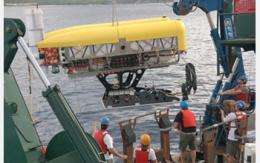
(PhysOrg.com) -- The Abyss is a dark, deep place, but it's no longer hidden. At least when Nereus is on the scene. Nereus is a new type of deep-sea robotic vehicle, called a hybrid remotely operated vehicle (HROV).
Nereus dove to 10,902 meters (6.8 miles) on May 31, 2009, in the Challenger Deep in the Mariana Trench in the western Pacific Ocean, reports a team of engineers and scientists aboard the research vessel Kilo Moana.
The dive makes Nereus the world's deepest-diving vehicle, and the first vehicle to explore the Mariana Trench since 1998.
"Much of the ocean's depths remain unexplored," said Julie Morris, director of the National Science Foundation (NSF)'s Division of Ocean Sciences, which funded the project. "Ocean scientists now have a unique tool to gather images, data and samples from everywhere in the oceans, rather than those parts shallower than 6,500 meters (4 miles). With its innovative technology, Nereus allows us to study and understand previously inaccessible ocean regions."
Nereus's unique hybrid-vehicle design makes it ideally suited to explore the ocean's last frontiers, marine scientists say. The unmanned vehicle is remotely operated by pilots aboard a surface ship via a lightweight, micro-thin, fiber-optic tether that allows Nereus to dive deep and be highly maneuverable. Nereus, however, can also be switched into a free-swimming, autonomous vehicle mode.
"Reaching such extreme depths is the pinnacle of technical challenges," said Andy Bowen, project manager and principal developer of Nereus at the Woods Hole Oceanographic Institution (WHOI). "The team is pleased that Nereus has been successful in reaching the very bottom of the ocean to return imagery and samples from such a hostile world. With a robot like Nereus we can now explore anywhere in the ocean. The trenches are virtually unexplored, and Nereus will enable new discoveries there. Nereus marks the start of a new era in ocean exploration."
Nereus (rhymes with "serious") is a mythical Greek god with a fish-tail and a man's torso. The vehicle was named in a nationwide contest open to high school and college students.
The Mariana Trench forms the boundary between two tectonic plates, where the Pacific Plate is subducted beneath the small Mariana Plate. It is part of the Pacific Ring of Fire, a 40,000-kilometer (25,000-mile) area where most of the world's volcanic eruptions and earthquakes occur. At 11,000 meters, its depth is about the height a commercial airliner flies.
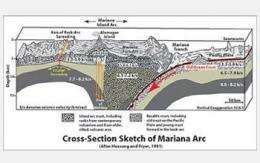
To reach the trench, Nereus dove nearly twice as deep as research submarines are capable of, and had to withstand pressures 1,000 times that at Earth's surface--crushing forces similar to those on the surface of Venus, according to Dana Yoerger of WHOI and Louis Whitcomb of Johns Hopkins University, who developed the vehicle's navigation and control system and conducted successively deeper dives to test Nereus.
"We couldn't be prouder of the stunning accomplishments of this dedicated and talented team," said Susan Avery, president and director of WHOI. "With this engineering trial successfully behind us, we're eager for Nereus to become widely used to explore the most inaccessible reaches of the ocean. With no part of the deep seafloor beyond our reach, it's exciting to think of the discoveries that await."
Only two other vehicles have succeeded in reaching the Mariana Trench: the U.S. Navy-built bathyscaphe Trieste, which carried Jacques Piccard and Don Walsh there in 1960, and the Japanese-built robot Kaiko, which made three unmanned expeditions to the trench between 1995 and 1998.
Trieste was retired in 1966 and Kaiko was lost at sea in 2003.
The Nereus engineering team believed that a tethered robot using traditional technologies would be prohibitively expensive to build and operate. So they used unique technologies and innovative methods to strike a balance between size, weight, materials cost and functionality.
Building on previous experience developing tethered robots and autonomous underwater vehicles (AUVs), the team fused the two approaches together to develop a hybrid vehicle that could fly like an aircraft to survey and map broad areas, then be converted quickly into a remotely operated vehicle (ROV) that can hover like a helicopter near the seafloor to conduct experiments or to collect biological or rock samples.
The tethering system presented one of the greatest challenges in developing a cost-effective ROV capable of reaching these depths. Traditional robotic systems use a steel-reinforced cable made of copper to power the vehicle, and optical fibers to enable information to be passed between the ship and the vehicle. If such a cable were used to reach the Mariana Trench, it would snap under its own weight before it reached that depth.
To solve this challenge, the Nereus team adapted fiber-optic technology developed by the Navy's Space and Naval Warfare Systems Center Pacific to carry real-time video and other data between the Nereus and the surface crew. Similar in diameter to a human hair and with a breaking strength of only eight pounds, the tether is composed of glass fiber with a very thin protective jacket of plastic.
Nereus brings approximately 40 kilometers (25 miles) of cable in two canisters the size of large coffee cans that spool out the fiber as needed. By using this very slender tether instead of a large cable, the team was able to decrease the size, weight, complexity and cost of the vehicle.
Another weight-saving advance of the vehicle is its use of ceramic spheres for flotation, rather than the much heavier traditional syntactic foam used on vehicles like the submersible Alvin or the ROV Jason.
Each of Nereus's two hulls contains between 700 and 800 of the 9-centimeter (3.5-inch) hollow spheres that are precisely designed and fabricated to withstand crushing pressures.
WHOI engineers also developed a hydraulically operated, lightweight robotic manipulator arm that could operate under intense pressure.
With its tandem hull design, Nereus weighs nearly 3 tons in air and is about 4.25 meters (14 feet) long and approximately 2.3 meters (nearly 8 feet) wide. It is powered by more than 4,000 lithium-ion batteries. They are similar to those used in laptop computers and cell phones, but have been carefully tested to be used safely and reliably under the intense pressure of the depths.
"These and future discoveries by Nereus will be the result of its versatility and agility--it's like no other deep submergence vehicle," said Tim Shank, a biologist at WHOI who is aboard the expedition. "It allows vast areas to be explored with great effectiveness. Our true achievement is not just getting to the deepest point in the oceans, but unleashing a capability that now enables deep exploration, unencumbered by a heavy tether and surface ship, to investigate some of the richest geological and biological systems on Earth."
On May 31, the team took the vehicle to 10,902 meters, the deepest dive to date. Testing will continue over the next few days and the team will return to port on June 5. On this initial engineering cruise, Nereus's AUV mode was not tested.
On its dive to the Challenger Deep, Nereus spent more than 10 hours on the bottom, sending live video back to the ship through its fiber-optic tether and collecting biological and geological samples with its manipulator arm, and placed a marker on the seafloor signed by those onboard the surface ship.
"The samples collected by the vehicle include sediment from the tectonic plates that meet at the trench and, for the first time, rocks from deep exposures of the Earth's crust close to mantle depths south of the Challenger Deep," said geologist Patty Fryer of the University of Hawaii, also aboard the expedition. We will know the full story once shore-based analyses are completed back in the laboratory this summer. We can integrate them with the new mapping data to tell a story of plate collision in greater detail than ever before accomplished in the world's oceans."
Provided by National Sleep Foundation (news : web)


