Common GPS could help better track airline flights
June 4, 2009 By MICHAEL TARM , Associated Press Writer
Common GPS could help better track airline flights (AP)

Enlarge

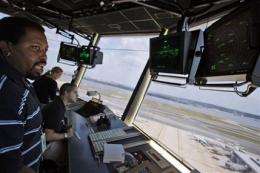
FILE - In this Sept. 18, 2008 file photo, air traffic controllers, from left to right: Karl Haynes, Jr., Danika Dry-Rodriguez, and Stephen Boyd, work in the control tower at Washington's Reagan National Airport. The disappearance of Air France Flight 477 has critics of radar-based air traffic control calling on the U.S. and other countries to hasten the move to GPS-based networks that promise to precisely track all planes. (AP Photo/Charles Dharapak, File)

(AP) -- Get lost in the woods and a cell phone in your pocket can help camping buddies find you. Drive into a ditch and GPS in your car lets emergency crews pinpoint the crash site. But when a transcontinental flight is above the middle of the ocean, no one on the ground can see exactly where it is - in the air, or worse, in the water.

The disappearance of Flight 477 and its 228 passengers over the Atlantic Ocean this week has critics of radar-based air traffic control calling on the U.S. and other countries to hasten the move to GPS-based networks that promise to precisely track all planes. Current radars are obsolete more than 200 miles from land.

"The technology's there - we've had this stuff for 15 years and little's happened," said Michael Boyd, a Colorado-based airline analyst. "My BlackBerry can be used to track me, so why can't we do it with planes?"

U.S. officials have discussed setting up such a network since the 1990s and the technology is being tested in parts of the country, including Alaska and off the Gulf Coast. A few carriers, like Southwest, already use to help planes make quicker landings that burn less fuel.

But full implementation, estimated at a cost of $35 billion, has languished amid funding delays and disputes over technical complexities. Although Transportation Secretary Ray LaHood has said the project will be among the Federal Aviation Administration's top priorities in the Obama administration, the existing radar system is likely to remain for at least another decade.

"It's a crude system they're using now," said Robert Poole, an aviation expert with the free market-oriented Reason Foundation. "For 100 dollars, you can run down and buy a GPS system, put it in your car and know exactly where you are. But planes don't have it."

Some European and Asian countries are moving more quickly toward establishing pricey satellite systems. But many other countries lag behind, including Brazil, where the ill-fated Air France took off Sunday.

Current air traffic systems do not allow controllers to see a transoceanic plane on radar until it is within about 200 miles of land. Instead, controllers often estimate a plane's location based on flight plans and departure times. Such imprecision leaves planes vulnerable in emergencies, such as water landings, Boyd said.

"If a plane ditches and there are survivors, you may not be able to get to it fast enough," he said. "And if an airplane was hijacked in the middle of the Atlantic Ocean, we wouldn't know until it pops up somewhere else."

A reported electrical system failure aboard Flight 477 likely would have knocked out any GPS devices even if the flight had been equipped with that technology. But under a satellite system, rescuers would have known the aircraft's precise location when the failure occurred, presumably making the search area much smaller and helping authorities locate the wreckage faster. That timeliness that can also be crucial in determining a cause of a crash.

Radar quality varies from country to country. For example, many U.S. control centers at least enable planes to send more frequent updates about their location, even when beyond radar's reach.

But over oceans, including vast blind spots in the middle of the Atlantic on U.S.-European routes, pilots usually have to resort to calling controllers with estimated positions every hour or so. The call-ins can frustrate pilots, especially in and around South America, where radio and radar coverage can be patchy, said retired airline pilot Vaughn Cordle, who lives in the Washington area.

"There's nothing worse than going through the painful exercise of trying to talk to someone and letting them know where you are," Cordle said. "The South American region can be more dangerous because pilots are sometimes on their own."

A plane failing to check in after more than two or three hours can be an air traffic controller's worst fear, said New York-based controller Pat McDonough.

"It's very disturbing to the controller to lose an aircraft - you feel responsible," he said. "I sympathize with those guys watching the Air France flight."

GPS proponents say satellite-based systems provide another benefit that could have directly affected Flight 477, which disappeared into a band of towering thunderstorms. Such systems would collect information from around the globe and allow for real-time weather maps to appear on cockpit displays, giving pilots a tool to better determine how to navigate oncoming weather.

"The point is if we have GPS to monitor airplanes, could it save lives?" Boyd said. "The answer is clearly yes."

©2009 The Associated Press. All rights reserved. This material may not be published, broadcast, rewritten or redistributed.

Filter


Move the slider to adjust rank threshold, so that you can hide some of the comments.


Display comments: newest first

Sirussinder
Jun 04, 2009

Rank: not rated yet
Seriously, there is no GPS on today's so called high tech aircraft like Airbus? You would think anything that would assist in navigation would be a given. Come on what gives !

I will send them my full featured GPS cell phone they can duck tape to the flight control panel!


TJ_alberta
Jun 04, 2009

Rank: not rated yet
look up APRS -- you can see the planes (and lots of other vehicles) moving around on the map. it's been working for years.
Rank 3 /5 (2 votes)
Related Stories
Relevant PhysicsForums posts
  • How to tilt a object
    created14 hours ago
  • How to calculate total compressibility in liquid porous solid system
    created19 hours ago
  • Need help reading 3-D
    createdFeb 11, 2012
  • A way to send and receive wireless data
    createdFeb 11, 2012
  • Calling function with no input argument
    createdFeb 10, 2012
  • Force free body diagram problem on gym equipment
    createdFeb 10, 2012
  • More from Physics Forums - General Engineering

More news stories

Independent group inspects Apple supplier

(AP) -- An independent group, the Fair Labor Association, has started auditing Apple Inc.'s Chinese supplier Foxconn after a request by Apple.

Technology / Business

created 29 minutes ago | popularity not rated yet | comments 0

Teaching teens safety in the virtual world

A new cyber safety program on the dangers of social networking is being developed by Flinders University, in light of an alarming report which shows children as young as 12 are meeting internet strangers in ...

Technology / Internet

created 1 hour ago | popularity not rated yet | comments 0

Ethanol mandate not the best option

Many people are willing to pay a premium for ethanol, but not enough to justify the government mandate for the corn-based fuel, a Michigan State University economist argues.

Technology / Energy & Green Tech

created 1 hour ago | popularity 5 / 5 (1) | comments 0

Microsoft India retail site down after 'cyber attack'

Microsoft said Monday it was investigating an attack by hackers on its Indian retail website, reportedly carried out by a Chinese group called the "Evil Shadow Team."

Technology / Internet

created 4 hours ago | popularity not rated yet | comments 0

Chinese city seizes Apple iPads in name dispute

(AP) -- Authorities have seized Apple iPads from retailers in a city in northern China due to a dispute with a domestic company that says it owns the iPad name, an official said Monday. The Chinese company said it is asking ...

Technology / Business

created 4 hours ago | popularity not rated yet | comments 0


Fast photon control brings quantum photonic technologies closer

(PhysOrg.com) -- Using photons instead of electrons to transmit information could lead to faster and more secure ways to communicate, among other advantages. Now a team of physicists has taken another step toward realizing ...

Planck mission steps closer to the cosmic blueprint

(PhysOrg.com) -- ESA's Planck mission has revealed that our Galaxy contains previously undiscovered islands of cold gas and a mysterious haze of microwaves. These results give scientists new treasure to mine ...

New ability to regrow blood vessels holds promise for treatment of heart disease

(Medical Xpress) -- University of Texas at Austin researchers have demonstrated a new and more effective method for regrowing blood vessels in the heart and limbs — a research advancement that could have ...

Myths and shame keep many from seeking bankruptcy protection

(PhysOrg.com) -- Two interesting facts that may counter modern ideas about bankruptcy: The overwhelming majority of U.S. filings belong to individuals rather than corporations or entities, and most of these ...

Big Society could threaten biodiversity conservation

A study of the Moray Firth Seal Management Plan (MFSMP), in north-east Scotland, identified four key conditions for long-term success, three of which pointed to the importance of direct government involvement.

Motivation to exercise affects behavior

(Medical Xpress) -- For many people, the motivation to exercise fluctuates from week to week, and these fluctuations predict whether they will be physically active, according to researchers at Penn State. In an effort to ...