A Billion Year Ultra-Dense Memory Chip (w/Video)
June 4, 2009
A Billion Year Ultra-Dense Memory Chip

Enlarge

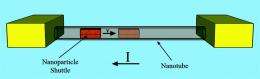
This illustration shows the configuration of a new digital memory storage device consisting of an iron nanoparticle shuttle that moves through a carbon nanotube when a voltage is applied. This memory device can pack a trillion bits of data into one square inch of medium and retain that data for a billion years. (Image from the American Chemical Society)

(PhysOrg.com) -- Berkeley Lab researchers have created a unique ultra-high density memory storage medium that can preserve digital data for a billion years.

When it comes to data storage, density and durability have always moved in opposite directions - the greater the density the shorter the durability. For example, information carved in stone is not dense but can last thousands of years, whereas today's silicon memory chips can hold their information for only a few decades. Researchers with the U.S. Department of Energy's Lawrence Berkeley National Laboratory (Berkeley Lab) and the University of California (UC) Berkeley have smashed this tradition with a new medium that can pack thousands of times more data into one square inch of space than conventional chips and retain this data for more than a billion years!

"We've developed a new mechanism for digital memory storage that consists of a crystalline iron nanoparticle shuttle enclosed within the hollow of a multiwalled ," said physicist Alex Zettl who led this research.

"Through this combination of nanomaterials and interactions, we've created a memory device that features both ultra-high density and ultra-long lifetimes, and that can be written to and read from using the conventional voltages already available in digital electronics."

Zettl, one of the world's foremost researchers into nanoscale systems and devices, holds joint appointments with Berkeley Lab's Materials Sciences Division (MSD) and the Physics Department at UC Berkeley, where he is the director of the Center of Integrated Nanomechanical Systems. He is the principal author of a paper that has been published on-line by entitled: "Nanoscale Reversible Mass Transport for Archival Memory." Co-authoring the paper with Zettl were Gavi Begtrup, Will Gannett and Tom Yuzvinsky, all members of his research group, plus Vincent Crespi, a theorist at Penn State University.

This video is not supported by your browser at this time.

This video shows an iron nanoparticle shuttle moving through a carbon nanotube in the presence of a low voltage electrical current. The shuttle’s position inside the tube can function as a high-density nonvolatile memory element. Credit: Courtesy of Zettl Research Group, Lawrence Berkeley National Laboratory and University of California at Berkeley

The ever-growing demand for digital storage of videos, images, music and text calls for storage media that pack increasingly more data onto chips that keep shrinking in size. However, this demand runs in sharp contrast to the history of data storage. Compare the stone carvings in the Egyptian temple of Karnak, which store approximately two bits of data per square inch but can still be read after nearly 4,000 years, to a modern DVD which can store 100 giga (billion) bits of data per square inch but will probably remain readable for no more than 30 years.

"Interestingly," said Zettl, "the Domesday Book, the great survey of England commissioned by William the Conqueror in 1086 and written on vellum, has survived over 900 years, while the 1986 BBC Domesday Project, a multimedia survey marking the 900th anniversary of the original Book, required migration from the original high-density laserdiscs within two decades because of media failure."

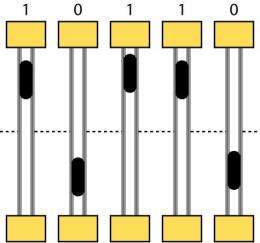
Zettl and his collaborators were able to buck data storage history by creating a programmable memory system that is based on a moveable part - an iron nanoparticle, approximately 1/50,000th the width of a human hair, that in the presence of a low voltage electrical current can be shuttled back and forth inside a hollow carbon nanotube with remarkable precision. The shuttle's position inside the tube can be read out directly via a simple measurement of electrical resistance, allowing the shuttle to function as a nonvolatile memory element with potentially hundreds of binary memory states.

"The shuttle memory has application for archival data storage with information density as high as one trillion bits per square inch and thermodynamic stability in excess of one billion years," Zettl said. "Furthermore, as the system is naturally hermetically sealed, it provides its own protection against environmental contamination."
A billion-year ultra-dense memory chip
Enlarge

The nanoscale electromechanical memory device can write/read data based on the position of an iron nanoparticle in a carbon nanotube. Here the memory devices are displaying a binary sequence 1 0 1 1 0. Credit: Courtesy of Zettl Research Group, Lawrence Berkeley National Laboratory and University of California at Berkeley

The low voltage electrical write/read capabilities of the memory element in this electromechanical device
facilitates large-scale integration and should make for easy incorporation into today's silicon processing systems. Zettl believes the technology could be on the market within the next two years and its impact should be significant.

"Although truly archival storage is a global property of an entire memory system, the first requirement is that the underlying mechanism of information storage for individual bits must exhibit a persistence time much longer than the envisioned lifetime of the resulting device," he said. "A single bit lifetime in excess of a billion years demonstrates that our system has the potential to store information reliably for any practical desired archival time scale."

The multiwalled carbon nanotube and enclosed iron nanoparticle shuttle were synthesized in a single step via pyrolysis of ferrocene in argon gas at a temperature of 1,000 degrees Celsius. The nanotube memory elements were then ultrasonically dispersed in isopropanol and deposited on a substrate. A transmission electron microscope provided high-resolution imaging in real time while the was in operation. In laboratory tests, this device met all the essential requirements for digital memory storage including the ability to overwrite old data.

"We believe our nanoscale electromechanical memory system
presents a new solution to the challenge of ultra-high density archival data storage," Zettl said.

Source: Lawrence Berkeley National Laboratory (news : web)

4.2 /5 (29 votes)  

Filter


Move the slider to adjust rank threshold, so that you can hide some of the comments.


Display comments: newest first

nilbud
Jun 04, 2009

Rank: 5 / 5 (4)
Hopefully they can improve it because I need to keep my stuff for 2 billion years.
holoman
Jun 04, 2009

Rank: 1 / 5 (1)
Does it come with a spicket on either end.

Can I have the guarantee in writing in case I
need to contact the service department.
h0dges
Jun 04, 2009

Rank: not rated yet
I just hope it's fast too.

Durable, dense, and FAST !
Azpod
Jun 04, 2009

Rank: 5 / 5 (2)
I'll settle for slow if it means I can have a 10Tb USB stick that I can archive all my data on and know my great grandchildren could still plug it into a reader & get reliable data from it.
Nik_2213
Jun 04, 2009

Rank: 5 / 5 (2)
Wow ! It's a real, live, digital Abacus !!
zbarlici
Jun 05, 2009

Rank: 1 / 5 (1)
dude... DO NOT DATE YOURSELF.... abacus? comeooon maaaaan! WTH is an abacus? how old are you? ;)
petrosdias
Jun 05, 2009

Rank: not rated yet
Wow ! It's a real, live, digital Abacus !!
Hahaha, it IS indeed a digital Abacus of a sort!
Interesting technology. Couple that with a good container and you got yourself a really neat time-box thingy. When can I pick one up? (hint, not soon enough).
SmartK8
Jun 05, 2009

Rank: not rated yet
Abacus! More likely a pneumatic tube system. It also reminds me of my thoughts, how the electricity works, when I was a kid. Anyway, nice indeed.
laserdaveb
Jun 05, 2009

Rank: not rated yet
hey zb, nik's not as old as i am....i still count on my fingers!
check the video...as they move the iron back and forth its getting shorter...1 billion years but limited read/write....
CWonPhysOrg
Jun 05, 2009

Rank: 5 / 5 (3)
Just for a little perspective:

When I was in college (a looonnng time ago) my programming instructor explained to us that nano-second speeds were impossible until we could manufacture a CPU that was smaller than one CUBIC FOOT in size.

Simply by clicking a button, I just watched a movie that came across thousands of miles. That movie showed real events 1/50,000th the width of a human hair. I watched it on a 6 year old computer that is readily available to a large percentage of the world's population.

That is pretty, stinking, amazing progress in 50 years!
nilbud
Jun 05, 2009

Rank: 5 / 5 (1)
Thanks. I do what I can.
gongii
Jun 07, 2009

Rank: not rated yet
I must have missed their explanation for the resistance difference and the motion.
Rank 4.2 /5 (29 votes)
Relevant PhysicsForums posts
  • Books To Inspire a Beginnig Physics Student
    created2 hours ago
  • Pith balls problem
    created2 hours ago
  • Electrostatics
    created2 hours ago
  • what is phase constant
    created2 hours ago
  • Basics In electromagnetic wave
    created2 hours ago
  • How to calculate theoretical initial velocity?
    created3 hours ago
  • More from Physics Forums - General Physics

More news stories

What lies beneath: Mapping hidden nanostructures

The ability to diagnose and predict the properties of materials is vital, particularly in the expanding field of nanotechnology. Electron and atom-probe microscopy can categorize atoms in thin sheets of material, ...

Nanotechnology / Nanophysics

created 17 hours ago | popularity 5 / 5 (3) | comments 1

New kind of solar cell could capture significantly more energy than current cells

New solar cells could increase the maximum efficiency of solar panels by over 25%, according to scientists from the University of Cambridge.

Nanotechnology / Nanophysics

created Feb 08, 2012 | popularity 4.5 / 5 (12) | comments 14 | with audio podcast

Nanoshell whispering galleries improve thin solar panels

Visitors to Statuary Hall in the U.S. Capitol Building may have experienced a curious acoustic feature that allows a person to whisper softly at one side of the cavernous, half-domed room and for another on ...

Nanotechnology / Nanomaterials

created Feb 07, 2012 | popularity 4.3 / 5 (6) | comments 6 | with audio podcast

'Dark plasmons' transmit energy

Microscopic channels of gold nanoparticles have the ability to transmit electromagnetic energy that starts as light and propagates via "dark plasmons," according to researchers at Rice University.

Nanotechnology / Nanophysics

created Feb 09, 2012 | popularity 4.8 / 5 (8) | comments 1 | with audio podcast

Revealing how a battery material works

Since its discovery 15 years ago, lithium iron phosphate (LiFePO4) has become one of the most promising materials for rechargeable batteries because of its stability, durability, safety and ability to deliver ...

Nanotechnology / Nanomaterials

created Feb 08, 2012 | popularity 5 / 5 (5) | comments 0 | with audio podcast


Anonymous knocks CIA website offline (Update)

The website of the Central Intelligence Agency was inaccessible on Friday after the hacker group Anonymous claimed to have knocked it offline.

New error-correcting codes guarantee the fastest possible rate of data transmission

Error-correcting codes are one of the triumphs of the digital age. They’re a way of encoding information so that it can be transmitted across a communication channel — such as an optical fiber o ...

Google users warned of threat to smartphone wallets

Users of Google smartphone wallets were being warned on Friday that there is a way to crack pass codes intended to thwart thieves from going on illicit shopping sprees.

Humans may have helped the decline of African rainforests 3000 years ago

(PhysOrg.com) -- Large areas of rainforests in Central Africa mysteriously disappeared over three thousand years ago, to be replaced by savannas. The prevailing theory has been that the cause was a change ...

New power source discovered

(PhysOrg.com) -- Researchers at the Massachusetts Institute of Technology (MIT) and RMIT University have made a breakthrough in energy storage and power generation.

The power of estrogen -- male snakes attract other males

A new study has shown that boosting the estrogen levels of male garter snakes causes them to secrete the same pheromones that females use to attract suitors, and turned the males into just about the sexiest ...