Stellar family in crowded, violent neighborhood proves to be surprisingly normal
June 4, 2009 Stellar family in crowded, violent neighborhood proves to be surprisingly normal

Enlarge

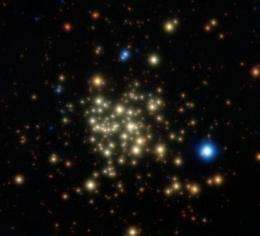
This image of the Arches Cluster of young, massive stars was obtained with NACO on ESO's Very Large Telescope. The field of view is 28 arcseconds. North is up and east is to the left. This image is a composite of infrared images obtained through J, H and K filters. The stars appear as bright cores surrounded by faint diffuse halos. This is typical of images obtained by adaptive optics instruments. The halo corresponds to light that was not fully corrected for the blurring effects of the Earth's atmosphere. Credit: ESO/P. Espinoza

The massive Arches Cluster is a rather peculiar star cluster. It is located 25 000 light-years away towards the constellation of Sagittarius (the Archer), and contains about a thousand young, massive stars, less than 2.5 million years old [1]. It is an ideal laboratory to study how massive stars are born in extreme conditions as it is close to the centre of our Milky Way, where it experiences huge opposing forces from the stars, gas and the supermassive black hole that reside there. The Arches Cluster is ten times heavier than typical young star clusters scattered throughout our Milky Way and is enriched with chemical elements heavier than helium.

Using the NACO adaptive optics instrument on ESO's Very Large Telescope, located in Chile, astronomers scrutinised the cluster in detail. Thanks to adaptive optics, astronomers can remove most of the blurring effect of the atmosphere, and so the new NACO images of the Arches Cluster are even crisper than those obtained with telescopes in space. Observing the Arches Cluster is very challenging because of the huge quantities of absorbing dust between Earth and the Galactic Centre, which visible light cannot penetrate. This is why NACO was used to observe the region in near-infrared light.

The new study confirms the Arches Cluster to be the densest cluster of massive young stars known. It is about three light-years across with more than a thousand stars packed into each cubic light-year — an extreme density a million times greater than in the Sun's neighbourhood.

Astronomers studying clusters of stars have found that higher mass stars are rarer than their less massive brethren, and their relative numbers are the same everywhere, following a universal law. For many years, the Arches Cluster seemed to be a striking exception.

"With the extreme conditions in the Arches Cluster, one might indeed imagine that stars won't form in the same way as in our quiet solar neighbourhood," says Pablo Espinoza, the lead author of the paper reporting the new results. "However, our new observations showed that the masses of stars in this cluster actually do follow the same universal law".

In this image the astronomers could also study the brightest stars in the cluster. "The most massive star we found has a mass of about 120 times that of the Sun," says co-author Fernando Selman. "We conclude from this that if stars more massive than 130 solar masses exist, they must live for less than 2.5 million years and end their lives without exploding as supernovae, as usually do."

The total mass of the cluster seems to be about 30 000 times that of the Sun, much more than was previously thought. "That we can see so much more is due to the exquisite NACO images," says co-author Jorge Melnick.

[1] The name "Arches" does not come from the constellation the cluster is located in (Sagittarius, i.e., the Archer), but because it is located next to arched filaments detected in radio maps of the centre of the Milky Way.

More information: This research was presented in a paper to appear in Astronomy and Astrophysics (The massive star Initial Mass Function of the Arches Cluster, by P. Espinoza et al.).

Source: ESO (news : web)


Rate this story - 4.7 /5 (6 votes)

Rank Filter

Move the slider to adjust rank threshold, so that you can hide some of the comments.


Display comments: newest first

  • yyz - Jun 07, 2009
    • Rank: not rated yet
    An interesting overview paper was published last year (2008) by Don Figer entitled "Massive Star Formation in the Galactic Center". A copy of this short, informative paper can be found here: http://www.cis.ri...ci06.pdf . Dr Figer specifically concentrates on the latest research on the Central Cluster of our Milky Way, the Arches Cluster and the Quintuplet Cluster (and its' 'Pistol Star'). MANY references are provided for all three massive clusters up to the date of publication (March 2008). Also included are useful diagrams highlighting these clusters and their positions and proximity to the center of our galaxy. And, of course, many painstakingly acquired images of these objects are also included. Interested readers would do well to check out the paper, as it reflects current research on these home grown massive stellar clusters and the bizarre neighborhood they inhabit

June 4, 2009 all stories

Comments: 1

4.7 /5 (6 votes)

  • hide
  • Related Stories

  • Stars Have a Weight Limit
    created Mar 09, 2005 | popularity not rated yet | comments 0
  • Massive star cluster in our backyard - astronomically speaking!
    created Mar 23, 2005 | popularity not rated yet | comments 0
  • Star on a Hubble diet
    created Dec 11, 2006 | popularity not rated yet | comments 0
  • Extreme star cluster bursts into life in new Hubble image
    created Oct 02, 2007 | popularity not rated yet | comments 0
  • Chandra Lifts the Veil on Milky Way 'Hotspot'
    created Jan 23, 2008 | popularity not rated yet | comments 0


  • hide
  • Relevant PhysicsForums posts

  • Spreading Life in the Universe
    created 1hour ago
  • Force of Gravity in terms of Density
    created Feb 08, 2010
  • what is the relation between gravity and light?
    created Feb 08, 2010
  • Does the Thermoelectric effect apply in sun?
    created Feb 07, 2010
  • More from Physics Forums - General Astronomy

Other News

Climate 'Tipping Points' May Arrive Without Warning, Says Top Forecaster

Space & Earth / Environment

created 54 minutes ago | popularity not rated yet | comments 0 | with audio podcast

(PhysOrg.com) -- A new University of California, Davis, study by a top ecological forecaster says it is harder than experts thought to predict when sudden shifts in Earth's natural systems will occur -- a worrisome finding ...


A new 3-D map of the interstellar gas within 300 parsecs from the sun

A new 3D map of the interstellar gas within 300 parsecs from the Sun

Space & Earth / Astronomy

created 3 hours ago | popularity 5 / 5 (3) | comments 0 | with audio podcast

(PhysOrg.com) -- Astronomy & Astrophysics is publishing new 3D maps of the interstellar gas in the local area around our Sun. A French-American team of astronomers presents new absorption measurements toward ...


URI researcher calls for global effort to monitor marine pollutants

Space & Earth / Environment

created 1hour ago | popularity 5 / 5 (1) | comments 1

A University of Rhode Island researcher who studies chemical pollutants in the marine environment has called on colleagues around the world to establish a global monitoring network to verify that the chemicals banned by the ...


Rho Ophiuchus cloud

Professor: We have a 'moral obligation' to seed universe with life

Space & Earth / Astronomy

created 12 hours ago | popularity 3.7 / 5 (19) | comments 34 | with audio podcast report

(PhysOrg.com) -- Eventually, the day will come when life on Earth ends. Whether that’s tomorrow or five billion years from now, whether by nuclear war, climate change, or the Sun burning up its fuel, the last ...


New international satellite observations help assess future earthquake risk in Haiti

New international satellite observations help assess future earthquake risk in Haiti

Space & Earth / Earth Sciences

created 4 hours ago | popularity not rated yet | comments 0

Virginia Key, Florida--Scientists at the University of Miami have analyzed images based on Synthetic Aperture Radar (SAR) observations taken before and just after Haiti's earthquake, on January 12. The images ...