Why Things Become Unpopular
June 4, 2009 By Lisa Zyga
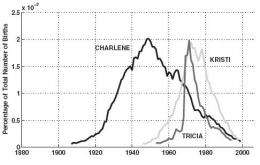
A recent study has found that the fall of an item’s popularity mirrors its rise to popularity, so that items that become popular faster also die out faster, which is demonstrated by name trends. Image caption: Berger and Le Mens. ©2009 PNAS.
(PhysOrg.com) -- "Why is everybody suddenly wearing those new sandals and listening to that new band? It's so trendy!" A recent study has investigated this sentiment in order to understand why some cultural products and styles die out faster than others. According to the results, the quicker a cultural item rockets to popularity, the quicker it dies. This pattern occurs because people believe that items that are adopted quickly will become fads, leading them to avoid these items, thus causing these items to die out.
In their study, Jonah Berger from the University of Pennsylvania and Gaël Le Mens from Stanford University and Pompeu Fabra University in Barcelona have investigated why things become unpopular, and have found some surprisingly counterintuitive results. Their study is published in a recent issue of Proceedings of the National Academy of Sciences.
“While it is easy to see products, ideas, or behaviors catch on in popular culture, less in known about why such things become unpopular,” Berger told PhysOrg.com. “We show how social dynamics drive cultural change, and examine the reciprocal interplay between individual decisions and collective outcomes. Aggregate changes in popularity shape individual choice, which in turn drives aggregate popularity.”
To investigate how cultural tastes change over time, Berger and Le Mens analyzed thousands of baby names from the past 100 years in France and the US. (Because there is less of an influence of technology or advertising on name choice, baby names provide a way to study how adoption depends on primarily internal factors.) The researchers found a consistent symmetry in the rise and fall of individual names; in other words, the longer it took for a name to become popular, the longer it took for the name to fade out of popularity, and thus the more staying power it had compared to names that quickly rose and fell. The effect was robust, occurring in both countries and across various time windows.
To find additional support for this relationship, the researchers also interviewed expecting parents on how likely they would be to give their children certain names. Afterwards, participants rated their perception of how trendy each name was. The results showed that parents viewed names that had experienced sharper recent increases in usage as fads, and avoided these names in accordance with this concern.
As the scientists explain, these findings suggest that beliefs about the evolution of popularity may be self-fulfilling. There is no mathematical necessity that forces cultural items (such as names) that sharply increase in popularity to die out faster, but people’s beliefs have the ability to create this reality, since people don’t want to be seen as following the herd. This effect is an example of how psychological processes shape culture, in addition to the more widely known reciprocal dynamic, that culture can shape thought processes.
Besides baby names, the symmetry between popularity rise and fall can carry over to other cultural items. For example, the scientists noted that similar outcomes have been observed in the music industry, where new artists who shoot to the top of the charts right away also fall quickly, and so have lower overall sales than those who rise more slowly. While this finding seems counterintuitive, since a quick rise in popularity would seem like a good thing, it shows that a backlash to perceived fads should be taken into account. As the researchers explain, people who want to ensure the persistence and success of particular items should seek to popularize the items at a slow but steady pace.
“Managers often want their products to catch on quickly, and conventional wisdom would say that products which catch on quickly should be more likely to succeed,” Berger said. “Our results, however, show that the exact opposite can occur. Fast adoption can hurt success. We think these findings extend to a broad range of areas where choices signal identity. People often join social movements, choose products, or wear styles because of what it communicates about them to others, and in these domains of life, adoption speed should influence cultural success.”
More information: Jonah Berger and Gaël Le Mens. “How adoption speed affects the abandonment of cultural tastes.” PNAS, 8146-8150, May 19, 2009, vol. 106, no. 20.
Copyright 2009 PhysOrg.com.
All rights reserved. This material may not be published, broadcast, rewritten or redistributed in whole or part without the express written permission of PhysOrg.com.
-
Adolescents with unpopular names more prone to committing crime
Jan 28, 2009 |
not rated yet |
0
-
If it's hard to say, it must be risky
Feb 20, 2009 |
not rated yet |
0
-
Labeling keeps our knowledge organized, study shows
Dec 04, 2007 |
not rated yet |
0
-
Researchers Study Digg.com to Investigate Collective Attention
Nov 16, 2007 |
not rated yet |
0
-
Domain registry on the rise
Apr 27, 2006 |
not rated yet |
0
-
Engineers build first sub-10-nm carbon nanotube transistor
Feb 01, 2012 |
5 / 5 (21) |
19
-
Something old, something new: Evolution and the structural divergence of duplicate genes
Jan 31, 2012 |
4.6 / 5 (7) |
1
-
The hidden nanoworld of ice crystals: Revealing the dynamic behavior of quasi-liquid layers
Jan 30, 2012 |
5 / 5 (2) |
1
-
Stock market network reveals investor clustering
Jan 27, 2012 |
4.1 / 5 (21) |
8
-
Of microchemistry and molecules: Electronic microfluidic device synthesizes biocompatible probes
Jan 26, 2012 |
not rated yet |
0
-
bonds and YTM
15 hours ago
-
Why is the world scarier at night?
Feb 01, 2012
-
Twitter Tool Allows Centralized Censorship
Jan 27, 2012
-
Supreme Court: GPS Tracking Requires a Warrant
Jan 24, 2012
-
SOPA Update 5: The Aftermath
Jan 23, 2012
-
Yearly US Manufacturing Capacity 1946-Now
Jan 18, 2012
- More from Physics Forums - Social Sciences
More news stories
Unlike Patriots, NFL slow to embrace 'Moneyball'
(AP) -- It's advice that sounds like heresy on the gridiron: Go for it on fourth down. Try more onside kicks. Running backs don't matter much.
8 hours ago |
not rated yet |
0
Media portrayal of race in sports reveals biases in corporate world
The U.S. may have its first black president and the Fortune 500 its first black female chief executive, but African American CEOs account for a mere one percent of the chiefs of those 500 largest companies.
Other Sciences / Economics & Business
10 hours ago |
not rated yet |
0
Firms' own social networks better for business than Facebook
(PhysOrg.com) -- Using Facebook and Twitter may be good for a company's bottom line, but firms can rake in even bigger profits if they have their own virtual brand community, says a University of Michigan ...
Other Sciences / Economics & Business
14 hours ago |
1 / 5 (1) |
0
Marriage therapist says high-conflict couples have work to do before saying 'I do'
(PhysOrg.com) -- A Kansas State University marriage therapist has Valentine's Day advice for couples contemplating commitments and engagement rings: Mix romance with a generous portion of reality.
Other Sciences / Social Sciences
13 hours ago |
not rated yet |
0
Class size matters to those who struggle most
Research shows that class size does matter; and that it matters most for socio-economically disadvantaged learners, the very groups that the Government says it is most concerned about, says Massey University Professor of ...
Other Sciences / Social Sciences
14 hours ago |
5 / 5 (1) |
0
Amazon fungi found that eat polyurethane, even without oxygen
(PhysOrg.com) -- Until now polyurethane has been considered non-biodegradable, but a group of students from Yale University in the US has found fungi that will not only eat and digest it, they will do so even in the absence ...
Scientists chart high-precision map of Milky Way's magnetic fields
(PhysOrg.com) -- Scientists at the Naval Research Laboratory (NRL) are part of an international team that has pooled their radio observations into a database, producing the highest precision map to date of ...
Whole exome sequencing identifies cause of metabolic disease
Sequencing a patient's entire genome to discover the source of his or her disease is not routine yet. But geneticists are getting close.
Hearing metaphors activates brain regions involved in sensory experience
When a friend tells you she had a rough day, do you feel sandpaper under your fingers? The brain may be replaying sensory experiences to help understand common metaphors, new research suggests.
Renowned physicist invents microscope that can peer at living brain cells
(PhysOrg.com) -- Ever since scientists began studying the brain, theyve wanted to get a better look at what was going on. Researchers have poked and prodded and looked at dead cells under electron microscopes, ...
New kind of high-temperature photonic crystal could someday power everything from smartphones to spacecraft
A team of MIT researchers has developed a way of making a high-temperature version of a kind of materials called photonic crystals, using metals such as tungsten or tantalum. The new materials which ...
Jun 04, 2009
Rank: 3 / 5 (2)
Jun 04, 2009
Rank: 4.2 / 5 (5)
Jun 04, 2009
Rank: 1 / 5 (1)
Jun 05, 2009
Rank: not rated yet
Jun 05, 2009
Rank: 5 / 5 (1)
Jun 05, 2009
Rank: 2 / 5 (4)
Jun 06, 2009
Rank: 5 / 5 (1)
Jun 06, 2009
Rank: 3 / 5 (2)
Barack can say the same things as W (e.g. leave Iraq as soon as they can protect themselves, but not NOW; close Guantanomo "as soon as we figure out where to put the prisoners"; in Palestine, "we back a two state solution" as soon as the Arabs agree; BAILOUT! ...whatever the cost!; etc. etc.) but he gets heaped with praise because he uses formal English instead of "Texan".
One thing the Left and Right agree on: they are frustrated that politicians seem to always claim one thing but do another!
Jun 08, 2009
Rank: 3 / 5 (2)
Jun 08, 2009
Rank: not rated yet
Jun 08, 2009
Rank: not rated yet
Other names say a child is special by sounding exotic and/or expressing a cute concept or tone. So Navaeh went from nonexistent in 2000 to the top 40 names last year (probably the quickest rise ever). But the same odd sound that made it sound exotic will make it sound common soon. And people will also realize that "heaven spelled backwards" is not the most profound statement to make about their child (William's "resolute protection" is much more contemplative, for example).
The article (or study authors, I can't tell which) seems to imply that marketers might want to intentionally slow the adoption of a product to increase longevity. But if your product is gaining popularity because it performs a function better than previous products, a quick rise in adoption will not prevent long-standing dominance. The makers of the Ford Model T, the microwave, and the ipod, to take a few examples, did not lament the fast launches of their products. Conversely, if your product is gaining popularity mostly because it seems unique and new, there's no way to prevent its decline, all you can do is lower the peak. Naveah is a fad because by its character it was destined to be a fad, the only question is whether it was going to be a big fad or a small one (actually, the decline hasn't started yet, I'm just predicting/hoping).
Jun 08, 2009
Rank: not rated yet
Jun 30, 2009
Rank: not rated yet