Reconstructing the evolution of laughter in great apes and humans
June 4, 2009 Ha-Ha! Ape study traces evolution of laughter (AP)

Enlarge

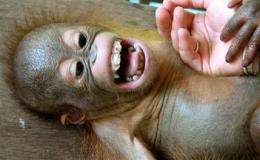
In this 2005 photo provided by the University of Portsmouth, England, baby orangutan Enero laughs while being tickled in Sabah, Malaysian Borneo. It took a lot of tickling of chimps and other apes, but scientists say they've traced the origin of laughter well back into humankind's evolutionary past. (University of Portsmouth, Dr. Marina Davila Ross)

Like human infants, young apes are known to hoot and holler when you tickle them. But is it fair to say that those playful calls are really laughter? The answer to that question is yes, say researchers reporting online on June 4th in Current Biology.

"This study is the first phylogenetic test of the evolutionary continuity of a emotional expression," said Marina Davila Ross of the University of Portsmouth in the United Kingdom. "It supports the idea that there is in apes."

The researchers analyzed the recorded sounds of tickle-induced vocalizations produced by infant and juvenile orangutans, chimpanzees, gorillas, and bonobos, as well as those of human infants. A quantitative phylogenetic analysis of those acoustic data found that the best "tree" to represent the evolutionary relationships among those sounds matched the known evolutionary relationships among the five species based on genetics. The researchers said that the findings support a common evolutionary origin for the human and ape tickle-induced expressions.

They also show that laughter evolved gradually over the last 10 to 16 million years of primate . But human laughter is nonetheless acoustically distinct from that of great apes and reached that state through an evident exaggeration of pre-existing acoustic features after the hominin separation from ancestors shared with bonobos and chimps, about 4.5 to 6 million years ago, Davila Ross says. For instance, humans make laughter sounds on the exhale. While chimps do that too, they can also laugh with an alternating flow of air, both in and out. Humans also use more regular voicing in comparison to apes, meaning that the vocal cords regularly vibrate.

Davila Ross said they were surprised to find that gorillas and bonobos can sustain exhalations during vocalization that are three to four times longer than a normal breath cycle -- an ability that had been thought to be a uniquely human adaptation, important to our capacity to speak.

"Taken together," the researchers wrote, "the acoustic and phylogenetic results provide clear evidence of a common evolutionary origin for tickling-induced laughter in humans and tickling-induced vocalizations in great apes. While most pronounced acoustic differences were found between humans and great apes, interspecific differences in vocal acoustics nonetheless supported a quantitatively derived phylogenetic tree that coincides with the well-established, genetically based relationship among these species. At a minimum, one can conclude that it is appropriate to consider 'laughter' to be a cross-species phenomenon, and that it is therefore not anthropomorphic to use this term for tickling-induced vocalizations produced by the great apes."

Source: Cell Press (news : web)


print this article email this article download pdf blog this article bookmark this article     Stumble it Digg this share on Facebook retweet share on Reddit add to delicious
Rate this story - 5 /5 (3 votes)

Rank Filter

Move the slider to adjust rank threshold, so that you can hide some of the comments.


Display comments: newest first

  • docknowledge - Jun 04, 2009
    • Rank: not rated yet
    Humans can laugh on inhale, too. It just sounds rather alarming and "over the top". Maybe a sign the person is getting too excited, etc.?

June 4, 2009 all stories

Comments: 1

5 /5 (3 votes)
  • Stumble this up

  • Digg this

  • share this

  • hide
  • Related Stories

  • Scientists study origins of laughter
    created Nov 22, 2005 | popularity not rated yet | comments 0
  • Ape gestures offer clues to the evolution of human communication
    created Apr 30, 2007 | popularity not rated yet | comments 0
  • Holding a mirror up to a gibbon’s mind
    created Mar 04, 2009 | popularity not rated yet | comments 0
  • Evolution Study Tightens Human-Chimp Connection
    created Jan 24, 2006 | popularity not rated yet | comments 0
  • Treaty: last chance to save great apes
    created Sep 12, 2005 | popularity not rated yet | comments 0


  • hide
  • Relevant PhysicsForums posts

Other News

Scientists visualize how bacteria talk to one another

Scientists visualize how bacteria talk to one another

Biology / Cell & Microbiology

created 15 hours ago | popularity 4.9 / 5 (8) | comments 1

Using imaging mass spectrometry, researchers at the University of California, San Diego have developed tools that will enable scientists to visualize how different cell populations of cells communicate. Their ...


W. Africa's last giraffes make surprising comeback (AP)

W. Africa's last giraffes make surprising comeback

Biology / Ecology

created 23 hours ago | popularity not rated yet | comments 0

(AP) -- A crisp African dawn is breaking overhead, and Zibo Mounkaila is on the back of a pickup truck bounding across a sparse landscape of rocky orange soil.


W. Africa's last giraffes make surprising comeback (AP)

China sends panda expert to Taiwan to aid breeding

Biology / Plants & Animals

created 23 hours ago | popularity not rated yet | comments 0

(AP) -- Nothing like a little time apart to rekindle the affections that could lead to a baby panda.


Laser etching safe alternative for labeling grapefruit

Laser etching safe alternative for labeling grapefruit

Biology / Other

created Nov 03, 2009 | popularity 4.4 / 5 (14) | comments 8

Laser labeling of fruit and vegetables is a new, patented technology in which a low-energy carbon dioxide laser beam is used to label, or "etch" information on produce, thereby eliminating the need for common ...


Caught in the act: Butterfly mate preference shows how 1 species can become 2

Caught in the act: Scientists find butterflies splitting into two species

Biology / Plants & Animals

created Nov 05, 2009 | popularity 4.5 / 5 (8) | comments 4

(PhysOrg.com) -- Breaking up may actually not be hard to do, say scientists who've found a population of tropical butterflies that may be on its way to a split into two distinct species.