At Long Last, How Plants Make Eggs
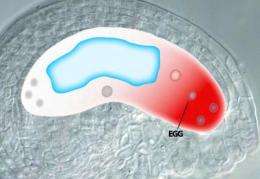
(PhysOrg.com) -- A long-standing mystery surrounding a fundamental process in plant biology has been solved by a team of scientists at the University of California, Davis.
The group's ground-breaking discovery that a plant hormone called auxin is responsible for egg production has several major implications.
First, this is the first definitive report of a plant hormone acting as a morphogen, that is, a substance that directs the pattern of development of cells based on its concentration.
Also, the study's results provide tantalizing new insights into the evolutionary pathway that flowering plants took 135 million years ago when they split off from gymnosperms, the "naked-seed" plant group that includes conifers, cycads and ginkgo trees.
Finally, the group used their discovery to make additional egg cells within plant reproductive structures, raising the prospects that these techniques may some day be used for enhancing the reproduction and fertility of crop plants.
"So the sequence becomes clear now," said Venkatesan Sundaresan, the UC Davis professor of plant biology and plant sciences who led the study. "The plant triggers auxin synthesis at one end of the female reproductive unit called the embryo sac, creating an auxin gradient. The eight nuclei in the sac are then exposed to different levels of auxin, but only the nucleus in the correct position in the gradient becomes an egg cell. And that cell is subsequently fertilized to make the next generation."
A paper describing the study will be published June 4 in the journal Science's online site, Science Express, in advance of its publication in the journal later this month.
Development of sperm and egg cells in plants
In humans and other animals, the germ cells for production of eggs and sperm are established at birth. But cells in flowering plants are assigned more or less randomly to become reproductive units when the plant reaches sexual maturity. Within the flower, sperm cells are produced by pollen at the tips of stamens, while egg cells develop in ovules, tiny structures embedded in the ovary at the base of the pistil.
At the start of the process of egg-cell development, a "mother cell" in the ovule divides several times, in a sequence involving both meiosis and mitotic divisions. These divisions result in the creation of an oblong, cell-like structure called the embryo sac, which contains eight nuclei, three of which are clustered near the open end of the ovule.
Within hours cell membranes start forming, eventually, creating seven cells: the all-important egg cell near the ovule opening where pollen will enter, and six other supporting cells, with essential functions for seed formation.
"The big question in our field for the past 50 years or more has been: How does this process happen in such a beautifully orchestrated pattern?" Sundaresan said. "It's been clear that there's a program here telling the plants exactly what to do, and that it is working not on cells, but on nuclei."
Auxin concentrations determine fate of nuclei
Two years ago Sundaresan and a postdoctoral fellow in his laboratory, Gabriela Pagnussat, used genetic tools to shift the position of a single nucleus at one end of an embryo sac in the plant Arabidopsis. When they examined the mature sac, they found that it had produced two egg cells instead of one.
Sundaresan recognized that a pattern shift like this was similar to the response that had been reported two decades earlier in Drosophila fruit flies in experiments that provided the first direct evidence for the existence of morphogens.
This prompted him to begin searching for a substance in Arabadopsis that might be acting as a morphogen. When the group discovered that auxin was accumulating at the open end of the ovule, they turned their attention to this ubiquitous hormone, which is known to play myriad signaling roles in plant growth and behavioral processes. (The hormone's existence was first guessed by Charles Darwin when he was studying how plants grow towards light.)
After many tests, Sundaresan and his group found that during embryo sac formation, auxin concentrations did indeed follow a gradient, with the highest levels occurring in the ovule at the end of the embryo sac where the pollen enters and lowest levels occurring at the opposite end of the sac.
To test the theory that this gradient was determining the fate of nuclei in the sac, Sundaresan and his group created a series of genetically manipulated Arabadopsis plants. In some plants they ratcheted up production of auxin in the embryo sac, and in others they decreased the sac's sensitivity to auxin, creating the same effect that a decline in auxin would make.
When they examined these experimental plants, their hypothesis was confirmed: Auxin concentrations determined the fate of the nuclei. Knowing whether auxin levels were high or low, it became possible to predict the appearance or disappearance of egg cells at different positions within the embryo sac.
Finally, the group employed a long series of bio-manipulative techniques to determine that the auxin gradient they had discovered within the embryo sac was due to on-site synthesis rather than transport from a source outside the sac.
"What we have found about the way auxin works here is amazing," Sundaresan said. "The idea that you can have a small molecule like this being maintained in a gradient within this eight-nucleate structure through synthesis alone is mind-boggling."
Implications for flowering plant evolution
Development of the embryo sac is arguably the key element in the evolution from gymnosperms to flowering plants, also known as angiosperms.
Yet the fossil record reveals very little about the stages that led from gymnosperm seed production to angiosperm seed production when the transition occurred around 135 million years ago. The rapid expansion of flowering plants and their eventual domination of the earth's vegetation was called "an abominable mystery" by Darwin.
By elucidating the mechanism of embryo sac development, Sundaresan and his team have opened the door to new work into the evolutionary pathway between these two major plant groups. The discovery supports what is known as the modular theory, which posits that the first angiosperms underwent a drastic reduction of their female reproductive unit compared to the gymnosperms, allowing flowering plants to reproduce more efficiently and eventually supplant their naked-seeded forebears.
Most remarkably, perhaps, the new work suggests that the eight nuclei of the angiosperm embryo sac have retained developmental plasticity in their evolution from gymnosperms. "It's amazing that even though the split supposedly happened over a hundred million years ago," Sundaresan said, "all these nuclei still have the capacity to become egg cells."
Source: University of California - Davis


