New proxy reveals how humans have disrupted the nitrogen cycle
June 4, 2009 New proxy reveals how humans have disrupted the nitrogen cycle

Enlarge

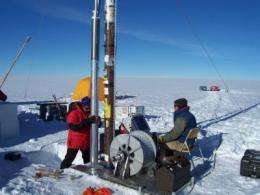
Scientists extracted a 100-meter-long ice core in Greenland to measure how fossil fuel burning of industrial times has disrupted the global nitrogen cycle. At left is Meredith Hastings of Brown University, the lead author of the study, accompanied by Bella Bergeron from Ice Coring and Drilling Services. Credit: Meredith Hastings/Julia Jarvis

More and more, scientists are getting a better grip on the nitrogen cycle. They are learning about sources of nitrogen and how this element changes as it loops from the nonliving, such as the atmosphere, soil or water, to the living, whether plants or animals. Scientists have determined that humans are disrupting the nitrogen cycle by altering the amount of nitrogen that is stored in the biosphere.

The chief culprit is fossil fuel combustion, which releases nitric oxides into the air that combine with other elements to form smog and acid rain. But it has been difficult to know precisely the extent to which such emissions have altered the nitrogen balance.

Researchers from Brown University and the University of Washington have found a new way to make the link. The scientists show that comparing nitrogen isotopes in their deposited form — nitrates — can reveal the sources of atmospheric nitric oxide. In a paper published this week in Science, the group traces the source of nitrates to nitric oxides released through fossil fuel burning that parallels the beginning of the Industrial Revolution. The group also reveals that the greatest change in nitrogen isotope ratios occurred between 1950 and 1980, following a rapid increase in .

"What we find is there has been this significant change to the over the past 300 years," said Meredith Hastings, assistant professor of geological sciences at Brown and the paper's lead author. "So we've added this new source — and not just a little bit of it, but a lot of it."
New proxy reveals how humans have disrupted the nitrogen cycle
Enlarge

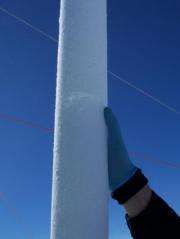
A section of the 100m ice core taken in Greenland in summer 2006. Scientists studied nitrates -- the deposited form of nitrogen isotopes -- in the core to determine that fossil fuel burning has altered the global nitrogen cycle. Credit: Meredith Hastings, Brown University

To make the link, Hastings, with Julia Jarvis and Eric Steig from the Department of Earth and Space Sciences at the University of Washington, examined at high resolution for the first time two isotopes of nitrogen found in nitrates in a Greenland ice core. The core, 100 meters long and taken at the peak of the Greenland ice cap in June 2006, contains a record of nitrates from about 1718 to 2006, according to the group.

Tests showed the ratio of the nitrogen-15 isotope to the more common nitrogen-14 isotope had changed from pre-industrial times to the present.

"The only way I can explain the trend over time," Hastings said, "are the nitric oxide sources, because we've introduced this whole new source — and that's burning."

Steig said the work also addresses a long-standing question about changes in lake chemistry in remote regions. "Sediment cores in Arctic lakes show that there have been significant 20th-century declines in the nitrogen isotopic composition of organic nitrogen," Steig said. "It's been unclear whether these are due to changes in the lake biogeochemistry or to the direct effect of changes in the isotopic composition of the incoming nitrate from the atmosphere. Our study makes it clear that it is primarily the latter."

The group now wants to determine the ratio of nitrogen-14 and nitrogen-15 isotopes for individual sources of nitric oxides, including lightning, biomass burning, bacterial "fixing" of nitrogen, and fossil fuel burning. The goal would be to pinpoint sources of nitrogen overloading, whether natural or human-caused.

"For example in Narragansett Bay, we could distinguish between nitrogen caused by sewage overflows or vehicular pollution, power plants, fertilizers, or other sources and know how to attack the problem," Hastings said.

Even more, the researchers want to quantify changes in the natural sources of nitric oxides and see whether climate change is influencing those processes.

The task is complicated, however, because , when cycling through the atmosphere or deposited on land or in water, is subject to influences that can alter the isotopic ratios, thus masking the source. So, the scientists will need to tease out the extent of those alterations to trace the isotopic signatures of sources accurately.

Source: Brown University (news : web)


print this article email this article download pdf blog this article bookmark this article     Stumble it Digg this share on Facebook retweet share on Reddit add to delicious
Rate this story - 2.6 /5 (7 votes)


June 4, 2009 all stories

Comments: 0

2.6 /5 (7 votes)
  • Stumble this up

  • Digg this

  • share this

  • hide
  • Related Stories

  • An invisible threat could change Britain’s landscapes
    created Feb 12, 2005 | popularity not rated yet | comments 0
  • Soil emissions are much-bigger-than-expected component of air pollution
    created Jun 06, 2005 | popularity not rated yet | comments 0
  • Professor says harmful byproducts of fossil fuels could be higher in urban areas
    created Oct 22, 2007 | popularity not rated yet | comments 0
  • U.S. Exports Nitrogen Pollution Elsewhere
    created Mar 17, 2005 | popularity not rated yet | comments 0
  • Addressing the 'nitrogen cascade'
    created May 15, 2008 | popularity not rated yet | comments 0


  • hide
  • Relevant PhysicsForums posts

  • cycles
    created 14 hours ago
  • The Origin of the term 'fossil' fuels
    created Nov 05, 2009
  • co2
    created Nov 03, 2009
  • Early Earths Sulfidic Ocean Conditions
    created Oct 30, 2009
  • vegetation
    created Oct 29, 2009
  • climate change
    created Oct 29, 2009
  • More from Physics Forums - Earth

Other News

Deep creep means milder, more frequent earthquakes along Southern California's San Jacinto fault

Deep creep means milder, more frequent earthquakes along Southern California's San Jacinto fault

Space & Earth / Earth Sciences

created 14 hours ago | popularity 4.7 / 5 (3) | comments 0

With an average of four mini-earthquakes per day, Southern California's San Jacinto fault constantly adjusts to make it a less likely candidate for a major earthquake than its quiet neighbor to the east, the ...


Success in 'space elevator' competition (AP)

Success in 'space elevator' competition (Update 3)

Space & Earth / Space Exploration

created Nov 05, 2009 | popularity 4.3 / 5 (33) | comments 50

(AP) -- A robot powered by a ground-based laser beam climbed a long cable dangling from a helicopter on Wednesday to qualify for prize money in a $2 million competition to test the potential reality of the ...


In a Galaxy Far, Far Away...

In a Galaxy Far, Far Away...

Space & Earth / Astronomy

created Nov 06, 2009 | popularity 4.8 / 5 (5) | comments 17

(PhysOrg.com) -- Astronomers have published the discovery of the farthest known object in the cosmos: a star that exploded when the universe was only 630 million years old -- only 4.6% of its current age. ...


'Dropouts' pinpoint earliest galaxies

'Dropouts' pinpoint earliest galaxies

Space & Earth / Astronomy

created Nov 06, 2009 | popularity 4.2 / 5 (10) | comments 13

Astronomers, conducting the broadest survey to date of galaxies from about 800 million years after the Big Bang, have found 22 early galaxies and confirmed the age of one by its characteristic hydrogen signature ...


Space hotel taking bookings for 2012 opening

Space hotel taking bookings for 2012 opening

Space & Earth / Space Exploration

created Nov 05, 2009 | popularity 4.4 / 5 (21) | comments 11

(PhysOrg.com) -- The first orbiting space hotel is on track to open for its first customers in 2012, but hurry, as bookings are filling fast.