Graphene may have advantages over copper for IC interconnects at the nanoscale
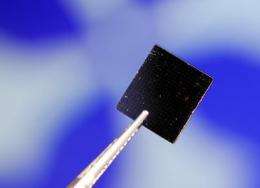
The unique properties of thin layers of graphite - known as graphene - make the material attractive for a wide range of potential electronic devices. Researchers have now experimentally demonstrated the potential for another graphene application: replacing copper for interconnects in future generations of integrated circuits.
In a paper published in the June 2009 issue of the IEEE journal Electron Device Letters, researchers at the Georgia Institute of Technology report detailed analysis of resistivity in graphene nanoribbon interconnects as narrow as 18 nanometers.
The results suggest that graphene could out-perform copper for use as on-chip interconnects - tiny wires that are used to connect transistors and other devices on integrated circuits. Use of graphene for these interconnects could help extend the long run of performance improvements for silicon-based integrated circuit technology.
"As you make copper interconnects narrower and narrower, the resistivity increases as the true nanoscale properties of the material become apparent," said Raghunath Murali, a research engineer in Georgia Tech's Microelectronics Research Center. "Our experimental demonstration of graphene nanowire interconnects on the scale of 20 nanometers shows that their performance is comparable to even the most optimistic projections for copper interconnects at that scale. Under real-world conditions, our graphene interconnects probably already out-perform copper at this size scale."
Beyond resistivity improvement, graphene interconnects would offer higher electron mobility, better thermal conductivity, higher mechanical strength and reduced capacitance coupling between adjacent wires.
"Resistivity is normally independent of the dimension - a property inherent to the material," Murali noted. "But as you get into the nanometer-scale domain, the grain sizes of the copper become important and conductance is affected by scattering at the grain boundaries and at the side walls. These add up to increased resistivity, which nearly doubles as the interconnect sizes shrink to 30 nanometers."
The research was supported by the Interconnect Focus Center, which is one of the Semiconductor Research Corporation/DARPA Focus Centers, and the Nanoelectronics Research Initiative through the INDEX Center.
Murali and collaborators Kevin Brenner, Yinxiao Yang, Thomas Beck and James Meindl studied the electrical properties of graphene layers that had been taken from a block of pure graphite. They believe the attractive properties will ultimately also be measured in graphene fabricated using other techniques, such as growth on silicon carbide, which now produces graphene of lower quality but has the potential for achieving higher quality.
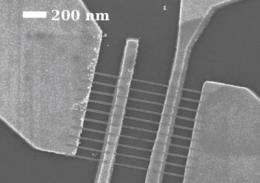
Because graphene can be patterned using conventional microelectronics processes, the transition from copper could be made without integrating a new manufacturing technique into circuit fabrication.
"We are optimistic about being able to use graphene in manufactured systems because researchers can already grow layers of it in the lab," Murali noted. "There will be challenges in integrating graphene with silicon, but those will be overcome. Except for using a different material, everything we would need to produce graphene interconnects is already well known and established."
Experimentally, the researchers began with flakes of multi-layered graphene removed from a graphite block and placed onto an oxidized silicon substrate. They used electron beam lithography to construct four electrode contacts on the graphene, then used lithography to fabricate devices consisting of parallel nanoribbons of widths ranging between 18 and 52 nanometers. The three-dimensional resistivity of the nanoribbons on 18 different devices was then measured using standard analytical techniques at room temperature.
The best of the graphene nanoribbons showed conductivity equal to that predicted for copper interconnects of the same size. Because the comparisons were between non-optimized graphene and optimistic estimates for copper, they suggest that performance of the new material will ultimately surpass that of the traditional interconnect material, Murali said.
"Even graphene samples of moderate quality show excellent properties," he explained. "We are not using very high levels of optimization or especially clean processes. With our straightforward processing, we are getting graphene interconnects that are essentially comparable to copper. If we do this more optimally, the performance should surpass copper."
Though one of graphene's key properties is reported to be ballistic transport - meaning electrons can flow through it without resistance - the material's actual conductance is limited by factors that include scattering from impurities, line-edge roughness and from substrate phonons - vibrations in the substrate lattice.
Use of graphene interconnects could help facilitate continuing increases in integrated circuit performance once features sizes drop to approximately 20 nanometers, which could happen in the next five years, Murali said. At that scale, the increased resistance of copper interconnects could offset performance increases, meaning that without other improvements, higher density wouldn't produce faster integrated circuits.
"This is not a roadblock to achieving scaling from one generation to the next, but it is a roadblock to achieving increased performance," he said. "Dimensional scaling could continue, but because we would be giving up so much in terms of resistivity, we wouldn't get a performance advantage from that. That's the problem we hope to solve by switching to a different materials system for interconnects."
Source: Georgia Institute of Technology


