New, light-driven nanomotor is simpler, more promising, scientists say
June 4, 2009
New, light-driven nanomotor is simpler, more promising, scientists say

Enlarge

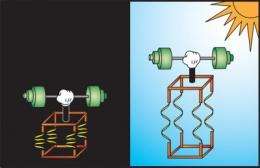
Sunlight prompts a newly developed molecular nanomotor to unclasp in this artist’s illustration. In a paper expected to appear soon in the online edition of the journal Nano Letters, a team of researchers from the University of Florida reports building a new type of “molecular nanomotor” driven only by photons, or particles of light. While it is not the first photon-driven nanomotor, the almost infinitesimal device is the first built entirely with a single molecule of DNA - giving it a simplicity that increases its potential for development, manufacture and real-world applications in areas ranging from medicine to manufacturing, the scientists say. (Yan Chen/University of Florida)

(PhysOrg.com) -- Sunflowers track the sun as it moves from east to west. But people usually have to convert sunlight into electricity or heat to put its power to use.

Now, a team of University of Florida chemists is the latest to report a new mechanism to transform light straight into motion - albeit at a very, very, very tiny scale.

In a paper expected to appear soon in the online edition of the journal , the UF team reports building a new type of "molecular nanomotor" driven only by photons, or particles of light. While it is not the first photon-driven nanomotor, the almost infinitesimal device is the first built entirely with a single molecule of DNA — giving it a simplicity that increases its potential for development, manufacture and real-world applications in areas ranging from medicine to manufacturing, the scientists say.

"It is easy to assemble, has fewer parts and theoretically should be more efficient," said Huaizhi Kang, a doctoral student in chemistry at UF and the first author of the paper.

The scale of the nanomotor is almost vanishingly small.

In its clasped, or closed, form, the nanomotor measures 2 to 5 — 2 to 5 billionths of a meter. In its unclasped form, it extends as long as 10 to 12 nanometers. Although the scientists say their calculations show it uses considerably more of the energy in light than traditional solar cells, the amount of force it exerts is proportional to its small size.

But that won't necessarily limit its potential.

In coming years, the nanomotor could become a component of microscopic devices that repair individual cells or fight viruses or . Although in the conceptual stage, those devices, like much larger ones, will require a power source to function. Because it is made of DNA, the nanomotor is biocompatible. Unlike traditional energy systems, the nanomotor also produces no waste when it converts light energy into motion.

"Preparation of is relatively easy and reproducible, and the material is very safe," said Yan Chen, a UF chemistry doctoral student and one of the authors of the paper.

Applications in the larger world are more distant. Powering a vehicle, running an assembly line or otherwise replacing traditional electricity or fossil fuels would require untold trillions of nanomotors, all working together in tandem — a difficult challenge by any measure.

"The major difficulty lies ahead," said Weihong Tan, a UF professor of chemistry and physiology, author of the paper and the leader of the research group reporting the findings. "That is how to collect the molecular level force into a coherent accumulated force that can do real work when the motor absorbs sunlight."

Tan added that the group has already begun working on the problem.

"Some prototype DNA nanostructures incorporating single photo-switchable motors are in the making which will synchronize molecular motions to accumulate forces," he said.

To make the nanomotor, the researchers combined a DNA molecule they created in the lab with azobenzene, a chemical compound that responds to light. A high-energy photon prompts one response; lower energy another.

To demonstrate the movement, the researchers attached a fluorophore, or light-emitter, to one end of the nanomotor and a quencher, which can quench the emitting light, to the other end. Their instruments recorded emitted light intensity that corresponded to the motor movement.

"Radiation does cause things to move from the spinning of radiometer wheels to the turning of sunflowers and other plants toward the sun," said Richard Zare, distinguished professor and chairman of chemistry at Stanford University. "What Professor Tan and co-workers have done is to create a clever light-actuated nanomotor involving a single DNA molecule. I believe it is the first of its type."

Source: University of Florida (news : web)

4.8 /5 (6 votes)  

Filter


Move the slider to adjust rank threshold, so that you can hide some of the comments.


Display comments: newest first

xanthian
Jun 05, 2009

Rank: not rated yet
Besides potential uses in generating energy, this might be a dandy component of a fluidics computer.

xanthian.
Rank 4.8 /5 (6 votes)
Related Stories
Relevant PhysicsForums posts
  • Pertubance in a model
    created2 hours ago
  • Cancer drugs and Alzheimer's, Oh my!
    created10 hours ago
  • Squishing cells
    created11 hours ago
  • Any books/articles for evolutionary stable strategy models in humans?
    created22 hours ago
  • Science behind the bore feeling?
    createdFeb 09, 2012
  • Homo Sapien vs. Chimpanzee - Divergence Timeline
    createdFeb 09, 2012
  • More from Physics Forums - Biology

More news stories

What lies beneath: Mapping hidden nanostructures

The ability to diagnose and predict the properties of materials is vital, particularly in the expanding field of nanotechnology. Electron and atom-probe microscopy can categorize atoms in thin sheets of material, ...

Nanotechnology / Nanophysics

created 4 minutes ago | popularity not rated yet | comments 0

'Dark plasmons' transmit energy

Microscopic channels of gold nanoparticles have the ability to transmit electromagnetic energy that starts as light and propagates via "dark plasmons," according to researchers at Rice University.

Nanotechnology / Nanophysics

created 16 hours ago | popularity 5 / 5 (5) | comments 0 | with audio podcast

Nanotube therapy takes aim at breast cancer stem cells

Wake Forest Baptist Medical Center researchers have again proven that injecting multiwalled carbon nanotubes (MWCNTs) into tumors and heating them with a quick, 30-second laser treatment can kill them.

Nanotechnology / Bio & Medicine

created 21 hours ago | popularity 5 / 5 (1) | comments 0 | with audio podcast

New kind of solar cell could capture significantly more energy than current cells

New solar cells could increase the maximum efficiency of solar panels by over 25%, according to scientists from the University of Cambridge.

Nanotechnology / Nanophysics

created Feb 08, 2012 | popularity 4.5 / 5 (11) | comments 14 | with audio podcast

Nanoshell whispering galleries improve thin solar panels

Visitors to Statuary Hall in the U.S. Capitol Building may have experienced a curious acoustic feature that allows a person to whisper softly at one side of the cavernous, half-domed room and for another on ...

Nanotechnology / Nanomaterials

created Feb 07, 2012 | popularity 4.3 / 5 (6) | comments 6 | with audio podcast


The power of estrogen -- male snakes attract other males

A new study has shown that boosting the estrogen levels of male garter snakes causes them to secrete the same pheromones that females use to attract suitors, and turned the males into just about the sexiest ...

Could Venus be shifting gear?

(PhysOrg.com) -- ESA’s Venus Express spacecraft has discovered that our cloud-covered neighbour spins a little slower than previously measured. Peering through the dense atmosphere in the infrared, the ...

Experts reveal how plants don't get sunburn

(PhysOrg.com) -- Experts at the University of Glasgow have discovered how plants survive the harmful rays of the sun.

Team isolates nerve cells involved in storing long term memory and gene proteins associated with them

(Medical Xpress) -- A research team in Taiwan has succeeded in isolating two nerve cells in fruit fly brains that are believed to be the major players in allowing for the formation of long term memories. Furthermore, ...

Fool's gold may prove an unlikely alternative to overexploited catalytic materials

Catalytic materials, which lower the energy barriers for chemical reactions, are used in everything from the commercial production of chemicals to catalytic converters in car engines. However, with current catalytic materials ...

Measurements from high-energy collisions lead to better understanding of why meson particles disappear

For several years, physicists at the Relativistic Heavy Ion Collider (RHIC) at Brookhaven National Laboratory (BNL), USA, have studied an unusual state of matter called the quark–gluon plasma, which they ...