Toward new drugs that turn genes on and off
June 4, 2009 Toward new drugs that turn genes on and off

Enlarge

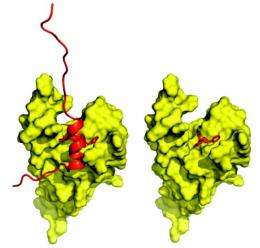
Scientists found a group of molecules that could provide clues to the development of various diseases. Credit: The American Chemical Society

Scientists in Michigan and California are reporting an advance toward development of a new generation of drugs that treat disease by orchestrating how genes in the body produce proteins involved in arthritis, cancer and a range of other disorders. Acting like an “on-off switch,” the medications might ratchet up the production of proteins in genes working at abnormally low levels or shut off genes producing an abnormal protein linked to disease.

Their report is in the current issue of ACS .

In the study, Anna K. Mapp and colleagues discusses that cause to be active and churn out proteins — so-called transcriptional activators. That’s because because they control a key process known as transcription, in which instructions coded in genes produce proteins. Malfunctions in these activators could lead to altered transcription patterns that lead to disease. For example, variations in the tumor suppressor gene p53 are found in more than half of all human cancers.

Mapp describes discovery of a group of molecules that could be used to help scientists better understand transcription. Known as activator artificial transcriptional activation domains, these small molecules mimic natural activators and could provide insights on how mistakes in gene regulation result in various diseases.

“Evidence suggests that these small molecules mimic the function and mechanism of their natural counterparts and present a framework for the broader development of small molecule transcriptional switches,” Mapp states.

More information:

Source: ACS


print this article email this article download pdf blog this article bookmark this article     Stumble it Digg this share on Facebook retweet share on Reddit add to delicious
Rate this story - 5 /5 (6 votes)


June 4, 2009 all stories

Comments: 0

5 /5 (6 votes)
  • Stumble this up

  • Digg this

  • share this

  • hide
  • Related Stories

  • Small molecules mimic natural gene regulators
    created Jun 03, 2009 | popularity not rated yet | comments 0
  • Rewrite the textbooks: Transcription is bidirectional
    created Jan 25, 2009 | popularity not rated yet | comments 0
  • Newly identified mechanism for silencing genes points to possible anti-cancer strategies
    created May 16, 2007 | popularity not rated yet | comments 0
  • Scientists discover new way in which ubiquitin modifies transcriptional machinery
    created Dec 18, 2008 | popularity not rated yet | comments 0
  • Early-stage gene transcription creates access to DNA
    created Oct 06, 2008 | popularity not rated yet | comments 0


  • hide
  • Relevant PhysicsForums posts

  • limiting reagent
    created 3 hours ago
  • preparation of acetanilide
    created 3 hours ago
  • Putting every element in a box
    created Nov 25, 2009
  • a question in Lewis structure???
    created Nov 25, 2009
  • More from Physics Forums - Chemistry

Other News

Research sheds light on workings of anti-cancer drug

Chemistry / Analytical Chemistry

created 16 hours ago | popularity not rated yet | comments 0

(PhysOrg.com) -- The copper sequestering drug tetrathiomolybdate (TM) has been shown in studies to be effective in the treatment of Wilson disease, a disease caused by an overload of copper, and certain metastatic cancers. ...


New chemical reaction offers opportunities for drug development

Chemistry / Biochemistry

created 20 hours ago | popularity not rated yet | comments 2

Researchers led by Conway Fellow, Professor Pat Guiry have solved a chemistry problem that has stumped researchers worldwide for more than a decade. The results have earned the group the cover story of the leading scientific ...


Sandia CR5

Machine Converts CO2 into Gasoline, Diesel, and Jet Fuel

Chemistry / Biochemistry

created Nov 23, 2009 | popularity 4.6 / 5 (30) | comments 20

(PhysOrg.com) -- Researchers at Sandia National Laboratories have built a machine that uses the sun's energy to convert carbon dioxide waste from power plants into transportation fuels such as gasoline, diesel, ...


New hydrogen-storage method discovered

New hydrogen-storage method discovered

Chemistry / Materials Science

created Nov 22, 2009 | popularity 4.3 / 5 (42) | comments 15

Scientists at the Carnegie Institution have found for the first time that high pressure can be used to make a unique hydrogen-storage material. The discovery paves the way for an entirely new way to approach ...


Chemists get custom-designed microscopic particles to self-assemble in liquid crystal

Chemists get custom-designed microscopic particles to self-assemble in liquid crystal

Chemistry / Materials Science

created Nov 25, 2009 | popularity 5 / 5 (5) | comments 0

(PhysOrg.com) -- The scientists anticipate their "LithoParticles" will have significant applications in photonics, optical communications and other areas.