Mars orbiter enters safe mode after disturbance
June 5, 2009
Mars Reconnaissance Orbiter

Enlarge

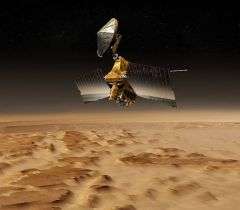
This artist's concept of the Mars Reconnaissance Orbiter. Image: NASA/JPL

NASA says its powerful Mars Reconnaissance Orbiter is in safe mode after being hit by a cosmic ray or solar particle.

NASA's Mars Reconnaissance Orbiter is in safe mode and in communications with Earth after an unexpected rebooting of its computer Wednesday evening, June 3.

The spontaneous reboot resembles a Feb. 23 event on the spacecraft. Engineers concluded the most likely cause for that event was a cosmic ray or solar particle hitting electronics and causing an erroneous voltage reading.

Jim Erickson, Mars Reconnaissance Orbiter project manager at NASA's Jet Propulsion Laboratory, Pasadena, Calif., said, "The spacecraft is sending down high-rate engineering data, power positive, batteries fully charged, sun pointed and thermally safe. The flight team is cautiously bringing the orbiter back to normal operations. We should be resuming our exploration of Mars by next week."

The reboot occurred at approximately 6:10 p.m. PDT (9:10 p.m. EDT) on June 3. This is the sixth time since the spacecraft began its primary science phase in November 2006 that it has entered safe mode, which is its programmed precaution when it senses a condition for which it does not know a more specific response.

Provided by NASA

4.5 /5 (10 votes)  

Filter


Move the slider to adjust rank threshold, so that you can hide some of the comments.


Display comments: newest first

Roj
Jun 06, 2009

Rank: 3 / 5 (2)
That's what you get for using Windows software.
LuckyBrandon
Jun 06, 2009

Rank: not rated yet
what and youd rather use an open source so that some guy who just got fired can upload some code strings to put it into the ground of the nearest moon or planet....

this isnt a windows thing, this was programmed into the satellites and into our ROVs as well that if they encounter problems they don't have a programmed solution for, they go into safe mode. This would happen no matter what OS was used on them.
butters
Jun 06, 2009

Rank: not rated yet
The operating system used is VxWorks which is a real-time operating system. You would never dream of using Windows on a spacecraft. Having used VxWorks myself, it is one of the best RTOS around. See http://en.wikiped..._Orbiter
LuckyBrandon
Jun 06, 2009

Rank: not rated yet
that was kind of my thought as well..you wouldnt stick XP on something flying millions of miles away.
Rank 4.5 /5 (10 votes)
Related Stories
Relevant PhysicsForums posts
  • Never ending outer space.....
    createdFeb 11, 2012
  • Neutron Star fragments?
    createdFeb 11, 2012
  • stationary or not?
    createdFeb 11, 2012
  • Scale of the Universe
    createdFeb 10, 2012
  • Titan's lack of impact craters
    createdFeb 09, 2012
  • Real pictures of black hole eating a star?
    createdFeb 08, 2012
  • More from Physics Forums - General Astronomy

More news stories

Salvage workers begin pumping fuel from Italian shipwreck

Salvage workers Sunday began pumping fuel from the shipwrecked Italian cruise liner Costa Concordia, a day ahead of schedule, officials said.

Space & Earth / Environment

created 10 hours ago | popularity 5 / 5 (2) | comments 0

Latin America mining boom clashes with conservation

Latin America is experiencing a mining boom as prices rise fuelled by a hike in global demand, but the region is also being hit by a wave of violent protests, strikes and rallies by environmentalists.

Space & Earth / Environment

created 18 hours ago | popularity 5 / 5 (1) | comments 1

Political leaders play key role in how worried Americans are by climate change: study

More than extreme weather events and the work of scientists, it is national political leaders who influence how much Americans worry about the threat of climate change, new research finds.

Space & Earth / Environment

created Feb 06, 2012 | popularity 5 / 5 (8) | comments 75

NASA budget will axe Mars deal with Europe: scientists

US President Barack Obama's budget proposal to be submitted next week for 2013 will cut NASA's budget by 20 percent and eliminate a major partnership with Europe on Mars exploration, scientists said Thursday.

Space & Earth / Space Exploration

created Feb 10, 2012 | popularity 5 / 5 (3) | comments 58

Humans may have helped the decline of African rainforests 3000 years ago

(PhysOrg.com) -- Large areas of rainforests in Central Africa mysteriously disappeared over three thousand years ago, to be replaced by savannas. The prevailing theory has been that the cause was a change ...

Space & Earth / Environment

created Feb 10, 2012 | popularity 4.1 / 5 (14) | comments 21 | with audio podcast report


Scientists discover molecular secrets of 2,000-year-old Chinese herbal remedy

For roughly two thousand years, Chinese herbalists have treated Malaria using a root extract, commonly known as Chang Shan, from a type of hydrangea that grows in Tibet and Nepal. More recent studies suggest that halofuginone, ...

New method to examine batteries -- MRI from the inside

There is an ever-increasing need for advanced batteries for portable electronics, such as phones, cameras, and music players, but also to power electric vehicles and to facilitate the distribution and storage of energy derived ...

Google might launch Drive for cloud storage soon

(PhysOrg.com) -- Google's next big move, according to the Wall Street Journal, is a cloud storage service called Drive. Hardly first to the plate, Google is simply catching up to introducing its cloud reposi ...

A mitosis mystery solved: How chromosomes align perfectly in a dividing cell

Although the process of mitotic cell division has been studied intensely for more than 50 years, Whitehead Institute researchers have only now solved the mystery of how cells correctly align their chromosomes during symmetric ...

Lab study raises questions over nano-particle impact

Tests involving chickens have raised questions about the impact on health from engineered nano-particles, the ultra-fine grains commonly used in drugs and processed foods, scientists said on Sunday.

Starve a virus, feed a cure? Findings show how some cells protect themselves against HIV

A protein that protects some of our immune cells from the most common and virulent form of HIV works by starving the virus of the molecular building blocks that it needs to replicate, according to research published online ...