'Colossal' Magnetic Effect Under Pressure
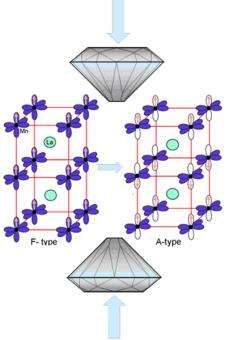
(PhysOrg.com) -- Millions of people today carry around pocket-sized music players capable of holding thousands of songs, thanks to the discovery 20 years ago of a phenomenon known as the “giant magnetoresistance effect,” which made it possible to pack more data onto smaller and smaller hard drives. Now scientists are on the trail of another phenomenon, called the “colossal magnetoresistance effect” (CMR) which is up to a thousand times more powerful and could trigger another revolution in computing technology.
Understanding, and ultimately controlling, this effect and the intricate coupling between electrical conductivity and magnetism in these materials remains a challenge, however, because of competing interactions in manganites, the materials in which CMR was discovered. In the June 12, 2009, issue of the journal Physical Review Letters, a team of researchers report new progress in using high pressure techniques to unravel the subtleties of this coupling.
To study the magnetic properties of manganites, a form of manganese oxide, the research team, led by Yang Ding of the Carnegie Institution’s High Pressure Synergetic Center (HPSync), applied techniques called x-ray magnetic circular dichroism (XMCD) and angular-dispersive diffraction at the Advanced Photon Source (APS) of Argonne National Laboratory in Illinois. High pressure XMCD is a newly developed technique that uses high-brilliance circularly polarized x-rays to probe the magnetic state of a material under pressures of many hundreds of thousands of atmospheres inside a diamond anvil cell.
The discovery of CMR in manganite compounds has already made manganites invaluable components in technological applications. An example is magnetic tunneling junctions in soon-to-be marketed magnetic random access memory (MRAM), where the tunneling of electrical current between two thin layers of manganite material separated by an electrical insulator depends on the relative orientation of magnetization in the manganite layers. Unlike conventional RAM, MRAM could yield instant-on computers. However, no current theories can fully explain the rich physics, including CMR effects, seen in manganites.
“The challenge is that there are competing interactions in manganites among the electrons that determine magnetic properties,” said Ding. “And the properties are also affected by external stimuli, such as, temperature, pressure, magnetic field, and chemical doping.”
“Pressure has a unique ability to tune the electron interactions in a clean and theoretically transparent manner,” he added. “It is a direct and effective means for manipulating the behavior of electrons and could provide valuable information on the magnetic and electronic properties of manganite systems. But of all the effects, pressure effects have been the least explored.”
The researchers found that when a manganite was subjected to conditions above 230,000 times atmospheric pressure it underwent a transition in which its magnetic ordering changed from a ferromagnetic type (electron spins aligned) to an antiferromagnetic type (electron spins opposed). This transition was accompanied by a non-uniform structural distortion called the Jahn-Teller effect.
“It is quite interesting to observe that uniform compression leads to a non-uniform structural change in a manganite, which was not predicted by theory,” said Ding, “Working with Michel van Veenendaal’s theoretical group at APS, we found that the predominant effect of pressure on this material is to increase the strength of an interaction known as superexchange relative to another known as the double exchange interaction. A consequence of this is that the overall ferromagnetic interactions in the system occur in a plane (two dimensions) rather than in three dimensions, which produces a non-uniform redistribution of electrons. This leads to the structural distortion.”
Another intriguing response of manganite to high pressure revealed by the experiments is that the magnetic transition did not occur throughout the sample at the same time. Instead, it spread incrementally.
“The results imply that even at ambient conditions, the manganite might already have two separate magnetic phases at the nanometer scale, with pressure favoring the growth of the antiferro-magnetic phase at the expense of the ferromagnetic phase,” said coauthor Daniel Haskel, a physicist at Argonne’s APS. “Manipulating phase separation at the nanoscale level is at the very core of nanotechnology and manganites provide an excellent playground to pursue this objective”.
“This work not only displays another interesting emergent phenomenon arising from the interplay between charge, spin, orbital and lattice in a strongly correlated electron system,” commented coauthor Dr. Ho-kwang Mao of Carnegie’s Geophysical Laboratory, Director of HPSync,” but it also manifests the role of pressure in magnetism studies of dense matter.”
More information: Pressure-induced magnetic transition in manganite (La0.75Ca0.25MnO3) Yang Ding, Daniel Haskel, Yuan-Chieh Tseng, Eiji Kaneshita, Michel van Veenendaal, John Mitchell, Stanislav V. Sinogeikin, Vitali Prakapenka, and Ho-kwang Mao, Physical Review Letters, June 2009.
Provided by Carnegie Institution


