New battery technology extends life of bomb disposal robots
June 5, 2009
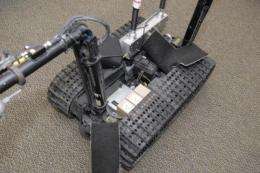
The Office of Naval Research TechSolutions department hosted a demo and final review of the recently completed Talon EOD robot Battery Replacement project. The battery replacement project was prompted by a request from the II MEF, 8th Engineering Battalion and resulted in a solution provided by Penn State University's Applied Research Laboratory that utilizes standard military batteries resulting in reduced cost, increased run time, and elimination of a custom battery charger. TechSolutions is an innovative, transformational business process created by the Chief of Naval Research and focused solely on rapidly delivering needed technology to the Fleet/Force. Credit: US Navy photo by John F. Williams
Safe removal of roadside bombs and improvised explosive devices (IEDs) is critical in hostile environments. Explosive Ordnance Disposal (EOD) crews often rely on remotely operated robots to disarm explosives - and the Office of Naval Research has just made their job a little easier.
In just seven months, the ONR-sponsored team at Penn State University Advanced Research Laboratory devised, designed and delivered an innovative solution to extend the battery life of remotely powered Talon robots by 23 percent. The extended battery life affords the Talon with more time to diffuse complex explosives.
At a demonstration held at ONR last week, the Talon Battery Module (TBM) eliminates the need for a special purpose custom battery and its charger. It incorporates a bank of four-to-six standard BB-2590 batteries that can be hot-swapped without rebooting the robot.
TBM also features a significantly improved battery health monitoring system. It capitalizes on standard military batteries that offer a cost savings of roughly 60 percent.
The technology has proven so successful that the Marine Corps plans to outfit all of its Talon robots with the new TBM, and the Army
and the joint IED office have ordered more than 1,300 to replace all battery units currently in the field.
In 2008, the Talon robot was a small-tracked, all-weather vehicle that was being used in a variety of terrains. Gunnery Sgt. Steven Sheals while at Marine Corps Base EOD, Camp Lejeune, expressed the need for a long-lasting alternative to the large, expensive custom battery provided with the Talon robot.
Sheals elevated the problem with ONR's TechSolutions branch where Master Chief Petty Officer Stephen French and Stephanie Everett, decided to take on the issue.
"The TBM solution has become the new DoD standard for the Talon robot and all EOD robots in its class," says French. "It also showcases how we work to provide rapid solutions that directly benefit the work-life of Sailors and Marines. Typically, most of our requests come from the enlisted community who often are closest to the action and understand the technical issues involved."
ONR TechSolutions is an innovative, transformational business process which affords Sailors and Marines at the ground level with a means for communicating technology needs directly with the science and technology community. TechSolutions is focused on rapid prototyping that deliver 50 percent solutions for the Fleet/Force.
"Our job is to connect the science and technology community with the warfighter and the acquisition community," says Everett.
"In this case, we provided the initial S&T funding to develop the proof of concept, and the Naval Explosive Ordnance Disposal Technology Division took the successful prototype into production as an acquisition program."
Source: Office of Naval Research
-
Engineers Deliver Robot to Neutralize Remote Explosives
Jul 21, 2005 |
not rated yet |
0
-
Engineers Deliver Robot to Neutralize Remote Explosives
Jul 01, 2005 |
not rated yet |
0
-
Virtual reality, real ingenuity
Apr 12, 2005 |
not rated yet |
0
-
ONR and GM partner to test advanced fuel cell vehicles of the future (w/Video)
Mar 18, 2009 |
not rated yet |
0
-
Surveillance vehicles take flight using alternative energy
Mar 30, 2009 |
not rated yet |
0
-
Engineers build first sub-10-nm carbon nanotube transistor
Feb 01, 2012 |
4.9 / 5 (30) |
30
-
Something old, something new: Evolution and the structural divergence of duplicate genes
Jan 31, 2012 |
4.6 / 5 (7) |
1
-
The hidden nanoworld of ice crystals: Revealing the dynamic behavior of quasi-liquid layers
Jan 30, 2012 |
5 / 5 (3) |
1
-
Stock market network reveals investor clustering
Jan 27, 2012 |
3.9 / 5 (23) |
8
-
Of microchemistry and molecules: Electronic microfluidic device synthesizes biocompatible probes
Jan 26, 2012 |
5 / 5 (1) |
0
-
feed hold button on CNC lathe
20 hours ago
-
Mechanics of Solids ( Final exam question) please help!
22 hours ago
-
RFAC in Fortran
Feb 09, 2012
-
dynamics 2/32
Feb 08, 2012
-
dynamics
Feb 08, 2012
-
Vibration Absorbtion Problem
Feb 08, 2012
- More from Physics Forums - General Engineering
More news stories
Soraa LED light may dim 50-watt halogen rivals
(PhysOrg.com) -- Soraa, a Fremont, California company founded in 2008, this week launched its first product, a light that uses LEDS (light emitting diodes). The "Soraa LED MR16 lamp" is the "perfect" replacement ...
Samsung can continue selling Galaxy tabs in Germany: court
South Korea's Samsung Electronics can continue to sell its Galaxy Tab 10.1N tablet computer in Germany, a German court ruled Thursday, rejecting a bid by arch-rival Apple to have them banned.
18 hours ago |
3.7 / 5 (3) |
3
First Google hire leaving for online academy
The first person hired by Google's founders is leaving the Internet giant to devote himself to an innovative online education website called Khan Academy.
8 hours ago |
5 / 5 (1) |
0
Google launches Chrome browser for Android smartphones
With more and more people connecting to the Internet through a phone or a tablet instead of a PC, Google Inc. is bringing its fast-growing browser, Chrome, to the newest Android-powered mobile devices.
17 hours ago |
5 / 5 (4) |
0
Model analyzes shape-memory alloys for use in earthquake-resistant structures
Recent earthquake damage has exposed the vulnerability of existing structures to strong ground movement. At the Georgia Institute of Technology, researchers are analyzing shape-memory alloys for their potential ...
15 hours ago |
5 / 5 (1) |
0
|
'Dark plasmons' transmit energy
Microscopic channels of gold nanoparticles have the ability to transmit electromagnetic energy that starts as light and propagates via "dark plasmons," according to researchers at Rice University.
FDA-approved drug rapidly clears amyloid from the brain, reverses Alzheimer's symptoms in mice
Neuroscientists at Case Western Reserve University School of Medicine have made a dramatic breakthrough in their efforts to find a cure for Alzheimer's disease. The researchers' findings, published in the journal Science, show t ...
Hydrogen from acidic water: Researchers develop potential low cost alternative to platinum for splitting water
A technique for creating a new molecule that structurally and chemically replicates the active part of the widely used industrial catalyst molybdenite has been developed by researchers with the Lawrence Berkeley ...
Ultraviolet protection molecule in plants yields its secrets
Lying around in the sun all day is hazardous not just for humans but also for plants, which have no means of escape. Ultraviolet (UV) radiation from the sun can damage proteins and DNA inside cells, leading ...
Anyone can learn to be more inventive, cognitive researcher says
There will always be a wild and unpredictable quality to creativity and invention, says Anthony McCaffrey, a cognitive psychology researcher at the University of Massachusetts Amherst, because an "Aha moment" is rare and ...
Flexible paper robots
(PhysOrg.com) -- These inexpensive robots can stretch, bend and twist under control, and lift objects up to 120 times their own weight. Being soft, they can apply gentle and even pressure, and adapt to varied ...