Researchers Reveal Structure of Key Genetic Proofreading Protein
(PhysOrg.com) -- Nature might abhor a vacuum, but it loves a backup plan. In living organisms, physiological systems are kept under tight control by hierarchies of organic safety catches and emergency releases, helping to make sure that things run as smoothly as possible.
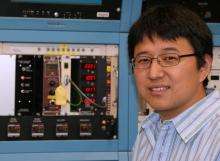
A team of Stanford University researchers working in the lab of Nobel laureate Roger Kornberg recently used the high energy X-rays at the Stanford Synchrotron Radiation Lightsource to examine one such mechanism, the proofreading function of a vital protein called RNA polymerase. According to Dong Wang, a post-doctoral fellow with Kornberg's lab and the principal investigator in the study, the findings will not only provide scientists with a better idea of how protein production works, but could also give fresh insight into the design of cancer-fighting drugs. The results were published in the May 28 issue of Science.
Protein synthesis occurs in two main stages—first, DNA inside the nucleus is transcribed to RNA. During this step, called transcription, RNA polymerase skims along the DNA template, producing a complementary strand of RNA as it goes. In the second step, called translation, the cell's machinery reads the RNA and constructs the corresponding proteins.
"We know from the central dogma that genetic information is stored in DNA," Wang said. "My work is to try to understand the mechanism of how RNA polymerase works."
The factors that drive this process operate with astounding fidelity; the error rate of RNA polymerase can be as low as one mistake for every 100,000 DNA base pairs read. This accuracy is due in large part to the proofreading function, in which the RNA polymerase occasionally backtracks along the growing strand of RNA, correcting any mistakes that may have been made along the way. If this repair system is compromised, the polymerase error rate increases dramatically, often with undesirable consequences for the organism.
To explore how this proofreading mechanism works, Wang and his colleagues used a technique called X-ray diffraction. By this method, biological samples are crystallized and placed in the path of an X-ray beam like those of SSRL. As the beam passes through the crystal matrix, it diffracts, producing a unique scattering pattern that can be used to determine the structure of the original sample.
In this case the researchers had an added challenge: The proofreading state is only one of three different configurations that RNA polymerase takes on while transcribing DNA. In order to get accurate results, the scientists needed to ensure that the proteins in their samples were in the proofreading state and not one of the others. To do this, they combined RNA polymerase with intentionally mismatched strands of DNA and RNA. When the RNA polymerase encountered an error, it attempted to fix it, which required going into its proofreading configuration.
Getting proteins to crystallize is a notoriously finicky process; researchers at the Kornberg lab have spent the past 20 years getting the process down pat. But despite the laborious nature of the work, the resulting information about protein structure can make the effort worthwhile.
"You can get some indirect evidence from biochemistry or genetics, but the structure gives you more direct information," Wang said. "Solving the structure gives you a more powerful tool to understand the direct mechanism [by which the protein works]."
According to Wang, a clearer picture of the backtracking mechanism could yield direct medical applications. For example, some anti-cancer drugs function by damaging the DNA of cancer cells, thereby causing them to undergo programmed cell death. In such cases, RNA polymerase correction mechanisms can serve as a form of drug resistance, exposing intentionally damaged regions of DNA to other repair factors and preventing the drugs from achieving their intended effect. Wang hopes that the new findings might help guide the development of new drugs capable of not only damaging cancer cell DNA, but also trapping RNA polymerase, thereby interfering with repair mechanisms and increasing the efficacy of treatments.
Data collection for the study was split between SSRL and the Lawrence Berkeley National Laboratory. The project was funded by grants from the Leukemia and Lymphoma Society and the National Institutes of Health.
Provided by SLAC National Accelerator Laboratory (news : web)


