Skyscraper greenhouses to sprout in crowded cities: expert
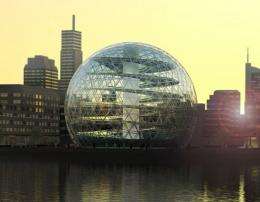
June 5, 2009 This computer-generated image released by Plantagon shows the design of a vertical greenhouse project

Enlarge

This computer-generated image released by Plantagon shows the design of a vertical greenhouse project. Vertical greenhouses that grow organic fruit and vegetables smack in the middle of crowded cities where land is scarce may soon be a reality, a Swedish company developing the project said Friday.

Vertical greenhouses that grow organic fruit and vegetables smack in the middle of crowded cities where land is scarce may soon be a reality, a Swedish company developing the project said Friday.

"A tomato seed is planted on the ground floor on a rotating spiral and when it arrives at the top, 30 days later, you pick the fruit," the vice president of Plantagon, Hans Hassle, told AFP.

In a few decades, 80 percent of the global population will live in cities, increasing the need "to grow fruits and vegetables in an urban environment due to the lack of land," he said.

With a vertical , "we could have fresh organic produce every day and sell it directly to consumers in the city," Hassle said.

That way, "we would save 70 percent on the cost of fresh produce because right now 70 percent of the price is transport and storage costs," he said.

Fresh and healthy produce would thereby also become more readily available to those with slim budgets, he added.

No vertical greenhouse exists yet, but "several cities in Scandinavia and in China have expressed an interest," Hassle said.

Each installation would cost around 30 million dollars (21 million euros), much more than a regular greenhouse. But the investment would rapidly turn a profit, he insisted.

"With ground space of 10,000 square metres (107, 640 square feet), a vertical greenhouse represents the equivalent of 100,000 square metres of cultivated land" thanks to the rotating spiral that allows continual planting.

"An inventor came up with the idea 20 years ago but none of the people he presented it to believed in it. He presented it to me 10 years ago and it seemed like a good idea, so I talked to Sweco, a Swedish engineering firm, and they agreed to build these vertical greenhouses," Hassle explained.

A virtual image of what one of the greenhouses could look like resembles a large glass sphere with a pillar in the middle, around which the seedlings rotate on a platform.

"It looks fantastic like that, but the technology is simple," Hassle said.

(c) 2009 AFP


print this article email this article download pdf blog this article bookmark this article     Stumble it Digg this share on Facebook retweet share on Reddit add to delicious
Rate this story - 4.1 /5 (15 votes)

Rank Filter

Move the slider to adjust rank threshold, so that you can hide some of the comments.


Display comments: newest first

  • Velanarris - Jun 05, 2009
    • Rank: 3 / 5 (7)
    Now this is innovative thinking.
  • 3432682 - Jun 05, 2009
    • Rank: 3 / 5 (11)
    This is rubbish. How many lies can be packed into one short science fiction story?
    1. We're not running out of land. About 3% of the US is urbanized.
    2. Agriculuture is getting much more efficient, we use less AG land now than in 1900. There's almost as much park, recreation and wilderness land as there is AG land in the US.
    3. It would be much more efficient to grow those tomatoes just outside the city, rather than on million-dollar an acre land in the city, in a $30 million building. Preposterous.
    4. The fuel cost for transporting crops to supermarkets is less than the fuel cost of the customer driving to buy it.
    5. If it's such a great idea, why is no one doing it already?

    Don't fall for this kind of nonsense.
  • Velanarris - Jun 05, 2009
    • Rank: 4.6 / 5 (5)
    This is rubbish. How many lies can be packed into one short science fiction story?

    1. We're not running out of land. About 3% of the US is urbanized.
    This article is from the Associated Foreign Press, although the US is largely untouched land, in Europe that is not the case.
    2. Agriculuture is getting much more efficient, we use less AG land now than in 1900. There's almost as much park, recreation and wilderness land as there is AG land in the US.

    3. It would be much more efficient to grow those tomatoes just outside the city, rather than on million-dollar an acre land in the city, in a $30 million building. Preposterous.

    4. The fuel cost for transporting crops to supermarkets is less than the fuel cost of the customer driving to buy it.

    5. If it's such a great idea, why is no one doing it already?

    Don't fall for this kind of nonsense.

    You're ignoring the specialized jobs, manufacture, and multiple other benefits.

    That expensive land is now a giant "carbon credit" if the insidious cap and trade or carbon tax silliness goes through (and much to my chagrin, you're an idiot if you think the government will allow it not to).

    I know the fuel costs are not that prohibitive for transport, however, so does the writer. The expense is in the amount of goods that don't make it to supermarkets. The vast majority of shipped food is spoiled in transit, I believe the figure is about 50%. Of the remaining 50% about 20% of that is held by the government for rationing in the event of crisis.

    Systems like this allow for a revamp of the transportation industry without detrimental effect to the populace. It is a very good idea in my opinion.
  • El_Nose - Jun 05, 2009
    • Rank: 4.5 / 5 (4)
    I dissagree with Valanarris --- Europe has double the population of the US with about the dame amount of land... But much of Europe is still rural just like the US.

    If 20% is held by the gov'r for crisis is simply subsidized and destroyed to effect the prices of food to keep small farmers in business.

    The issue i have with this story is that even though use are using a city block for a building around 10,00 m^2 u are only getting 100,000 m^2 for growing area --- in englis metrics thats 2 acres to 24 acres while a good use of space you would need like 10 of the building to feed a small and i mean small town. 10 of these building wouldn't keep a burrow feed in NYC let alone a zipcode in LA.

    I love the concept but we need bigger -- a lot bigger to see a viable product in say the super cities of India, Indonesia, Japan, and China.
  • dirk_bruere - Jun 05, 2009
    • Rank: 4 / 5 (2)
    600 tonnes of vegetables per hectare per annum is already possible, and done. This facility would supply some 6000 tonnes per annum. Probably enough for around 50,000 people.
  • THEY - Jun 05, 2009
    • Rank: 3.5 / 5 (4)
    Well, at least it has the "novelty" effect going for it!
  • Quantum_Conundrum - Jun 05, 2009
    • Rank: 4 / 5 (4)
    This really is identical to something I suggested like a year ago on discussions of the possible benefits of archology.

    I was shot down for a reason which is obvious in hindsight.

    For a similar price, you can make a housing complext which can house thousands of families, thus saving a similar amount of ground space for farming anyway. It actually ends up being cheaper over all to make a similar land area worth of housing units inside a sky scraper than farms.
  • MatthiasF - Jun 06, 2009
    • Rank: 3.7 / 5 (3)
    To add on to Quantum Conundrum, it would be even cheaper to just add several levels of sub-basement below the skyscrappers, use fiber-optics/solar and grey water to grow crops in the basements of said apartment complexes. Or at the minimum set the underground greenhouses to an offset sun cycle using cheaper electricity at night.

    But I still agree with 3432682 and El Nose. This seems like a grandiose Utopian attention-getter with little basis in reality.
  • ShotmanMaslo - Jun 06, 2009
    • Rank: 3 / 5 (2)
    I think this is stupid... there is enough land in the world.. why raise something in the middle of a city?
  • Nik_2213 - Jun 06, 2009
    • Rank: 4.3 / 5 (3)
    Something to do with those emptying glass towers and their plunging rental income ??

    UK's experimented with tower-block housing, and has now demolished much. They're fine when they work. But, leaks, fires, lift-faults, isolation, vandalism, security, waste-disposal etc etc turn them into nightmares.

    For modern buildings, low-rise is usual, a fire-ladder's reach about the limit. By curious coincidence, such modern buildings come with tiny balconies for 'daylight', ventilation and evac...

    And, to be honest, covering acres and acres of city-edge land with greenhouse glass creates its own problems...

    FWIW, there's already a thriving industry growing crops indoors in towns and cities: The retro-notion of putting UK 'community police' back on bicycles has gone some way towards sniffing out such herbal enterprise...
  • Jess - Jun 06, 2009
    • Rank: 5 / 5 (2)
    i can see a lot of problems, like everyone pointed out, with the sheer ridiculousness of it. it does seem like a cool idea, but the spherical shape would take up an awkward piece of land, the cost seems totally unnecessary, and there is admittedly a lot of room for farms and greenhouses in other places. besides, how long does anyone think a huge glass structure is going to last in a major city? it's GLASS. that said, it's totally kool.
  • Soylent - Jun 07, 2009
    • Rank: 1 / 5 (3)
    You're ignoring the specialized jobs, manufacture, and multiple other benefits.


    And that's a good thing?!? What Universe are you in?

    Not only are you draining the most vital segment of the working population into useless make-work instead of something useful. You're subsidizing people who are highly employable and don't need a subsidy at the expense of those who do. This necessarily destroys jobs.

    See the study on "green" jobs in Spain. 2.2 jobs were destroyed for each "green" make-work job created. In this case it's probably even worse since the benefit are even more out of proportion with the cost.
  • jerryd - Jun 07, 2009
    • Rank: 5 / 5 (2)

    Greenhouse growing can be good in several ways though not exactly as shown in this article.
    Especially in Northern states, countries a greenhouse of say 6' wide shell around gives not only food, but heat too saving much on heating bills.
    So add in a 10x6x8' space an apartment would have probably 500-2000lbs of food and $1000 worth of heat/yr or more and with opening windows $300 of shade/cooling in summer. Not to mention cleaner air. So pay back can be in as little as 2 yrs.
    And in my town there are several greenhouses that do quite well and I believe will be normal soon in many towns as local food, jobs becomes more important.
    Next yr oil, coal will double in price so we need to change the way we live or you'll get screwed. So you right wing nuts need to get with the program and start helping the US get ready or it will be your fault again just like the present crisis is.

June 5, 2009 all stories

Comments: 13

4.1 /5 (15 votes)
  • Stumble this up

  • Digg this

  • share this

  • hide
  • Related Stories


  • hide
  • Relevant PhysicsForums posts

  • Himalayan glaciers
    created 7 hours ago
  • upcoming GRL paper shows CO2 fraction is constant
    created 12 hours ago
  • Is there a point to buying organic?
    created 16 hours ago
  • cycles
    created Nov 08, 2009
  • More from Physics Forums - Earth

Other News

Exoplanets Clue to Sun's Curious Chemistry

Exoplanets Clue to Sun's Curious Chemistry

Space & Earth / Astronomy

created 7 hours ago | popularity 4.8 / 5 (10) | comments 7

(PhysOrg.com) -- A ground-breaking census of 500 stars, 70 of which are known to host planets, has successfully linked the long-standing "lithium mystery" observed in the Sun to the presence of planetary systems. ...


Earth's early ocean cooled more than a billion years earlier than thought: Stanford study

Earth's early ocean cooled more than a billion years earlier than thought (w/ Video)

Space & Earth / Earth Sciences

created 6 hours ago | popularity 4.7 / 5 (3) | comments 0

(PhysOrg.com) -- The scalding-hot sea that supposedly covered the early Earth may in fact never have existed, according to a new study by Stanford University researchers who analyzed isotope ratios in 3.4 ...


A Tale of Planetary Woe

A Tale of Planetary Woe (w/ Video)

Space & Earth / Space Exploration

created 3 hours ago | popularity 5 / 5 (2) | comments 1

Once upon a time — roughly four billion years ago — Mars was warm and wet, much like Earth. Liquid water flowed on the Martian surface in long rivers that emptied into shallow seas. A thick atmosphere blanketed ...


Researchers Discover Use for Carbon Dioxide in Conversion of Biomass Into Biofuel

Researchers Discover Use for Carbon Dioxide in Conversion of Biomass Into Biofuel

Space & Earth / Environment

created 3 hours ago | popularity 3.6 / 5 (5) | comments 1

(PhysOrg.com) -- Researchers at Columbia University have successfully discovered a beneficial use for carbon dioxide in the conversion of organic materials, such as grass and bark, into fuel. Their findings ...


A bubbling ball of gas

A bubbling ball of gas (w/ Video)

Space & Earth / Space Exploration

created 8 hours ago | popularity 5 / 5 (10) | comments 3

The Sun is a bubbling mass. Packages of gas rise and sink, lending the sun its grainy surface structure, its granulation. Dark spots appear and disappear, clouds of matter dart up - and behind the whole thing ...