China Pearl River Delta Creating Large Amounts of Hydroxyl Radicals
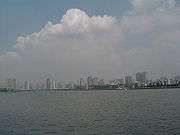
June 6, 2009 by Mary Anne Simpson Pearl River

Credit: Wikipedia

A team of atmospheric scientists have published their field study findings about unusual chemical reactions taking place in the Pearl River Delta in China during 2006. The Julich Research Center's Institute for Tropospheric Chemistry in Germany and institutes in China and the USA participated in round the clock samplings of various atmospheric constituents in the Pearl River region located about 60 kilometers from Guangzhou noted for its high population and a repository for air borne pollutants wafting in from nearby industrial cities combined with volatile organic substances produced by local vegetation and trees.

The highly reactive hydroxyl radicals typically appear in fractions of a second prior to combining with volatile organic chemicals and other gases which act as a cleanser for the atmosphere. Scientists found unusually high levels and surge in hydroxyl radical levels, but without an accompanying increase in ozone levels around noon time. The scientific team found hydroxyl radicals levels some three to five times more than would be expected in current models of atmospheric chemistry. Altogether, for some inexplicable reason or known source of hydroxyl produced an astounding 28 parts per billion each hour concentration of the chemical.

The net effect is that a not yet discovered process has occurred in the Pearl River Delta that is producing an extremely high level of hydroxyl radicals. The next step of the research is to test samples of the air from the Pearl River region to see if light-stimulated reactions produce similar high readings of hydroxyl radicals under lab conditions. Thus far, the scientists are impressed with their unusual findings, but are only able to speculate on the source coming from a combination of anthropogenic sources, biogenic sources and gases found in the air surrounding the delta.

Source: Amplified Trace Gas Removal in the Troposhere; http://www.sciencemag.org/cgi/content/abstract/1164566


print this article email this article download pdf blog this article bookmark this article     Stumble it Digg this share on Facebook retweet share on Reddit add to delicious
Rate this story - 4.3 /5 (6 votes)


June 6, 2009 all stories

Comments: 0

4.3 /5 (6 votes)
  • Stumble this up

  • Digg this

  • share this

  • hide
  • Related Stories

  • Chemists find important contributor to smog
    created Mar 20, 2008 | popularity not rated yet | comments 0
  • Scientists find chlorine may contribute to ozone formation
    created Jun 13, 2006 | popularity not rated yet | comments 0
  • Key molecule discovered in Venus's atmosphere
    created May 15, 2008 | popularity not rated yet | comments 0
  • Atmosphere may cleanse itself better than previously thought
    created May 12, 2005 | popularity not rated yet | comments 0
  • Methane gas levels begin to increase again
    created Oct 29, 2008 | popularity not rated yet | comments 0


  • hide
  • Relevant PhysicsForums posts

  • cycles
    created 17 hours ago
  • The Origin of the term 'fossil' fuels
    created Nov 05, 2009
  • co2
    created Nov 03, 2009
  • Early Earths Sulfidic Ocean Conditions
    created Oct 30, 2009
  • More from Physics Forums - Earth

Other News

Deep creep means milder, more frequent earthquakes along Southern California's San Jacinto fault

Deep creep means milder, more frequent earthquakes along Southern California's San Jacinto fault

Space & Earth / Earth Sciences

created 16 hours ago | popularity 4.5 / 5 (4) | comments 0

With an average of four mini-earthquakes per day, Southern California's San Jacinto fault constantly adjusts to make it a less likely candidate for a major earthquake than its quiet neighbor to the east, the ...


Success in 'space elevator' competition (AP)

Success in 'space elevator' competition (Update 3)

Space & Earth / Space Exploration

created Nov 05, 2009 | popularity 4.3 / 5 (33) | comments 50

(AP) -- A robot powered by a ground-based laser beam climbed a long cable dangling from a helicopter on Wednesday to qualify for prize money in a $2 million competition to test the potential reality of the ...


In a Galaxy Far, Far Away...

In a Galaxy Far, Far Away...

Space & Earth / Astronomy

created Nov 06, 2009 | popularity 4.8 / 5 (5) | comments 17

(PhysOrg.com) -- Astronomers have published the discovery of the farthest known object in the cosmos: a star that exploded when the universe was only 630 million years old -- only 4.6% of its current age. ...


'Dropouts' pinpoint earliest galaxies

'Dropouts' pinpoint earliest galaxies

Space & Earth / Astronomy

created Nov 06, 2009 | popularity 4.2 / 5 (10) | comments 13

Astronomers, conducting the broadest survey to date of galaxies from about 800 million years after the Big Bang, have found 22 early galaxies and confirmed the age of one by its characteristic hydrogen signature ...


Space hotel taking bookings for 2012 opening

Space hotel taking bookings for 2012 opening

Space & Earth / Space Exploration

created Nov 05, 2009 | popularity 4.4 / 5 (21) | comments 11

(PhysOrg.com) -- The first orbiting space hotel is on track to open for its first customers in 2012, but hurry, as bookings are filling fast.