Scientists eye glowing volcano crater in Hawaii
June 7, 2009 Scientists eye glowing volcano crater in Hawaii (AP)

Enlarge

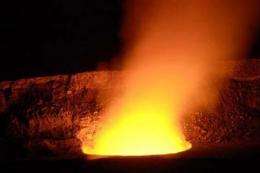
In this undated photo provided by Hawaiian Volcano Observatory, a camera's telephoto lens captures the detail of crater wall illuminated by vent glow at the summit of the Kilauea volcano in Hawaii. Scientists at the U.S. Geological Survey's Hawaiian Volcano Survey say the expanding vent of Halemaumau crater helps confirm their believe that the lava is close to the Earth's surface. (AP Photo/Hawaiian Volcano Observatory, G. Brad Lewis)

(AP) -- The summit of Hawaii's Kilauea volcano is glowing brightly as molten lava swirls 300 feet below its crater's floor, bubbling near the surface after years of spewing from the volcano's side.

The expanding vent of Halemaumau crater helps confirm scientists' belief that the is close to the surface of the summit, said Janet Babb, a geologist and spokeswoman for the U.S. Geological Survey's Hawaiian Volcano Observatory.

Park rangers have begun keeping the overlook at the Jaggar Museum open later at night to accommodate the growing number of visitors arriving at dusk or after dark to view the glow.

Kilauea has been erupting for more than 25 years, with its lava creating a plume of steam as it spills into the Pacific Ocean.

But this recent activity is coming from the top of the volcano, not its sea-level side. This is the strongest glow coming from the crater since October, but scientists don't know if lava will ever erupt in a fountain from within the crater, Babb said.

"There's no way to know if that will ever materialize," she said. "It would be grand to see some fountaining here."

The changes in the crater have not created any increased risk to visitors or park staff, she said.

Volcanic smog - known as vog - regularly emits from the crater, spreading a haze of toxic sulfur dioxide over the island. Sometimes, it has been thick enough to cause illnesses, kill crops and force school closures.

Measurements taken earlier this week showed that sulfur dioxide emissions remain similar to recent elevated levels, Babb said.

A non-lava eruption from the summit in March 2008 rained gravel-sized rocks onto a lookout, road and trail, forcing parts of the park to close.

---

Information from: West Hawaii Today, http://www.westhawaiitoday.com

©2009 The Associated Press. All rights reserved. This material may not be published, broadcast, rewritten or redistributed.


print this article email this article download pdf blog this article bookmark this article     Stumble it Digg this share on Facebook retweet share on Reddit add to delicious
Rate this story - 4.2 /5 (11 votes)

Rank Filter

Move the slider to adjust rank threshold, so that you can hide some of the comments.


Display comments: newest first

  • Doug_Huffman - Jun 07, 2009
    • Rank: 3 / 5 (4)
    "Volcanic smog - known as vog - regularly emits from the crater, spreading a haze of toxic sulfur dioxide over the island. Sometimes, it has been thick enough to cause illnesses, kill crops and force school closures." But not GW/cc! Only Anthropocenes can cause GW.
  • Velanarris - Jun 08, 2009
    • Rank: 5 / 5 (1)
    Seeing as this is the location of the world's CO2 monitoring station, one would wonder why we picked that location, as opposed to say an inactive volcano, or perhaps a mountain top.

June 7, 2009 all stories

Comments: 2

4.2 /5 (11 votes)
  • Stumble this up

  • Digg this

  • share this

  • hide
  • Related Stories


  • hide
  • Relevant PhysicsForums posts

  • cycles
    created 12 hours ago
  • The Origin of the term 'fossil' fuels
    created Nov 05, 2009
  • co2
    created Nov 03, 2009
  • Early Earths Sulfidic Ocean Conditions
    created Oct 30, 2009
  • More from Physics Forums - Earth

Other News

Deep creep means milder, more frequent earthquakes along Southern California's San Jacinto fault

Deep creep means milder, more frequent earthquakes along Southern California's San Jacinto fault

Space & Earth / Earth Sciences

created 11 hours ago | popularity 4.7 / 5 (3) | comments 0

With an average of four mini-earthquakes per day, Southern California's San Jacinto fault constantly adjusts to make it a less likely candidate for a major earthquake than its quiet neighbor to the east, the ...


Success in 'space elevator' competition (AP)

Success in 'space elevator' competition (Update 3)

Space & Earth / Space Exploration

created Nov 05, 2009 | popularity 4.3 / 5 (33) | comments 50

(AP) -- A robot powered by a ground-based laser beam climbed a long cable dangling from a helicopter on Wednesday to qualify for prize money in a $2 million competition to test the potential reality of the ...


In a Galaxy Far, Far Away...

In a Galaxy Far, Far Away...

Space & Earth / Astronomy

created Nov 06, 2009 | popularity 4.8 / 5 (5) | comments 16

(PhysOrg.com) -- Astronomers have published the discovery of the farthest known object in the cosmos: a star that exploded when the universe was only 630 million years old -- only 4.6% of its current age. ...


'Dropouts' pinpoint earliest galaxies

'Dropouts' pinpoint earliest galaxies

Space & Earth / Astronomy

created Nov 06, 2009 | popularity 4.2 / 5 (10) | comments 13

Astronomers, conducting the broadest survey to date of galaxies from about 800 million years after the Big Bang, have found 22 early galaxies and confirmed the age of one by its characteristic hydrogen signature ...


Space hotel taking bookings for 2012 opening

Space hotel taking bookings for 2012 opening

Space & Earth / Space Exploration

created Nov 05, 2009 | popularity 4.4 / 5 (21) | comments 11

(PhysOrg.com) -- The first orbiting space hotel is on track to open for its first customers in 2012, but hurry, as bookings are filling fast.