Researchers Shed Light on Esophageal Disease
June 8, 2009 Researchers Shed Light on Esophageal Disease

Enlarge

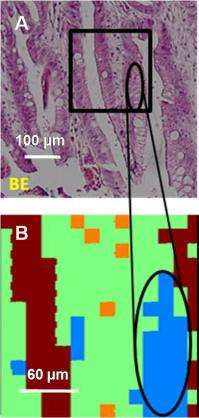
Visible light micrograph of Barrett's Esophagus tissue (A) and a synchrotron infrared image (B) from the Canadian Light Source. The light blue area corresponds to an area rich in glycoproteins, a biomarker for Barrett's Esophagus. Image courtesy of Luca Quaroni, CLS.

(PhysOrg.com) -- Canadian Light Source (CLS) staff scientist Luca Quaroni and Dr. Alan Casson from the University of Saskatchewan used the synchrotron's infrared microscope to identify tissue afflicted with a condition known as Barrett's Esophagus from chemical fingerprints associated with the disease, which can lead to esophageal cancer.

"The advantage to using microscopes with synchrotron light is that it allows us to identify chemical biomarkers inside specific cells," says Dr. Quaroni, who conducted the analysis. "Often the differences between healthy and malignant tissue can be quite small, but the differences seen here were quite striking. This is a good proof of concept for developing a traceable technique that matches what can be seen at the macroscopic scale using microscopic samples."

The team analyzed preserved samples of healthy and diseased tissue that Dr. Casson had collected during esophageal biopsies. Using a technique known as Fourier Transform Infrared Microscopy, Quaroni and Casson identified specific chemicals - known as biomarkers - within the individual cells that make up the tissue. It was found that increased concentrations of particular biomarkers such as glycoproteins were associated with the Barrett's tissue.

Barrett's Esophagus (BE) occurs when the cells that normally line the esophagus - the tube that connects our throat to our stomach - are replaced by cells that resemble those that line the intestine. While BE only affects approximately one percent of Americans, the number of people diagnosed with the condition is on the rise, with the increasing incidence of chronic heartburn (gastro-esophageal reflux disease or GERD) considered a risk factor for developing BE. The disease in turn can lead to an aggressive form of cancer known as esophageal adenocarcinoma.

Currently, diagnosing BE depends on the skill and experience of individual pathologists examining biopsy samples from patients, often relying on subjective criteria. Identifying biomarkers that can be associated with a particular condition provides an additional tool for diagnosis.

The finding is published in the June, 2009 issue of the Royal Society of Chemistry journal, The Analyst.


print this article email this article download pdf blog this article bookmark this article     Stumble it Digg this share on Facebook retweet share on Reddit add to delicious
Rate this story - 5 /5 (2 votes)

Rank Filter

Move the slider to adjust rank threshold, so that you can hide some of the comments.


Display comments: newest first

  • Mercury_01 - Jun 08, 2009
    • Rank: not rated yet
    So they re- wired an Atari and switched it to "expert"?

June 8, 2009 all stories

Comments: 1

5 /5 (2 votes)
  • Stumble this up

  • Digg this

  • share this

  • hide
  • Related Stories


  • hide
  • Relevant PhysicsForums posts

  • How to prevent another stroke?
    created 16 hours ago
  • Swine flu vaccination
    created Nov 10, 2009
  • Improving the brain through chemistry
    created Nov 07, 2009
  • Sleep / REM Sleep and homeostasis
    created Nov 07, 2009
  • More from Physics Forums - Medical Sciences

Other News

baby mice

Early life stress has effects at the molecular level

Medicine & Health / Neuroscience

created 1hour ago | popularity 5 / 5 (2) | comments 0

(PhysOrg.com) -- A new study of mice suggests that stress and trauma in early life can have an impact on the genes and result in behavioral problems later in life.


High fat diet increases inflammation in the mouse colon

Medicine & Health / Health

created 1hour ago | popularity not rated yet | comments 0

(PhysOrg.com) -- In mice fed a diet high in fat and low in fiber, vitamin D and calcium -- the so-called Western diet -- expression of a series of genes collectively associated with immune and inflammatory responses was altered. ...


'Nature or nurture' study reveals 'musical genes' (w/ Video)

Medicine & Health / Genetics

created 1hour ago | popularity not rated yet | comments 0

(PhysOrg.com) -- If you've ever wondered why a close group of friends might like completely different types of music, blame their genes. A study by Nokia and Kings' College London into the musical tastes of nearly 4,000 twins ...


Australian bid to 'regrow' breasts after cancer surgery

Medicine & Health / Cancer

created 2 hours ago | popularity not rated yet | comments 0

Australian scientists said Thursday they were to trial a revolutionary treatment which would allow women to regrow their breasts after cancer surgery.


Walking, talking and memory

Walking, talking and memory

Medicine & Health / Psychology & Psychiatry

created 1hour ago | popularity not rated yet | comments 0

(PhysOrg.com) -- How easy is it to walk, talk and remember what was said? Dr Dee Way studied how actors learn a script and whether walking affects their memory performance.